
Instant Beverage Premix Market Size and Share
Market Overview
| Study Period | 2021 - 2031 |
|---|---|
| Market Size (2026) | USD 93.11 Billion |
| Market Size (2031) | USD 125.37 Billion |
| Growth Rate (2026 - 2031) | 6.13 % |
| Fastest Growing Market | North America |
| Largest Market | Asia-Pacific |
| Market Concentration | Medium |
Major Players *Disclaimer: Major Players sorted in no particular order Image ? 黑料不打烊. Reuse requires attribution under CC BY 4.0. | |
Instant Beverage Premix Market Analysis by 黑料不打烊
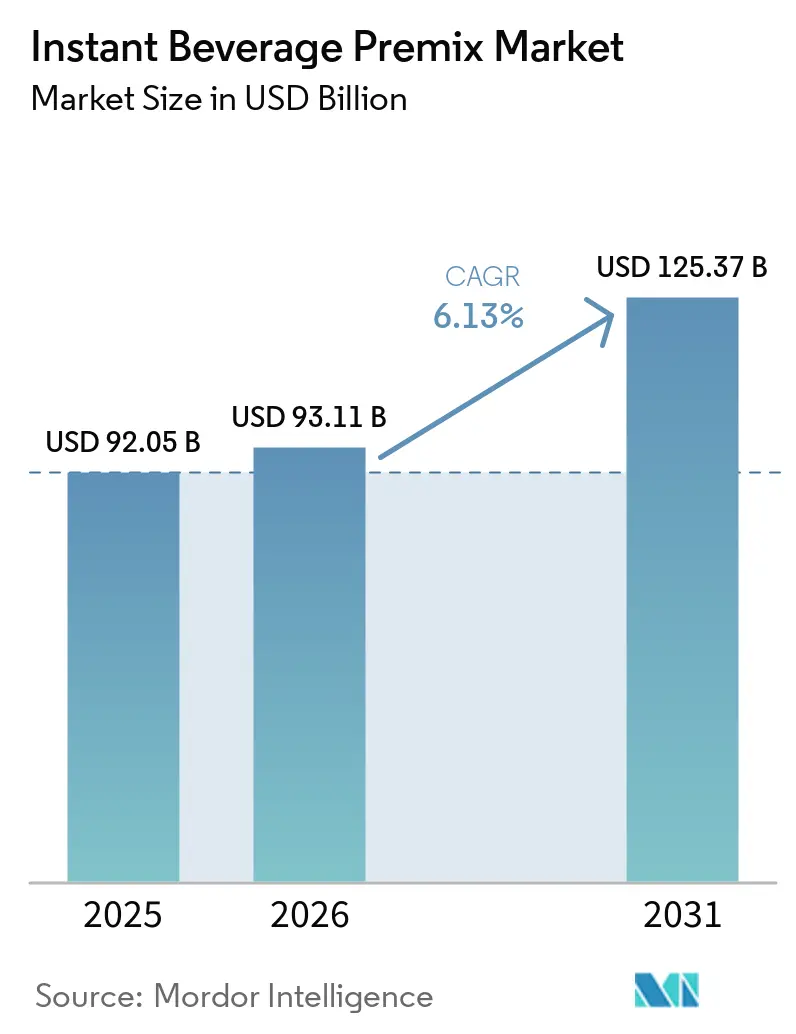
The Instant beverage premix market size is expected to increase from USD 92.05 billion in 2025 to USD 93.11 billion in 2026 and reach USD 125.37 billion by 2031, growing at a CAGR of 6.13% over 2026-2031. The Instant beverage premix market is supported by urban lifestyles that reduce the time available for beverage preparation and favor shelf-stable, portion-controlled formats. The World Health Organization reported that the majority of the global population lives in urban areas, which supports a broader shift toward products that fit routine consumption at home, at work, and while traveling. In India, Southeast Asia, and sub-Saharan Africa, first-generation urban consumers are increasingly adopting premixes as a regular beverage choice rather than moving gradually from traditional preparation methods. The Instant beverage premix market therefore has room to grow across everyday occasions, while manufacturers compete through functional formulations, flavor development, and formats suited to retail and institutional channels. Product quality, clear labels, and dependable distribution remain important because ready-to-drink products and private-label offerings continue to present alternatives for consumers.
Key Report Takeaways
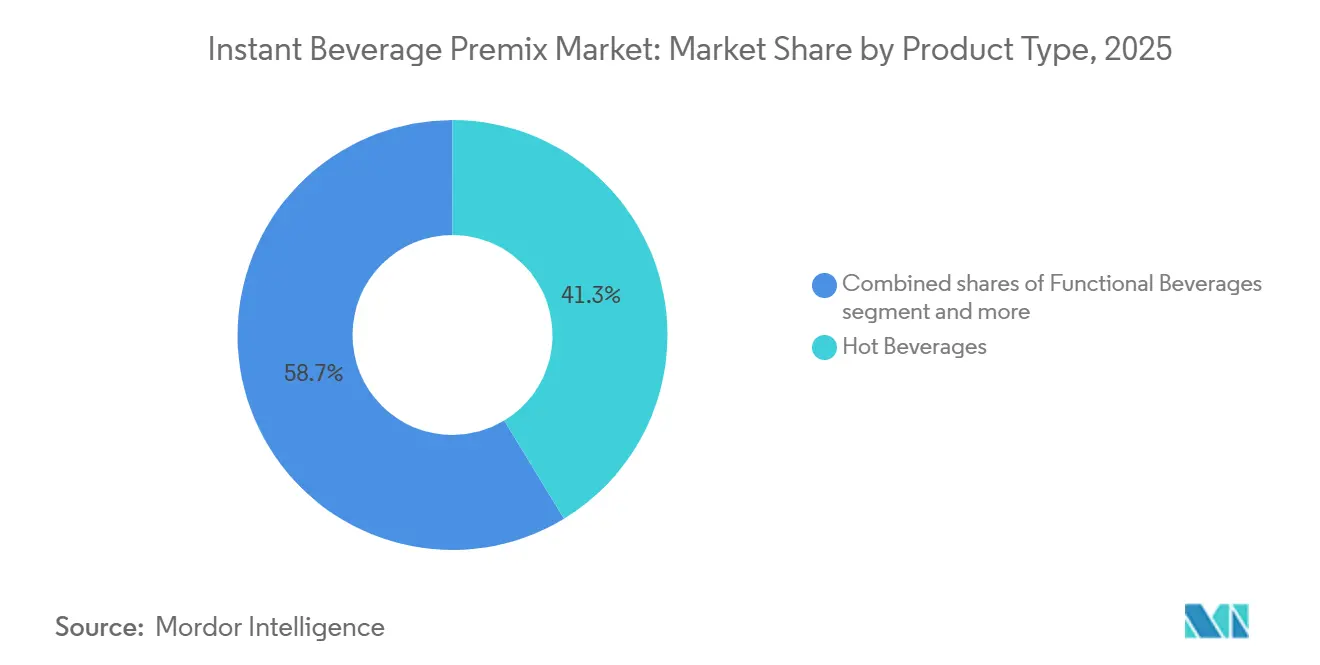
- By product type, hot beverages led with 41.32% of the Instant beverage premix market share in 2025, while functional beverages recorded the highest projected CAGR at 7.23% through 2031.
- By category, plain products held 62.56% of the Instant beverage premix market share in 2025, while flavored products recorded the highest projected CAGR at 7.89% through 2031.
- By form, powder accounted for 86.54% of the Instant beverage premix market size in 2025, while liquid premixes are projected to expand at a 6.77% CAGR through 2031.
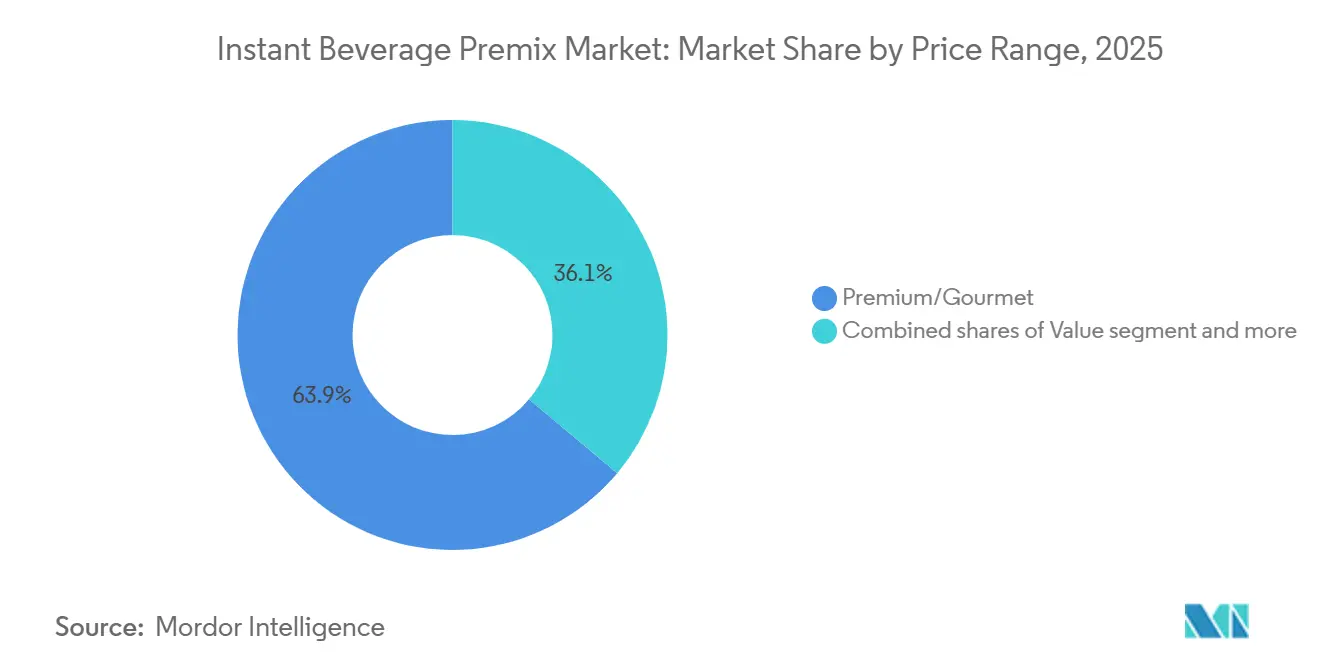
- By price range, value products held 36.11% revenue share in 2025, while premium and gourmet products recorded the highest projected CAGR at 8.21% through 2031.
- By distribution channel, off-trade channels held 65.48% revenue share in 2025, while on-trade channels recorded the highest projected CAGR at 6.78% through 2031.
- By geography, Asia-Pacific held 41.22% revenue share in 2025, while North America recorded the highest projected CAGR at 6.72% through 2031.
Note: Market size and forecast figures in this report are generated using 黑料不打烊’s proprietary estimation framework, updated with the latest available data and insights as of January 2026.
Market Trends and Insights
Drivers Impact Analysis of Instant Beverage Premix Market*
| Driver | (~) % Impact on CAGR Forecast | Geographic Relevance | Impact Timeline |
|---|---|---|---|
| Rising demand for convenient and ready-to-prepare beverages | +1.4% | Global, highest intensity in Asia-Pacific and sub-Saharan Africa | Short term (≤ 2 years) |
| Increasing adoption of single-serve and portion-controlled formats | +0.8% | North America, Europe, and Asia-Pacific core markets | Medium term (2-4 years) |
| Expansion of vending machines and automated beverage dispensers | +0.7% | Asia-Pacific core markets, including India and Southeast Asia, and North America | Medium term (2-4 years) |
| Growing demand for premium and specialty beverage flavors | +0.6% | North America and Europe | Long term (≥ 4 years) |
| Increasing demand for functional and fortified beverage premixes | +1.0% | Global, with early traction in North America and Europe | Medium term (2-4 years) |
| Product innovation in sugar-free, low-calorie, and clean-label formulations | +0.5% | North America and the European Union, with spillover to Asia-Pacific | Long term (≥ 4 years) |
| Source: 黑料不打烊 | |||
Rising Demand for Convenient and Ready-to-Prepare Beverages
Within the Instant beverage premix market, convenience has become a practical purchasing consideration for consumers who need beverage options that fit work, travel, and home routines. The International Coffee Organization reported that global soluble coffee exports rose 13.3% in August 2024 to 1.22 million bags, showing continued demand for a widely used ready-to-prepare format [1]. The Instant beverage premix market benefits when consumers compare the per-serving cost of a premix with brewed alternatives and find the format accessible. Sachets and resealable pouches also make preparation easier when consumers do not have access to a full brewing setup. Improved solubility supports cold-water use, which extends consumption into outdoor, travel, and institutional settings. These features broaden the occasions in which consumers can choose premixes rather than only increasing use within the home.
Increasing Demand for Functional and Fortified Beverage Premixes
In the Instant beverage premix market, functional formulations are expanding the role of premixes beyond the morning hot-drink routine. Protein and meal-replacement products, immunity blends, energy mixes, and sleep or relaxation blends are directed at different daily consumption occasions. This product activity is tied to consumers who review labels and are willing to pay more for formulations that fit their wellness preferences. The U.S. Food and Drug Administration finalized an updated definition for the voluntary healthy claim in late 2024, and the rule took effect on April 28, 2025 [2]. The updated framework gives qualifying manufacturers a clearer basis for product labeling in the United States. It also places greater value on brands that can maintain compliant formulas and communicate their ingredients clearly.
Expansion of Vending Machines and Automated Beverage Dispensers
Vending gives the Instant beverage premix market access to workplaces, campuses, and hospitals where consumption occurs repeatedly throughout the day. The channel can provide branded drinks at the point of use without requiring a consumer to choose a product from a retail shelf. In India, the expansion of formal workplace and institutional beverage services supports demand for premix formats that work consistently in automated equipment. Digital capabilities such as cashless payment, equipment telemetry, and refill planning can help operators manage service more efficiently. For manufacturers, a dedicated vending offer requires products with reliable solubility and compatibility with specific dispensing systems. These requirements can make established channel relationships more valuable than standard retail distribution alone.
Increasing Adoption of Single-Serve and Portion-Controlled Formats
For the Instant beverage premix market, single-serve formats address convenience, waste reduction, and dosage consistency in the same product format. The Instant beverage premix market can use sachets to offer premium and mass-priced variants under the same brand without creating a direct conflict between price tiers. Consumers receive a measured serving, while institutions can use portion control to support hygiene and consistent preparation. Airlines, hospitals, and hotels also value formats that simplify inventory handling and service procedures. Resealable and individually packed formats improve portability for consumers who prepare beverages away from home. This makes portion control relevant to institutional procurement as well as individual consumer preferences.
Restraints Impact Analysis of Instant Beverage Premix Market*
| Restraint | (~) % Impact on CAGR Forecast | Geographic Relevance | Impact Timeline |
|---|---|---|---|
| Growing consumer concerns regarding sugar content and artificial additives | -0.6% | North America and Europe, with growing relevance in Asia-Pacific | Short term (≤ 2 years) |
| Competition from ready-to-drink beverages | -0.8% | North America and Europe, with spillover to the Middle East and Africa | Medium term (2-4 years) |
| Competition from freshly prepared and traditional beverages | -0.4% | Asia-Pacific core markets and South America | Long term (≥ 4 years) |
| Increasing regulatory requirements for ingredient and nutritional labeling | -0.3% | European Union, North America, India, and Brazil | Medium term (2-4 years) |
| Source: 黑料不打烊 | |||
Growing Consumer Concerns Regarding Sugar Content and Artificial Additives
Sugar and additive concerns are influencing product development across value, mainstream, and premium offerings. Consumer response varies by region, with North America and Western Europe showing more active avoidance of some artificial sweeteners than several emerging markets. The FDA proposed a front-of-package Nutrition Info box in January 2025 that would make certain nutrition information more visible at the point of purchase if finalized. Manufacturers may need to manage reformulation and labeling work at the same time when they reduce sweeteners in complex flavor profiles. Clear ingredient communication can help brands explain the product rather than relying only on flavor claims. Brands that make material clean-label changes may have a stronger basis for premium positioning than brands that make minor formula adjustments.
Competition from Ready-to-Drink Beverages
Ready-to-drink beverages compete directly with premixes because they remove the preparation step. Ready-to-drink products can be appealing in developed urban markets where refrigerated distribution and modern retail are well established. Premix powders retain an advantage in locations where cold-chain coverage is incomplete because they are easier to store and transport. The competing formats also serve some different occasions, as a sachet can be prepared in a workplace or hotel room while a ready-to-drink product is consumed as purchased. Functional and flavored ready-to-drink launches can reduce trial for premixes among lighter users. Powder formats can still differentiate through lower packaging requirements per serving and through the flexibility to prepare a beverage to individual taste.
*Our forecasts treat driver/restraint impacts as directional, not additive. The impact forecasts reflect baseline growth, mix effects, and variable interactions.
Instant Beverage Premix Market Segment Analysis
By Product Type:
Functional Beverages Outpace the Traditional CategoriesHot beverages held 41.32% of sector revenue in 2025, supported by established use of instant coffee, instant tea, and malted drinks. The segment benefits from broad use in homes, vending locations, and foodservice settings, where consumers and operators value a familiar result, modest preparation time, straightforward storage, and formats that can be used repeatedly without changing established routines, which helps explain why traditional hot products continue to provide a stable foundation even as newer product concepts receive more commercial attention. Demand for cold formats is affected by seasonality in temperate markets and by the growing appeal of cold coffee in warmer climates. Functional beverages are projected to grow at a 7.23% CAGR through 2031, driven by protein, meal-replacement, immunity, and energy mixes.
The functional category creates occasions that are different from traditional coffee and tea consumption. Brands that place these products in sports nutrition or specialty health retail can seek higher per-unit pricing and face less private-label pressure than in mass grocery, because the purchase decision can depend on the stated purpose of the product, its ingredient profile, and the consumer's willingness to compare alternatives more closely before selecting a formulation, rather than only choosing the lowest shelf price. The investment shows that established hot beverage products still have scope for improvements in formulation and quality, including the ability to improve the consumer experience without moving away from the instant preparation format that gives the category its broad everyday appeal in both household and out-of-home settings. Product development in this area allows manufacturers to link familiar coffee formats with changing expectations for taste and convenience.

By Category:
Flavored Variants Gain Ground on a Plain-Dominant BasePlain products held 62.56% of sector revenue in 2025 because unflavored coffee, tea, and malted products remain daily staples for many consumers. The segment is supported by routines that favor recognizable taste profiles and accessible pricing, especially where consumers buy the same product frequently and expect it to work with a familiar preparation method, a known serving size, and a predictable household budget, leaving established plain products well positioned for regular use even when flavored choices attract interest. Its scale also makes it a natural target for private-label products sold through off-trade retailers. Retailer brands can compete directly in plain formats where product differences are limited, and cost is a major purchase factor, requiring established manufacturers to maintain quality, availability, and recognizable brand value when shoppers compare similar formats on a retail shelf or through an online listing.
Flavored products are projected to grow at a 7.89% CAGR through 2031. Their growth is associated with café-inspired choices and confectionery-linked product concepts that offer a differentiated at-home occasion. Flavor development is bringing profiles that were previously associated with café menus into packaged formats, allowing manufacturers to offer more variety without asking consumers to change the basic preparation habit that makes premixes convenient, while also giving retailers and online channels a clearer way to present a product as different from a standard coffee or tea sachet. Brown sugar latte mixes, matcha sachets, and masala chai blends can extend the appeal of flavored products beyond early adopters. Tata Consumer Products introduced Tata Tea Gold Iced Tea and Tetley Matcha Latte during FY2025-26, reflecting its focus on summer and café-style premix occasions. The opportunity depends on keeping the sensory experience distinct enough from plain products to support a higher price.
By Form:
Powder Consolidates While Liquid Formats Carve a NicheWithin the Instant beverage premix market, powder accounted for 86.54% of the market size in 2025, reflecting its cost efficiency, ambient storage, long shelf life, and fit with dispensing infrastructure. Powder does not require a cold chain, which remains important in markets with varied logistics capacity, because manufacturers, retailers, institutions, and consumers can handle the product without the additional storage conditions needed for chilled alternatives, helping the format remain practical across long distribution routes and in locations where equipment and retail infrastructure differ widely. Existing investment in spray-drying, agglomeration, and freeze-drying supports the format's manufacturing base, giving manufacturers established production methods for products that need to dissolve reliably, travel through long supply chains, and remain stable until the consumer or operator prepares the final beverage. These production capabilities also make it difficult for liquid alternatives to replace powder purely on cost.
Liquid premixes are projected to expand at a 6.77% CAGR through 2031 from a smaller base. Their current use is concentrated in premium foodservice, hotel amenities, and busy institutional settings where consistency can justify higher costs. Liquid formats can reduce preparation complexity in cold-coffee and foodservice applications, particularly where operators need to deliver a similar drink across multiple outlets and service periods, although the format has to show a clear benefit in consistency or speed to justify its higher logistics requirements when compared with familiar powder products. They are relevant when operators need dependable results across staff shifts and service locations, as a prepared concentrate can simplify steps that otherwise require measurement and repeated handling, provided the operator can manage the storage and delivery conditions associated with the liquid format.
By Price Range:
Premium Growth Coexists With a Dominant Value BaseIn the Instant beverage premix market, value products held a 36.11% revenue share in 2025, supported by mass-market coffee and tea premixes sold through supermarkets, convenience stores, and workplace vending. The segment serves high-volume demand in emerging markets where price remains an important purchase factor, and it gives consumers a readily available option for repeated household, workplace, and convenience-store purchases, which means brands need to protect affordability and dependable quality at the same time when competing in this widely accessible part of the category. Mid-range products bridge the gap for consumers seeking a step up from private-label quality without choosing gourmet pricing, offering manufacturers a way to serve consumers whose purchasing decisions reflect both price awareness and a preference for stronger taste cues, familiar brands, or a wider choice of flavors.
Premium and gourmet products are projected to grow at an 8.21% CAGR through 2031. Growth comes from urban consumers seeking café-style drinks at home and from middle-income consumers using accessible single-serve packs to try premium variants. This combination gives the Instant beverage premix market a value base alongside a premium growth path. The additions show how manufacturers can seek wider premium participation without leaving accessible price points, using familiar formats and flavors to make trial less difficult for consumers who may be interested in a café-style product but still compare the purchase against the cost and convenience of an everyday premix, creating a bridge between value-led and gourmet choices. Premium products must provide a convincing taste experience because consumers compare at-home results with the quality they expect from cafés, making repeat purchase dependent on whether the product delivers the convenience promised by the format while still feeling distinct from a standard lower-priced instant beverage.
By Distribution Channel:
On-Trade Growth Signals a Structural Channel ShiftIn the instant beverage premix market, off-trade channels held a 65.48% revenue share in 2025, led by supermarkets, hypermarkets, convenience stores, grocery outlets, and online retail. These channels are important because they allow consumers to buy familiar products for routine household use, while also giving manufacturers broad shelf access for established items and a setting in which product size, price, promotion, and pack format can be matched to frequent purchasing patterns, including planned grocery trips and smaller convenience purchases. Online retail extends access to consumers outside major urban centers and can support subscription relationships. It is particularly relevant for functional and premium formats that may require more product discovery and repeat trial, since an online page can provide product details and allow a consumer to return to a preferred item without depending only on the limited space and immediate choice environment of a physical shelf.
On-trade channels are projected to expand at a 6.78% CAGR through 2031, led by workplace vending, foodservice operators, hotels, and restaurants. The channel benefits from workplace re-occupancy and the wider use of automated dispensing in institutions. On-trade products must perform consistently with variable water temperatures and commercial dispenser systems, since operators rely on predictable results during busy service periods and cannot depend on the preparation methods used for household products, which makes technical fit, bulk packaging, equipment compatibility, and ongoing service support central to a supplier's ability to retain institutional customers. Manufacturers also need bulk packs or canister formats that differ from retail sachets, because foodservice and workplace customers evaluate ease of loading, serving consistency, stock handling, and the fit with their equipment as part of the purchasing decision rather than only judging the consumer-facing pack design.
Geography Analysis
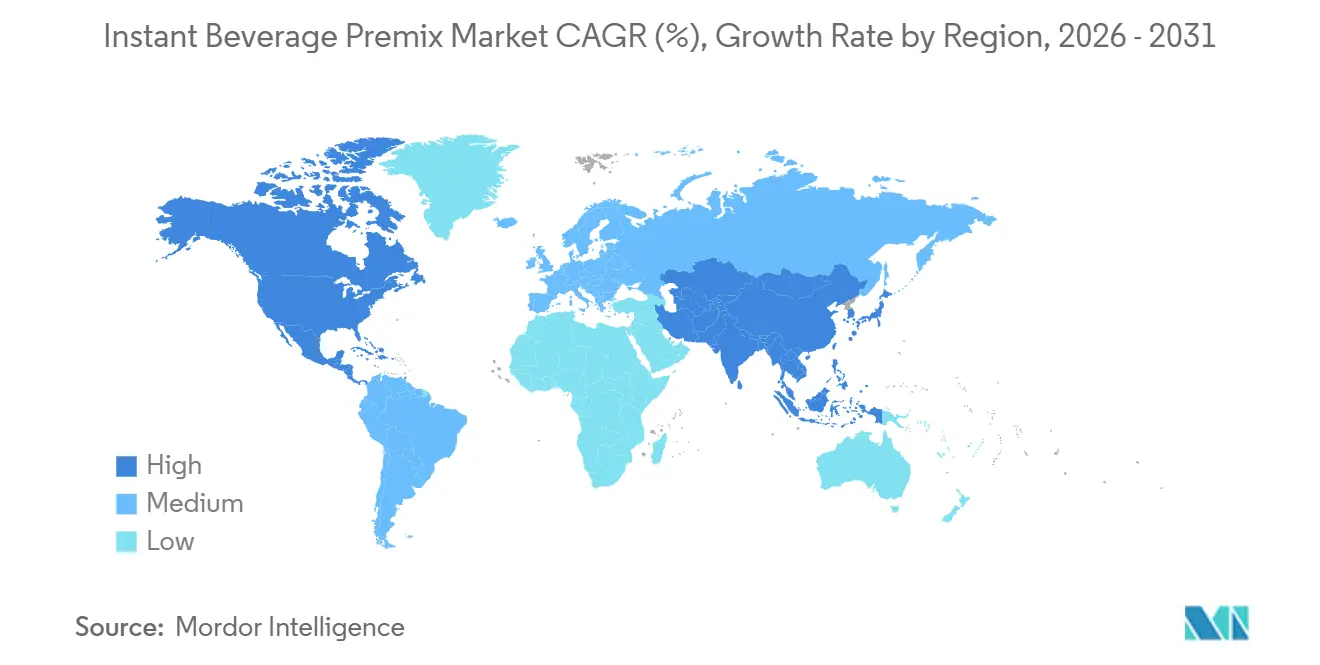
Asia-Pacific held 41.22% of sector revenue in 2025, supported by tea and coffee consumption cultures in China, India, and Southeast Asia. China has a broad range of premix products available through e-commerce, including Taobao and JD.com, and has domestic manufacturing and flavoring capabilities. These capabilities allow local brands to introduce and distribute products quickly. India is the fastest-growing major national market within Asia-Pacific, supported by organized retail expansion and the formalization of workplace beverage services. Government measures that support food processing and export capacity also provide a favorable setting for manufacturers, since they sit alongside the retail, workplace, and urban consumption changes that make it easier for brands to distribute both familiar hot beverage mixes and newer functional, flavored, and cold beverage formats across the region. Vietnam, Indonesia, Thailand, and South Korea add to regional demand through young urban populations, café culture, and expanding modern retail.
North America is projected to grow at a 6.72% CAGR through 2031, making it the fastest-growing geography in the Instant beverage premix market. The United States recorded a market value of USD 20.1 billion in 2025. Regional demand is supported by functional products, consumer interest in organic and sustainable offerings, and a developed e-commerce channel. Canada and Mexico also contribute to regional demand, with Mexico showing stronger alignment with U.S.-style premix consumption as urbanization and retail expansion continue. The FDA's healthy claim rule and proposed front-of-package Nutrition Info box create compliance responsibilities while supporting clearer health communication for qualifying products. The regulatory setting favors brands that can explain ingredient and nutrition information clearly, because consumer interest in functional, organic, sustainable, and innovative flavor profiles is more likely to translate into repeat demand when manufacturers can support those product propositions with straightforward labels and stable formulation practices.
Europe represented a prominent share in 2025 and is shaped by high quality expectations, private-label competition, and food information rules. Germany leads country-level share within the region, while the United Kingdom is among the faster-growing country markets. Commission Implementing Regulation (EU) 2026/1011, published on May 8, 2026, corrected technical labeling requirements for food additive premixtures sold in the European Union[3]. South America is supported by Brazil as its largest market and Colombia as its fastest-growing market. The Middle East and Africa market is forecast to exceed USD 6.2 billion by 2031, with Saudi Arabia as the largest national market and South Africa as the fastest-growing. Cardamom coffee, saffron-infused milk premixes, functional herbal blends, and cappuccino sachets reflect the range of flavor preferences in Gulf markets.
Competitive Landscape
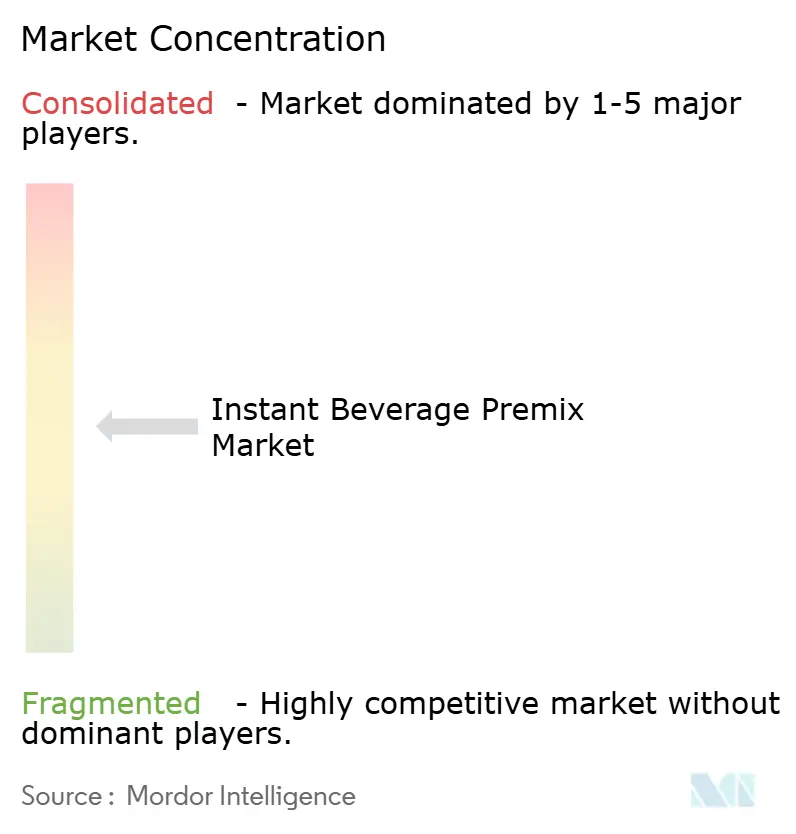
The instant beverage premix market has a moderately fragmented structure where multinational brands coexist with regional specialists and private-label suppliers. Nestlé, Unilever, JDE Peet's, Tata Consumer Products, PepsiCo, Coca-Cola, and Ajinomoto have strong brand recognition and distribution reach. Regional companies and retailer brands continue to create price pressure, especially in the value tier, where consumers can compare similar plain products more easily and where a supplier's ability to maintain dependable availability, procurement discipline, and consistent quality can matter as much as large-scale brand visibility. Competition centers on flavor development, functional ingredients, and access to vending, foodservice, and digital channels. Large companies can invest in research, packaging, manufacturing, and distribution systems that smaller participants may find difficult to match. At the same time, local companies can respond quickly to regional flavor preferences and price points.
JDE Peet's transformed its Utrecht Innovation Laboratory in 2025 and installed advanced freeze-drying systems, including a minus 40°C freezer, to support next-generation coffee development. Tata Consumer Products added Iced Tea, Matcha Latte, cold coffee, and flavored all-in-one premixes in FY2025-26 while expanding its vending and HoReCa activities. Keurig Dr Pepper is rolling out liquid espresso concentrate across 20 countries, showing how leading companies are creating formats for cold-coffee use. These moves illustrate how companies are using product architecture and channel reach to compete. Functional and premium categories have higher ingredient and brand requirements, which can limit easy private-label replication. Value products remain more exposed to competition based on scale, procurement, and price.
Direct-to-consumer subscriptions are relevant for some functional premixes because they can build recurring relationships without relying fully on retail shelf access. Protein, immunity, and sleep-oriented products are suited to formats where consumers may reorder a preferred product. The FDA proposed a rule on August 10, 2026, to strengthen oversight of substances used in food under the GRAS framework. The proposal may add compliance work for new functional formulations. Companies with regulatory resources may be better able to manage evolving requirements than smaller entrants. The competitive structure therefore combines multinational scale with continued room for regional and specialized brands, particularly where local flavor understanding, focused functional propositions, and responsive distribution can help smaller participants serve needs that may not be fully addressed by a broad global portfolio.
Instant Beverage Premix Industry Leaders
-
Nestlé S.A.
-
Mondelēz International, Inc
-
Unilever PLC
-
Starbucks Corporation
-
The Kraft Heinz Company
- *Disclaimer: Major Players sorted in no particular order
Instant Beverage Premix Market Companies Covered in this Report
- Nestlé S.A.
- Mondelēz International, Inc.
- Unilever
- Starbucks Coffee Company
- The Kraft Heinz Company
- The Coca-Cola Company
- PepsiCo, Inc.
- Tata Consumer Products
- Ajinomoto Co., Inc.
- JDE Peet’s (Jacobs Douwe Egberts)
- Suntory Beverage & Food Ltd.
- Monster Beverage Corp.
- CCL Products (India) Ltd.
- Strauss Group Ltd.
- Massimo Zanetti Beverage Group
- GlaxoSmithKline – Horlicks (HUL)
- Abbott Laboratories
- Herbalife Nutrition Ltd.
- Danone S.A.
- Amway Corp.
- Kerry Group plc
Recent Industry Developments in Instant Beverage Premix Market
- September 2026: Impulse Coffees launched its Ube Latte for Focus, a ready-to-prepare beverage premix combining real Filipino ube with L-theanine, beetroot extract, saffron, and a coconut-based non-dairy creamer. The product is formulated without artificial colors or flavors and is positioned around the growing demand for functional beverages that combine distinctive flavors with targeted wellness attributes.
- June 2025: The V8 Energy team brought a fresh twist to their iconic vegetable-based beverages with the launch of V8 Energy Drink Mix. The drink mix powder offered a steady energy boost in a new convenient on-the-go format. A convenient option for those on the go, V8 Energy Drink Mix provided a smooth, fruit-forward profile, packed with 80mg of natural caffeine from black and green tea. V8 Energy Drink Mix was available in three delicious flavors: Pomegranate Blueberry, Peach Mango, and Strawberry Lemonade.
- May 2025: RTD tea brand Kaytea introduced a new range of instant iced tea powder products, aiming to bring 'next-generation hydration' to the United Kingdom market. The powders were available in three flavors – Peach and Mango, Lemon, and Classic Milk Tea. Designed for easy preparation, the pre-blended powders could simply be stirred into hot water and topped with ice or mixed with cold water in a blender.
- May 2025: Continental Coffee, one of India's leading beverage brands and a subsidiary of CCL Products (India) Limited, launched a refreshing new addition to its growing portfolio – the Continental THIS Lemon Iced Tea Premix, available pan-India. The Lemon Iced Tea Premix was available in two convenient formats – a 400g pouch and a 140g stick pack (10g x 14 sticks) catering to both individual and family consumption.
Global Instant Beverage Premix Market Report Scope
Instant Beverage Premix refers to powdered or liquid formulations that are quickly mixed with water or other liquids to prepare ready-to-serve beverages. The Instant Beverage Premix Market is Segmented by Product Type (Hot Beverages, Cold Beverages, and Functional Beverages), Category (Plain and Flavored), Form (Powder and Liquid), Price Range (Value, Mid-Range, and Premium/Gourmet), Distribution Channel (On-Trade and Off-Trade), and Geography (North America, Europe, Asia-Pacific, and More). The Market Forecasts are Provided in Terms of Value (USD).
Segmentation Overview
| Hot Beverages | Instant Coffee |
| Instant Tea | |
| Hot Chocolate/Cocoa Mix | |
| Malted Drinks | |
| Milk Tea Mixes | |
| Cold Beverages | Iced Tea Mix |
| Lemonade Mix | |
| Fruit-flavored Drink Mixes | |
| Sports and Electrolyte Drink Mixes | |
| Others | |
| Functional Beverages | Protein/Meal Replacement Mixes |
| Immunity Boosters | |
| Energy Drink Mixes | |
| Sleep/Relaxation Mixes | |
| Others |
| Plain |
| Flavored |
| Powder |
| Liquid |
| Value |
| Mid-range |
| Premium/Gourmet |
| On-Trade | |
| Off-Trade | Supermarkets/Hypermarkets |
| Convenience/Grocery Stores | |
| Online Retailers | |
| Other Distribution Channels |
| North America | United States |
| Canada | |
| Mexico | |
| Rest of North America | |
| Europe | Germany |
| United Kingdom | |
| France | |
| Italy | |
| Spain | |
| Netherlands | |
| Sweden | |
| Poland | |
| Belgium | |
| Rest of Europe | |
| Asia-Pacific | China |
| India | |
| Japan | |
| Australia | |
| South Korea | |
| Vietnam | |
| Indonesia | |
| Thailand | |
| Singapore | |
| Rest of Asia-Pacific | |
| South America | Brazil |
| Argentina | |
| Chile | |
| Peru | |
| Colombia | |
| Rest of South America | |
| Middle East and Africa | United Arab Emirates |
| Saudi Arabia | |
| South Africa | |
| Nigeria | |
| Egypt | |
| Morocco | |
| Turkey | |
| Rest of Middle East and Africa |
| By Product Type | Hot Beverages | Instant Coffee |
| Instant Tea | ||
| Hot Chocolate/Cocoa Mix | ||
| Malted Drinks | ||
| Milk Tea Mixes | ||
| Cold Beverages | Iced Tea Mix | |
| Lemonade Mix | ||
| Fruit-flavored Drink Mixes | ||
| Sports and Electrolyte Drink Mixes | ||
| Others | ||
| Functional Beverages | Protein/Meal Replacement Mixes | |
| Immunity Boosters | ||
| Energy Drink Mixes | ||
| Sleep/Relaxation Mixes | ||
| Others | ||
| By Category | Plain | |
| Flavored | ||
| By Form | Powder | |
| Liquid | ||
| By Price Range | Value | |
| Mid-range | ||
| Premium/Gourmet | ||
| By Distribution Channel | On-Trade | |
| Off-Trade | Supermarkets/Hypermarkets | |
| Convenience/Grocery Stores | ||
| Online Retailers | ||
| Other Distribution Channels | ||
| By Geography | North America | United States |
| Canada | ||
| Mexico | ||
| Rest of North America | ||
| Europe | Germany | |
| United Kingdom | ||
| France | ||
| Italy | ||
| Spain | ||
| Netherlands | ||
| Sweden | ||
| Poland | ||
| Belgium | ||
| Rest of Europe | ||
| Asia-Pacific | China | |
| India | ||
| Japan | ||
| Australia | ||
| South Korea | ||
| Vietnam | ||
| Indonesia | ||
| Thailand | ||
| Singapore | ||
| Rest of Asia-Pacific | ||
| South America | Brazil | |
| Argentina | ||
| Chile | ||
| Peru | ||
| Colombia | ||
| Rest of South America | ||
| Middle East and Africa | United Arab Emirates | |
| Saudi Arabia | ||
| South Africa | ||
| Nigeria | ||
| Egypt | ||
| Morocco | ||
| Turkey | ||
| Rest of Middle East and Africa | ||
Key Questions Answered in the Report
What is the projected size of the instant beverage premix market by 2031?
The sector is forecast to reach USD 125.37 billion by 2031, growing at a 6.13% CAGR from 2026.
Which product type is growing fastest in instant beverage premixes?
Functional beverages are projected to grow at a 7.23% CAGR through 2031, supported by protein, immunity, energy, and meal-replacement uses.
Why do powder formats remain the leading form?
Powder held 86.54% share in 2025 because it supports ambient storage, long shelf life, lower logistics complexity, and vending compatibility.
What is driving premium and gourmet premix demand?
Premium and gourmet products are forecast to grow at an 8.21% CAGR as consumers seek café-style experiences and accessible single-serve trials.