
India Organic Fertilizer Market Size and Share
Market Overview
| Study Period | 2021 - 2031 |
|---|---|
| Forecast Data Period | 2026 - 2031 |
| Base Year Market Size (2025) | USD 501.40 Million |
| Market Size (2026) | USD 544.30 Million |
| Market Size (2031) | USD 820.30 Million |
| Growth Rate (2026 - 2031) | 8.55 % |
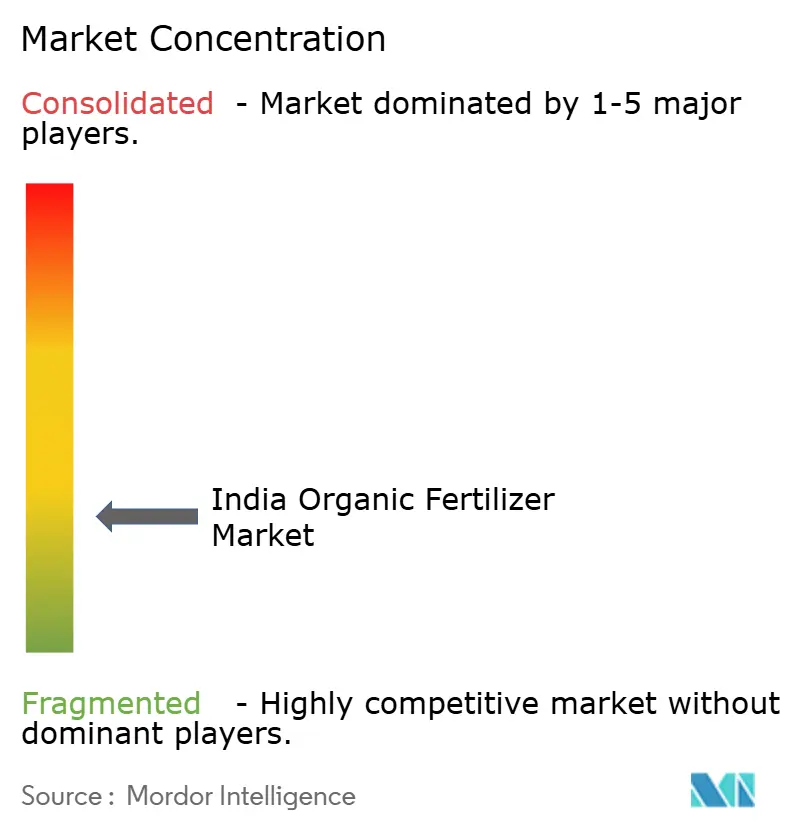
| Market Concentration | Low |
Major Players *Disclaimer: Major Players sorted in no particular order Image ? 黑料不打烊. Reuse requires attribution under CC BY 4.0. | |
India Organic Fertilizer Market Analysis by 黑料不打烊
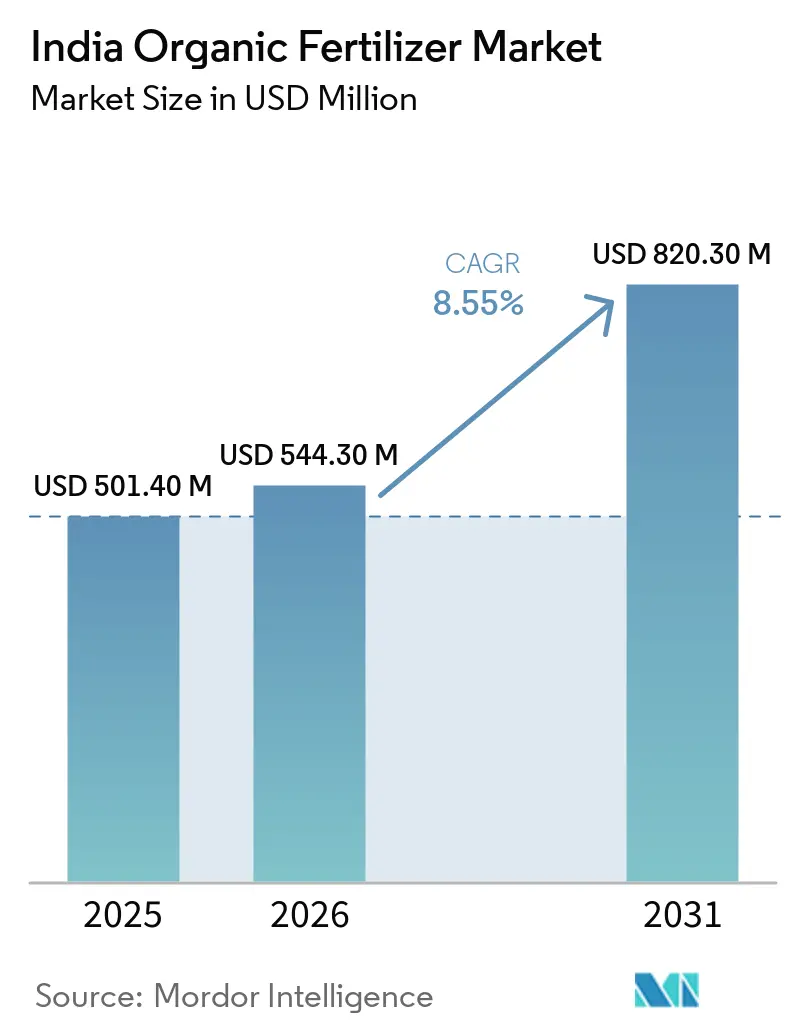
The India organic fertilizer market size was valued at USD 501.40 million in 2025 and is projected to grow from USD 544.30 million in 2026 to USD 820.30 million by 2031, with a forecast CAGR of 8.55% from 2026 to 2031. The market is supported by increasing adoption of organic farming, government-backed cluster-based programs, and the formalization of quality standards for organic fertilizer products. The Fertilizer Control Order, 1985 establishes prescribed standards for organic fertilizers, while successive amendments have expanded and modified the range of regulated fertilizer products. Government programs such as the Paramparagat Krishi Vikas Yojana (PKVY) are strengthening the adoption base, with around 15 lakh hectares brought under organic farming, 52,289 clusters formed, and 25.30 lakh farmers benefiting as of February 2025, according to the Press Information Bureau (PIB)[1]. The market is also supported by certified organic farming, increasing formalization of input supply, and the emergence of organic fertilizer products derived from waste streams such as digestate from compressed biogas facilities. These conditions favor suppliers that can offer consistent formulations, compliance with regulatory standards, certification support, and localized agronomic services.
Key Report Takeaways
- By form, meal-based fertilizers accounted for 67.3% of the India organic fertilizer market share in 2025, while manure is forecast to grow at a CAGR of 9.2% from 2026 to 2031.
- By crop type, row crops accounted for 85.6% of the India organic fertilizer market size in 2025, while cash crops are forecast to grow at a CAGR of 8.7% from 2026 to 2031.
Note: Market size and forecast figures in this report are generated using 黑料不打烊’s proprietary estimation framework, updated with the latest available data and insights as of January 2026.
India Organic Fertilizer Market Trends and Insights
Drivers Impact Analysis*
| Driver | (~) % Impact on CAGR Forecast | Geographic Relevance | Impact Timeline |
|---|---|---|---|
| Government Incentives and Organic-Input Subsidies | +1.8% | National, with concentrated gains in Madhya Pradesh, Maharashtra, and the North Eastern Region | Medium term (2-4 years) |
| Rising Demand for Certified and Export-Oriented Organic Produce | +1.3% | South India and West India, with spillover to East India | Medium term (2-4 years) |
| Expansion of Certified Organic Farmland and Cluster Farming | +1.5% | National, with highest intensity in Madhya Pradesh, Maharashtra, and Rajasthan | Long term (≥ 4 years) |
| Environmental Pressure to Reduce Chemical Fertilizer Overuse | +1.0% | National, with early gains in Punjab, Haryana, and Andhra Pradesh | Long term (≥ 4 years) |
| GOBARdhan and Compressed Biogas Feedstock Commercialization | +0.8% | West India, Maharashtra, Gujarat, Rajasthan, and Uttar Pradesh | Long term (≥ 4 years) |
| Crop-Specific Organic Formulations Enabled by Soil Testing and Digital Advisory | +0.7% | National, with early gains in South India and West India | Short term (≤ 2 years) |
| Source: 黑料不打烊 | |||
Government Incentives and Organic-Input Subsidies
Government incentives and organic-input subsidies are supporting the adoption of organic fertilizers by reducing the cost burden on farmers and improving access to certified organic inputs. Under the Paramparagat Krishi Vikas Yojana (PKVY), farmers receive INR 31,500 (USD 331.25) per hectare over three years, including INR 15,000 (USD 157.38) per hectare through direct benefit transfer for organic inputs, according to the Press Information Bureau (PIB). These financial incentives encourage farmers to adopt organic fertilizers as part of structured organic farming programs and support demand through cluster-based procurement. Similar assistance under programs such as the Mission Organic Value Chain Development for North Eastern Region (MOVCDNER) extends government-supported organic-input adoption to additional regions. The availability of multi-year financial assistance, certification support, and organized organic farming programs improves market access for suppliers offering compliant organic fertilizer products and can encourage repeat procurement within supported farming clusters.
Rising Demand for Certified and Export-Oriented Organic Produce
Growing demand for certified organic produce in export markets is supporting the use of compliant organic inputs across India’s certified farming supply chains. India exported USD 665.97 million of organic products in 2024–25, according to the Agricultural and Processed Food Products Export Development Authority (APEDA)[2]. Export-oriented organic production requires adherence to certification and traceability requirements under the National Programme for Organic Production (NPOP), increasing the importance of documented and compliant input use. The launch of the 8th edition of NPOP and TraceNet 2.0 in January 2025 further strengthened digital traceability, certification, and compliance across organic supply chains. These requirements favor organic fertilizer suppliers that can provide standardized formulations, certification-related documentation, and traceability records suitable for NPOP-registered farms, supporting demand from farmers targeting premium domestic and export markets.
Expansion of Certified Organic Farmland and Cluster Farming
The expansion of certified organic farmland and farms under conversion is increasing the addressable base for organic fertilizer products in India. Under the National Programme for Organic Production (NPOP), 22.5 lakh hectares were under certified organic cultivation in 2024–25, according to the Agricultural and Processed Food Products Export Development Authority (APEDA). The additional area under conversion further expands the potential demand base as farmers transition toward certified organic production and adopt compliant inputs. States with substantial organic cultivation, including Madhya Pradesh, Maharashtra, and Rajasthan, provide important regional markets for organic fertilizer suppliers, particularly for products used to improve soil fertility and nutrient availability. Meanwhile, the Paramparagat Krishi Vikas Yojana (PKVY) cluster-based approach organizes participating farms into defined groups, facilitating coordinated input distribution and implementation of organic farming practices. This organized structure can help suppliers reach multiple farmers through bulk procurement while supporting documentation and traceability requirements, thereby strengthening the distribution of organic fertilizers across certified and transitioning farms.
GOBARdhan and Compressed Biogas Feedstock Commercialization
The commercialization of organic manure from compressed biogas (CBG) plants is creating an additional supply stream of organic fertilizer products in India. Sales of fermented organic manure (FOM), liquid fermented organic manure (LFOM), and phosphate-rich organic manure (PROM) reached 1.67 million metric tons during 2025–26 up to February 2026, according to the Press Information Bureau (PIB)[3]. Government support through the Market Development Assistance (MDA) scheme is encouraging the production, marketing, and wider distribution of these CBG-derived organic fertilizers. The expansion of CBG infrastructure is also improving the availability of organic manure produced from agricultural residues, cattle dung, and other biomass feedstocks, strengthening the link between waste management and agricultural input supply. The approved GOBARdhan National Circular Bioenergy Scheme supports compressed biogas (CBG) development, feedstock aggregation, organic manure processing, and value addition, strengthening the organic fertilizer value chain. These developments are expanding the availability of alternative organic fertilizer products and favor suppliers that can secure reliable biomass feedstock, establish processing capabilities, and develop distribution networks for CBG-derived organic manure.
Restraints Impact Analysis*
| Restraint | (~) % Impact on CAGR Forecast | Geographic Relevance | Impact Timeline |
|---|---|---|---|
| Higher Delivered Cost Compared With Subsidized Synthetic Fertilizers | -1.5% | National, most acute in North India and East India | Medium term (2-4 years) |
| Inconsistent Nutrient Content and Quality Across Decentralized Suppliers | -1.0% | National, highest in East India and Central India | Long term (≥ 4 years) |
| High Moisture, Low Nutrient Density, and Fragmented Logistics Raise Delivered Costs | -0.8% | West India, North India, and states with dense livestock | Long term (≥ 4 years) |
| Limited Monetization of Farm-Made Organic Inputs and Weak Traceability | -0.5% | National, most acute in East India and the North Eastern Region | Long term (≥ 4 years) |
| Source: 黑料不打烊 | |||
Higher Delivered Cost Compared With Subsidized Synthetic Fertilizers
Higher delivered costs compared with subsidized synthetic fertilizers remain a restraint for the India organic fertilizer market, particularly in regions where transportation, handling, and storage costs are higher. Urea is sold at a government-notified MRP of INR 242 (USD 2.54) per 45-kilogram bag, with the government covering the difference between its delivered cost and the amount realized from farmers through the Urea Subsidy Scheme, according to the Press Information Bureau. Organic fertilizers generally have a different cost structure because their bulkier nature can increase transportation, storage, handling, and application expenses relative to concentrated synthetic fertilizers. Government initiatives encouraging reduced chemical fertilizer use can support the adoption of alternative nutrient sources, but they do not eliminate the established price advantage of subsidized synthetic fertilizers. This cost differential can make organic fertilizers more difficult to adopt among price-sensitive farmers, particularly where organic products do not command a premium or receive direct input support.
Inconsistent Nutrient Content and Quality Across Decentralized Suppliers
Inconsistent nutrient content and product quality across decentralized organic fertilizer suppliers can constrain farmer confidence and repeat purchases in the India organic fertilizer market. Variations in feedstock composition, processing methods, moisture levels, and composting conditions can result in differences in nutrient concentration and product characteristics between batches. This can make product performance less predictable for farmers and complicate comparisons across suppliers. In November 2024, the Indian Council of Agricultural Research (ICAR) initiated a two-year demonstration project to evaluate the performance of fermented organic manure (FOM) and liquid fermented organic manure (LFOM), according to the Press Information Bureau (PIB). The initiative reflects the need for stronger field-level evidence on the effectiveness of emerging organic fertilizer products. Consequently, consistent formulations, standardized production processes, quality testing, and batch-level traceability remain important for improving product reliability and sustaining farmer confidence.
*Our forecasts treat driver/restraint impacts as directional, not additive. The impact forecasts reflect baseline growth, mix effects, and variable interactions.
Segment Analysis
By Form: Meal-Based Fertilizers Lead the Market, While Manure Records the Fastest Growth
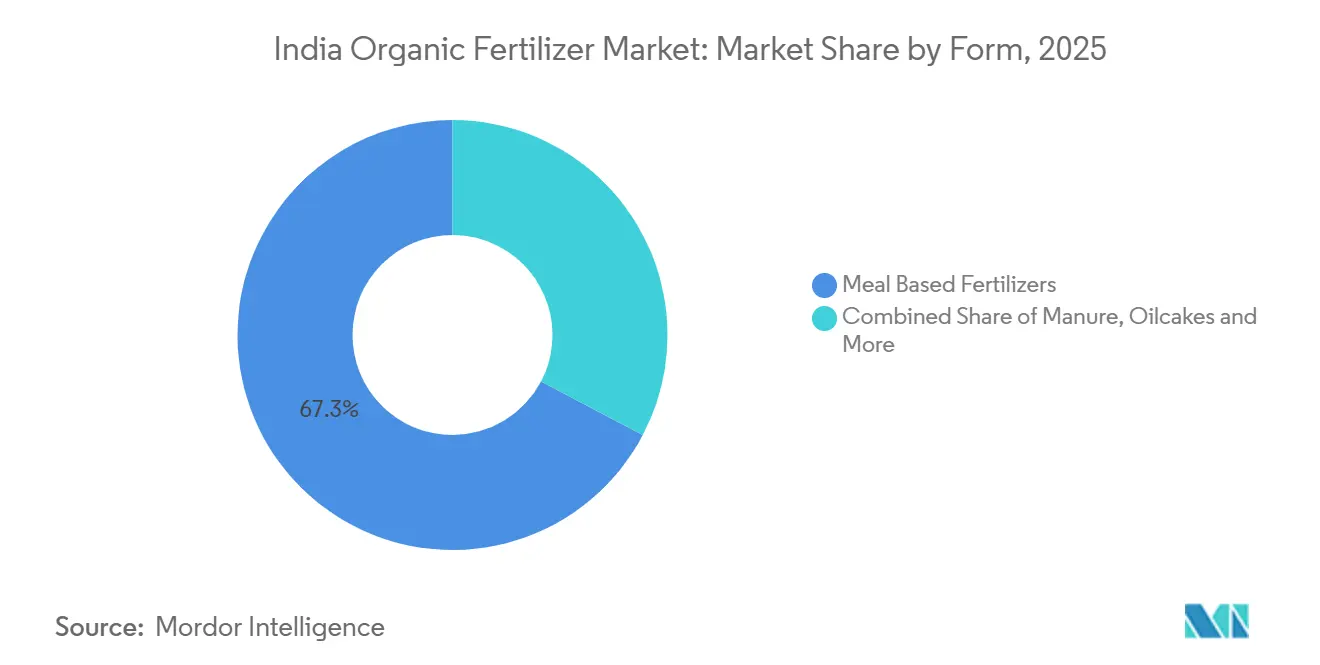
Meal-based fertilizers accounted for 67.3% of the India organic fertilizer market size in 2025, making them the largest form segment. Their leading position is supported by their established use in nutrient management across cotton, turmeric, chili, and other higher-value crops, as well as the availability of granular and easy-to-apply formulations compatible with existing fertilizer-spreading equipment. Quality requirements under the Fertilizer Control Order (FCO) can favor processors with established testing and quality-control systems. Manure and other organic fertilizers, including city compost, press mud-based manure, and enriched formulations, complement meal-based products by serving broader soil-conditioning and nutrient-management applications.
Manure is the fastest-growing segment, forecast to expand at a 9.2% CAGR between 2026 and 2031. Its growth is supported by increasing availability of organic manure from compressed biogas (CBG) facilities, which generate fermented organic manure (FOM) and liquid fermented organic manure (LFOM) as co-products. The expansion of CBG infrastructure is creating additional sources of standardized manure products while strengthening the link between waste management and agricultural input supply. Press mud-based manure and other enriched manure products also benefit from government support and increasing commercialization of organic nutrient sources. This expanding supply base can improve product availability and distribution, although suppliers need to maintain consistent nutrient content, quality, and regulatory compliance as manure-based products gain a larger role in the India organic fertilizer market.

By Crop Type: Row Crops Lead Demand While Cash Crops Gain Certification Pull
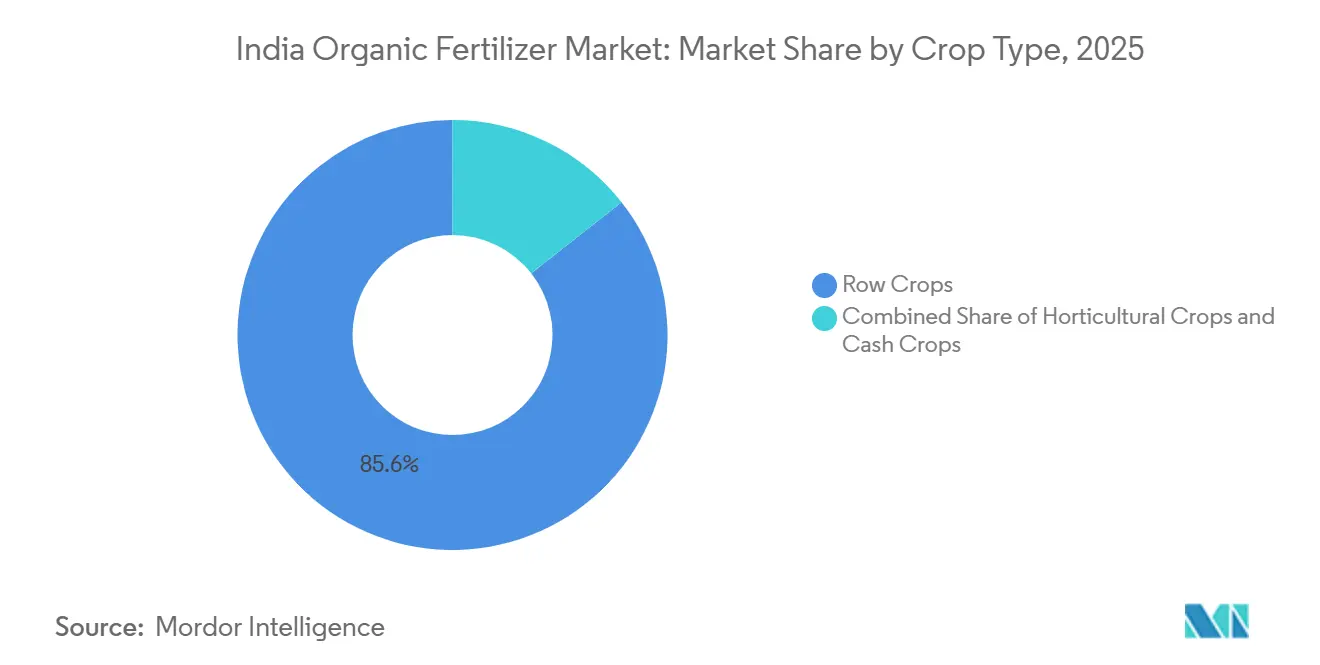
Row crops accounted for 85.6% of the India organic fertilizer market share in 2025, making them the largest crop type. Rice, wheat, sorghum, and pulses account for a substantial share of organic fertilizer use because of their extensive cultivated area and participation in government-supported organic farming programs. The Paramparagat Krishi Vikas Yojana (PKVY) and National Mission on Natural Farming (NMNF) are supporting the adoption of organic inputs across this broad farming base. Rice-producing states such as Odisha, Andhra Pradesh, and Jharkhand therefore represent important demand centers for organic fertilizer suppliers. Horticultural crops have a smaller area base but can generate higher-value demand where certification, residue compliance, and premium markets encourage the use of documented organic inputs.
Cash crops are the fastest-growing crop type, forecast to expand at an 8.7% CAGR between 2026 and 2031. Sugarcane, cotton, spices, and other export-linked crops are gaining demand for organic fertilizers as producers participate in certified supply chains that require traceable and documented input use. The export orientation of several cash crops strengthens this requirement, particularly where buyers and certification bodies require records of compliant agricultural inputs. Organic spice and condiment exports from India reached USD 45.4 million in 2024–25, according to the Agricultural and Processed Food Products Export Development Authority (APEDA). Growing certification and traceability requirements in crops such as grapes, coffee, spices, and other export-oriented products can therefore create opportunities for suppliers offering NPOP-compliant formulations and supporting documentation, while horticultural and other specialty crops continue to provide additional premium-demand opportunities.
Geography Analysis
Maharashtra was the largest regional market for organic fertilizers in India in 2025, supported by its substantial certified organic farming base and diverse crop structure. The state had 5.3 lakh hectares of certified organic area in 2024–25, according to the Agricultural and Processed Food Products Export Development Authority (APEDA). Maharashtra's production of sugarcane, cotton, oilseeds, and table grapes creates demand for different organic fertilizer formulations, while export-oriented crops increase the importance of traceable and compliant inputs. The state's large agricultural base and expanding availability of organic manure through biomass and compressed biogas activities further support its position in the India organic fertilizer market.
Gujarat combines a substantial organic farming base with demand from cotton, oilseeds, horticultural crops, and other commercial agriculture. The state had 1.9 lakh hectares of certified organic area in 2024–25, according to APEDA. Karnataka and Tamil Nadu benefit from plantation and export-oriented crops such as coffee, tea, cardamom, and pepper, where certified producers require documented and compliant organic inputs. Madhya Pradesh represents another important market because of its large certified organic farming area and extensive row-crop production, while Odisha, Andhra Pradesh, and Jharkhand provide opportunities through rice production and government-supported organic farming clusters. The North Eastern states also offer a distinct opportunity through the Mission Organic Value Chain Development for North Eastern Region (MOVCDNER), particularly for suppliers able to meet the requirements of smallholder and plantation-based organic production.
Across these states, supply-chain execution remains important because organic fertilizer suppliers need to maintain consistent product quality, regulatory compliance, traceability, and reliable distribution. Suppliers with localized production or aggregation facilities can reduce transportation requirements for bulky organic fertilizers while improving availability near farming clusters. Commercial opportunities also differ by crop structure, with Maharashtra and Gujarat offering strong demand from commercial and export-oriented agriculture, Karnataka and Tamil Nadu benefiting from plantation supply chains, and Madhya Pradesh and other central and eastern states providing larger opportunities across row crops and government-supported organic farming programs. Geographic growth in the India organic fertilizer market will therefore depend not only on the expansion of certified cultivation but also on suppliers' ability to establish efficient regional distribution networks and provide products suited to local crop and certification requirements.
Competitive Landscape
The India organic fertilizer market is fragmented, with Coromandel International Limited, Indian Farmers Fertiliser Cooperative Limited (IFFCO), T. Stanes and Company Limited, Swaroop Agri Sciences Private Limited, and Amruth Organic Fertilizers among the major players in 2025. Competition spans meal-based fertilizers, manure, compost, enriched organic formulations, and other organic nutrient products. Coromandel International Limited leverages its broad fertilizer portfolio, manufacturing capabilities, and rural retail network, while IFFCO benefits from its extensive farmer network, cooperative distribution structure, and organic agricultural inputs portfolio. T. Stanes and Company Limited draws on its established presence in organic agricultural inputs, agronomy capabilities, and distribution network. Meanwhile, regional producers and decentralized manufacturers account for a substantial share of supply, particularly in areas with abundant local biomass and established farming relationships. This fragmented structure makes feedstock access, product consistency, regulatory compliance, distribution reach, and agronomic support key competitive factors.
Competitive differentiation increasingly depends on consistent nutrient content, standardized formulations, quality testing, traceability, and reliable distribution. Larger suppliers can leverage laboratory testing, formal quality-control systems, regulatory documentation, and extensive dealer networks, while regional producers benefit from lower logistics costs and proximity to agricultural clusters. The adoption of fermented organic manure (FOM), liquid fermented organic manure (LFOM), enriched formulations, and other standardized products further expands the competitive landscape, placing greater emphasis on product performance, certification support, and farmer-level technical assistance.
Opportunities exist for companies that can aggregate organic feedstocks, standardize product quality, and establish reliable distribution networks across fragmented farming markets. Government-supported organic farming clusters, certified farms, and export-oriented agricultural supply chains create demand for compliant products and supporting documentation. Suppliers that integrate feedstock sourcing, processing, quality testing, certification, and farm-level application records are well positioned to serve these requirements. Traceability systems such as TraceNet 2.0 further reinforce the importance of documented input use in certified organic supply chains. While localized producers benefit from access to low-cost biomass and proximity to farming clusters, larger companies can capitalize on manufacturing scale, testing infrastructure, regulatory documentation, and established distribution networks. Consequently, competitive positioning in the India organic fertilizer market depends on combining reliable feedstock access with consistent product quality, regulatory compliance, distribution reach, and agronomic support rather than relying on manufacturing capacity alone.
India Organic Fertilizer Industry Leaders
-
Coromandel International Limited
-
Indian Farmers Fertiliser Cooperative Limited
-
T. Stanes and Company Limited
-
Swaroop Agri Sciences Private Limited
-
Amruth Organic Fertilizers
- *Disclaimer: Major Players sorted in no particular order
Recent Industry Developments
- August 2026: The Union Cabinet approved GOBARdhan, the National Circular Bioenergy Scheme, with an outlay of INR 23,731 crore (USD 2.45 billion) for FY2026–27 to FY2035–36, supporting compressed biogas production and organic manure processing, including fermented organic manure (FOM) and liquid fermented organic manure (LFOM) co-products.
- June 2026: Coromandel International Limited and Samunnati Agri Value Chain Solutions Private Limited signed an MoU to strengthen agricultural input distribution to Farmer Producer Organizations (FPOs) across India, potentially expanding access to Coromandel’s organic fertilizer products through Samunnati’s FPO network.
- January 2025: The Ministry of Commerce and Industry, through Agricultural and Processed Food Products Export Development Authority (APEDA), launched the 8th edition of the National Programme for Organic Production (NPOP) and TraceNet 2.0, strengthening organic certification, digital traceability, and regulatory oversight for certified organic supply chains.
India Organic Fertilizer Market Report Scope
Organic fertilizers are fertilizers derived primarily from plant, animal, or other naturally occurring organic materials that supply nutrients to crops and improve soil fertility. They include materials such as compost, farmyard manure, animal manure, bone meal, oil cakes, crop residues, and other processed organic nutrient sources.
The India organic fertilizer market report is segmented by form (manure, meal-based fertilizers, and more) and by crop type (cash crops, horticultural crops, and row crops). The market sizes and forecasts are provided in terms of value (USD) and volume (metric tons).
| Manure |
| Meal-Based Fertilizers |
| Oilcakes |
| Other Organic Fertilizers |
| Cash Crops |
| Horticultural Crops |
| Row Crops |
| By Form | Manure |
| Meal-Based Fertilizers | |
| Oilcakes | |
| Other Organic Fertilizers | |
| By Crop Type | Cash Crops |
| Horticultural Crops | |
| Row Crops |
Market Definition
- AVERAGE DOSAGE RATE - The average application rate is the average volume of organic fertilizers applied per hectare of farmland in the respective region/country.
- CROP TYPE - Crop type includes Row crops (Cereals, Pulses, Oilseeds), Horticultural Crops (Fruits and vegetables) and Cash Crops (Plantation Crops, Fibre Crops and Other Industrial Crops)
- FUNCTION - The crop nutrition function of agricultural biological consists of various products that provide essential plant nutrients and enhance soil quality.
- TYPE - Organic fertilizers are applied to provide essential crop nutrients and enhance the soil quality.
| Keyword | Definition |
|---|---|
| Cash Crops? | Cash crops are non-consumable crops sold as a whole or part of the crop to manufacture end-products to make a profit. |
| Integrated Pest Management (IPM)? | IPM is an environment-friendly and sustainable approach to control pests in various crops. It involves a combination of methods, including biological controls, cultural practices, and selective use of pesticides. |
| Bacterial biocontrol agents? | Bacteria used to control pests and diseases in crops. They work by producing toxins harmful to the target pests or competing with them for nutrients and space in the growing environment. Some examples of commonly used bacterial biocontrol agents include Bacillus thuringiensis (Bt), Pseudomonas fluorescens, and Streptomyces spp.? |
| Plant Protection Product (PPP)? | A plant protection product is a formulation applied to crops to protect from pests, such as weeds, diseases, or insects. They contain one or more active substances with other co-formulants such as solvents, carriers, inert material, wetting agents or adjuvants formulated to give optimum product efficacy.? |
| Pathogen? | A pathogen is an organism causing disease to its host, with the severity of the disease symptoms.? |
| Parasitoids? | Parasitoids are insects that lay their eggs on or within the host insect, with their larvae feeding on the host insect. In?agriculture, parasitoids can be used as a form of biological pest control, as they help to control pest damage to crops and?decrease the need for chemical pesticides.? |
| Entomopathogenic Nematodes (EPN)? | Entomopathogenic nematodes are parasitic roundworms that infect and kill pests by releasing bacteria from their gut. Entomopathogenic nematodes are a form of biocontrol agents used in agriculture.? |
| Vesicular-arbuscular mycorrhiza (VAM)? | VAM fungi are mycorrhizal species of fungus. They live in the roots of different higher-order plants. They develop a symbiotic relationship with the plants in the roots of these plants.? |
| Fungal biocontrol agents? | Fungal biocontrol agents are the beneficial fungi that control plant pests and diseases. They are an alternative to chemical pesticides. They infect and kill the pests or compete with pathogenic fungi for nutrients and space.? |
| Biofertilizers? | Biofertilizers contain beneficial microorganisms that enhance soil fertility and promote plant growth.? |
| Biopesticides? | Biopesticides are natural/bio-based compounds used to manage agricultural pests using specific biological effects.? |
| Predators? | Predators?in?agriculture?are?the organisms?that?feed?on?pests?and?help?control?pest damage to the?crops.?Some?common?predator?species?used?in?agriculture?include?ladybugs,?lacewings,?and?predatory?mites.? |
| Biocontrol agents? | Biocontrol agents are living organisms used to control pests and diseases in agriculture. They are alternatives to chemical pesticides and are known for their lesser impact on the environment and human health.? |
| Organic Fertilizers? | Organic fertilizer is composed of animal or vegetable matter used alone or in combination with one or more non-synthetically derived elements or compounds used for soil fertility and plant growth.? |
| Protein hydrolysates (PHs)? | Protein hydrolysate-based biostimulants contain free amino acids, oligopeptides, and polypeptides produced by enzymatic or chemical hydrolysis of proteins, primarily from vegetal or animal sources.? |
| Biostimulants/Plant Growth Regulators?(PGR)? | Biostimulants/Plant Growth Regulators (PGR) are substances derived from natural resources to enhance plant growth and health by stimulating plant processes (metabolism).? |
| Soil Amendments? | Soil Amendments are substances applied to soil that improve soil health, such as soil fertility and soil structure.? |
| Seaweed Extract? | Seaweed extracts are rich in micro and macronutrients, proteins, polysaccharides, polyphenols, phytohormones, and osmolytes. These substances boost seed germination and crop establishment, total plant growth and productivity.? |
| Compounds related to biocontrol and/or?promoting growth (CRBPG)? | Compounds related to biocontrol or promoting growth (CRBPG)? are the ability of a bacteria to produce compounds for phytopathogen biocontrol and plant growth promotion.? |
| Symbiotic Nitrogen-Fixing Bacteria? | Symbiotic nitrogen-fixing bacteria such as Rhizobium obtain food and shelter from the host, and in return, they help by providing fixed nitrogen to the plants.? |
| Nitrogen Fixation? | Nitrogen fixation is a chemical process in soil which converts molecular nitrogen into ammonia or related nitrogenous compounds.? |
| ARS (Agricultural Research Service)? | ARS is the U.S. Department of Agriculture's chief scientific in-house research agency. It aims to find solutions to agricultural problems faced by the farmers in the country.? |
| Phytosanitary Regulations? | Phytosanitary regulations imposed by the respective government bodies check or prohibit the importation and marketing of certain insects, plant species, or products of these plants to prevent the introduction or spread of new plant pests or pathogens.? |
| Ectomycorrhizae?(ECM)? | Ectomycorrhiza (ECM) is a symbiotic interaction of fungi with the feeder roots of higher plants in which both the plant and the fungi benefit through the association for survival.? |
Research Methodology
黑料不打烊 follows a four-step methodology in all our reports.
- Step-1: Identify Key Variables: In order to build a robust forecasting methodology, the variables and factors identified in Step-1 are tested against available historical market numbers. Through an iterative process, the variables required for market forecast are set and the model is built on the basis of these variables.
- Step-2: Build a Market Model: Market-size estimations for the forecast years are in nominal?terms. Inflation is not a part of the pricing, and the average selling price (ASP) is kept constant throughout the forecast period.
- Step-3: Validate and Finalize: In this important step, all market numbers, variables and analyst calls are validated through an extensive network of primary research experts from the market studied. The respondents are selected across levels and functions to generate a holistic picture of the market studied.
- Step-4: Research Outputs: Syndicated Reports, Custom Consulting Assignments, Databases & Subscription Platforms.


