
Market Overview
| Study Period | 2021 - 2031 |
|---|---|
| Forecast Data Period | 2026 - 2031 |
| Base Year Market Size (2025) | USD 1.26 Billion |
| Market Size (2026) | USD 1.31 Billion |
| Market Size (2031) | USD 1.60 Billion |
| Growth Rate (2026 - 2031) | 4.09 % |
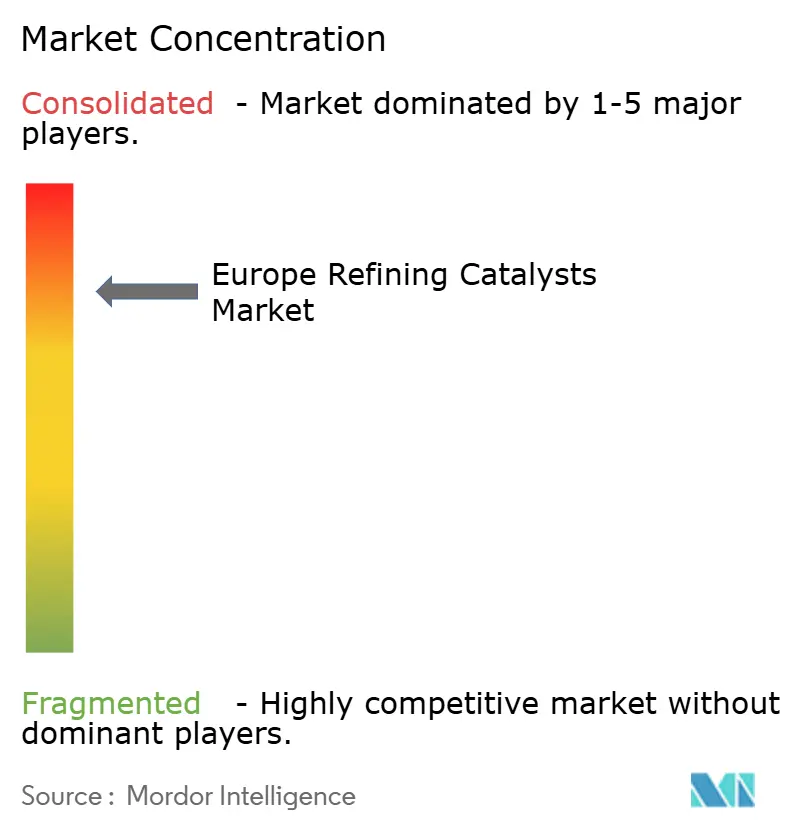
| Market Concentration | High |
Major Players *Disclaimer: Major Players sorted in no particular order Image ? 黑料不打烊. Reuse requires attribution under CC BY 4.0. | |
Europe Refining Catalysts Market Analysis by 黑料不打烊
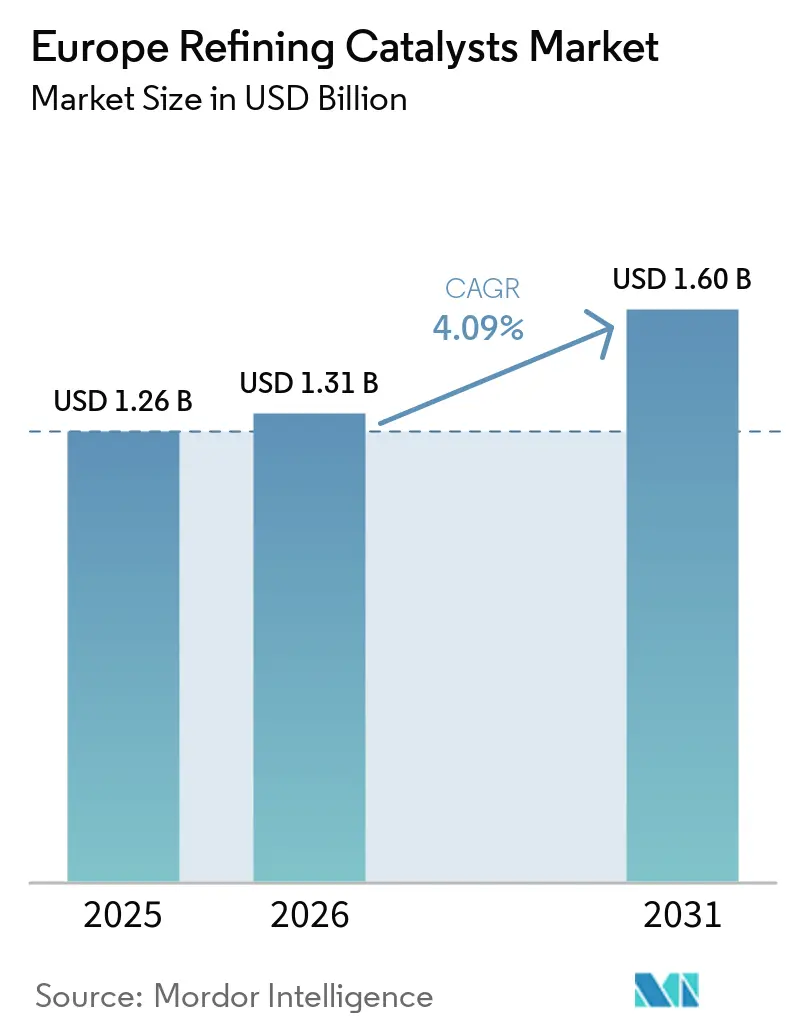
The Europe refining catalysts market size was valued at USD 1.26 billion in 2025 and is estimated to grow from USD 1.31 billion in 2026 to USD 1.60 billion by 2031, at a CAGR of 4.09% during the forecast period (2026-2031). The Europe refining catalysts market is expanding despite declining regional crude-processing capacity, as remaining refineries increase their focus on complex conversion activities. Capacity reductions announced since 2024 increase attention on facilities that support hydrocracking, residue upgrading, and biofeedstock co-processing. These operations require more specialized catalyst systems than conventional distillation-focused assets. Suppliers compete based on catalyst performance, service coverage, regeneration capabilities, and support for renewable feedstocks. Cost pressures, lower utilization rates, and metal price volatility may constrain discretionary upgrades while increasing demand for products that extend operating cycles and improve operational efficiency.
Key Report Takeaways
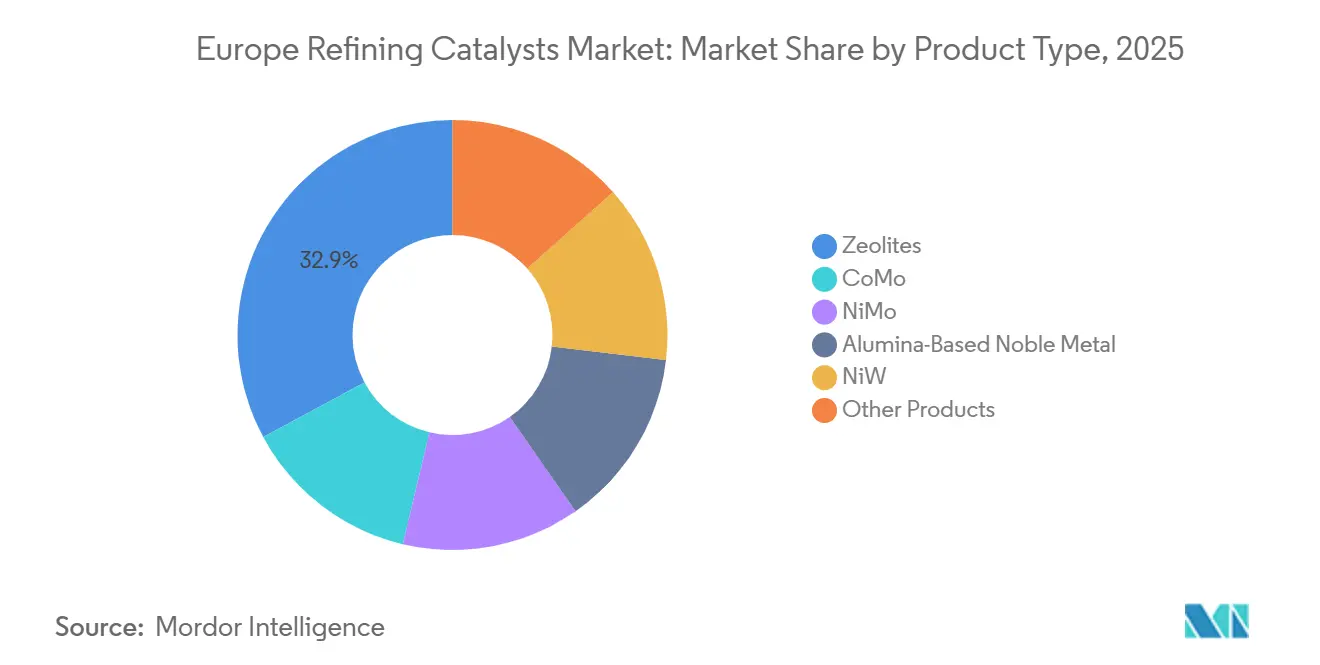
- By product type, zeolites led with 32.86% of the Europe refining catalysts market share in 2025 and are forecast to grow at a 4.46% CAGR through 2031.
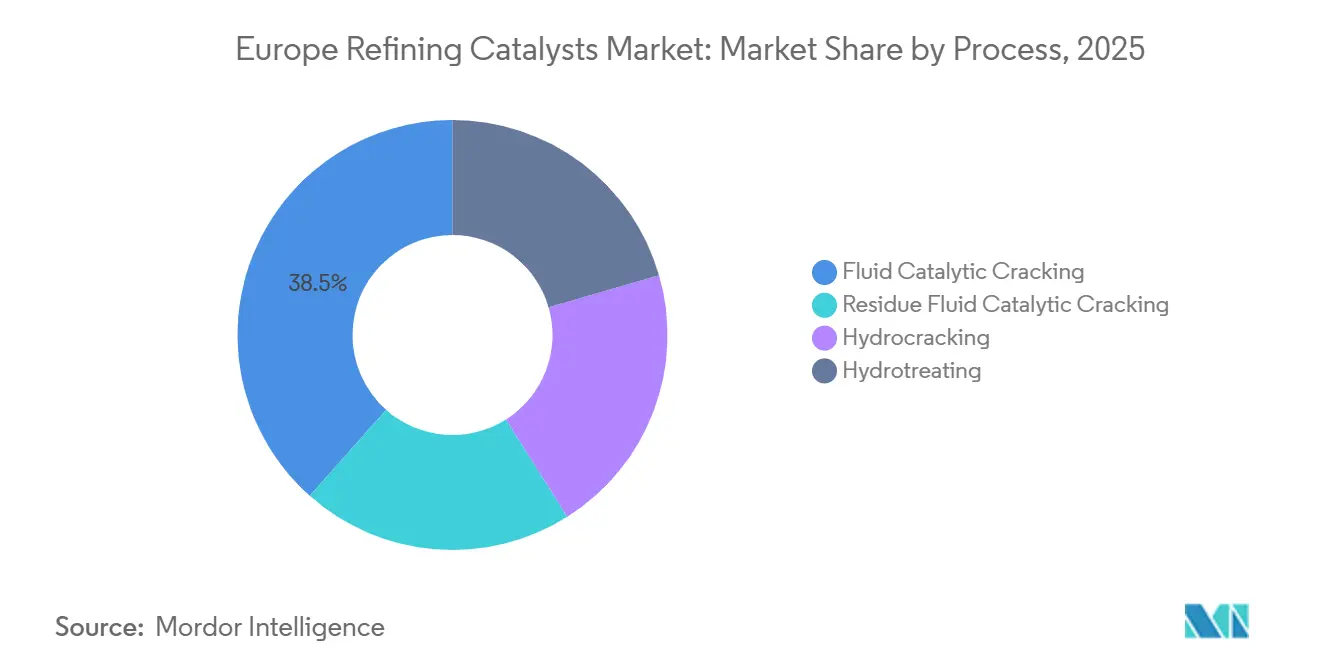
- By process, fluid catalytic cracking held 38.45% of the Europe refining catalysts market share in 2025, while hydrocracking is forecast to record the highest CAGR of 5.05% through 2031.
- By geography, Germany accounted for 24.67% of regional demand in 2025, while Spain is forecast to grow at a 4.98% CAGR through 2031.
Note: Market size and forecast figures in this report are generated using 黑料不打烊’s proprietary estimation framework, updated with the latest available data and insights as of January 2026.
Market Trends and Insights
Drivers Impact Analysis of Europe Refining Catalysts Market*
| Drivers | (~) % Impact on CAGR Forecast | Geographic Relevance | Impact Timeline |
|---|---|---|---|
| Stricter European Fuel-Sulfur and Emissions Requirements | +1.2% | EU-wide, with the highest intensity in Germany, France, and Italy | Short term (≤ 2 years) |
| Catalyst Replacement and Debottlenecking in Aging Refineries | +0.8% | Germany, France, Italy, the Netherlands | Medium term (2-4 years) |
| Hydrocracking and Hydrotreating for Crude-Slate Flexibility | +0.7% | Germany, Spain, the Netherlands | Medium term (2-4 years) |
| Co-Processing of Waste and Bio-Based Feedstocks | +0.5% | Spain, Italy, Germany, Finland | Long term (≥ 4 years) |
| Digital Catalyst Monitoring and Performance Optimization | +0.3% | Germany, the United Kingdom, and the Netherlands | Long term (≥ 4 years) |
| Source: 黑料不打烊 | |||
Stricter European Fuel-Sulfur and Emissions Requirements
Diesel and gasoline sold across the European Union must comply with a maximum sulfur content of 10 parts per million under the Fuel Quality Directive. This requirement supports demand for hydrotreating catalyst capacity and performance at European refineries. It also creates varying requirements across the European refining catalysts market. Refineries producing conventional ultra-low-sulfur diesel use established cobalt-molybdenum and nickel-molybdenum formulations. Refineries processing biogenic co-feeds require formulations that tolerate higher oxygen levels and trace-metal contamination. Honeywell UOP has expanded its hydrotreating portfolio for fluid catalytic cracking (FCC) pretreatment, diesel, kerosene, and vacuum gas oil applications, reflecting the broader product requirements created by compliance standards.
Catalyst Replacement and Debottlenecking in Aging Refineries
European refining assets include many aging facilities, where catalyst replacement cycles coincide with debottlenecking activities. FCC units generally require catalyst replacement every two to five years, while fixed-bed hydroprocessing reactors operate on longer cycles. Capacity reductions since 2024 have shifted more throughput to refineries that remain operational. Higher throughput can accelerate catalyst deactivation and shorten replacement schedules. A broader crude slate can also increase FCC catalyst top-up requirements and support demand for metals-tolerant hydroprocessing grades. The European refining catalysts market therefore presents upgrade opportunities at complex sites, where application engineering and high-activity products differ from standard catalyst supply.
Hydrocracking and Hydrotreating for Crude-Slate Flexibility
Access to diverse crude grades is increasing the importance of hydrocracking and hydrotreating units that can process broader feedstock slates. Refiners are directing capital toward nickel-molybdenum and nickel-tungsten formulations for high-pressure, high-severity conversion applications. BP retained and upgraded the hydrocracker at Gelsenkirchen while reducing one-third of its atmospheric distillation capacity, indicating a focus on high-conversion assets. JGC Catalysts and Chemicals and Saudi Aramco developed titanium-loaded ultra-stable Y zeolite hydrocracking catalysts to maintain active-site stability under severe operating conditions. Longer campaign cycles can reduce catalyst costs per barrel. Topsoe states that its current NiMo hydrocracking pretreatment catalysts deliver 500% higher activity than mid-1980s benchmarks.
Co-Processing of Waste and Bio-Based Feedstocks
Co-processing used cooking oil, animal fats, pyrolysis oil, and tall oil residues in existing hydroprocessing units enables refiners to produce renewable fuels without constructing dedicated biorefineries. Topsoe and Preem completed a co-processing campaign at Preem’s Gothenburg refinery in June 2026, using waste- and residue-based lipids with conventional feedstocks. The campaign confirmed the commercial application of HydroFlex technology at an industrial scale. Biogenic feedstocks contain oxygenates, water, and trace metals that can deactivate standard CoMo and NiMo catalysts more rapidly than petroleum-only feedstocks. Evonik launched its Purocel hydrotreating catalyst series in February 2025 to remove metal and chloride contaminants from pyrolysis oil, with regeneration and reuse capabilities[1]. Axens has also presented co-processing solutions for vacuum gas oil and kerosene units, indicating that product development targets bio-based applications.
Restraints Impact Analysis of Europe Refining Catalysts Market*
| Restraints | (~) % Impact on CAGR Forecast | Geographic Relevance | Impact Timeline |
|---|---|---|---|
| European Refinery Rationalization and Declining Fossil-Fuel Demand | -0.6% | EU-wide, concentrated in Germany, the United Kingdom, and Italy | Medium term (2-4 years) |
| High Manufacturing Costs and Pressure on Refinery Margins | -0.4% | EU-wide | Medium term (2-4 years) |
| Precious-Metal and Strategic-Metal Price Volatility | -0.3% | EU-wide | Short term (≤ 2 years) |
| Source: 黑料不打烊 | |||
European Refinery Rationalization and Declining Fossil-Fuel Demand
European refinery closures have reduced the installed base of catalyst-consuming units. The International Energy Agency (IEA) expects at least 1 million barrels per day of European refining capacity to be at risk of closure by 2030. Since early 2024, closures have removed 400,000-500,000 barrels per day from the operating network. These closures include the Grangemouth refinery in Scotland, Shell’s Wesseling plant, and a reduction in distillation capacity at BP’s Gelsenkirchen site. However, the impact on catalyst demand may not directly correspond to the decline in refining throughput. Surviving refineries are increasingly adopting fluid catalytic cracking (FCC), hydrocracking, and deep hydrotreatment configurations, which consume more catalyst per barrel than simpler refinery operations. Consequently, the Europe refining catalysts market may experience lower demand for basic hydrotreating catalysts, while demand for high-performance FCC and hydrocracking catalyst grades remains comparatively stable.
High Manufacturing Costs and Pressure on Refinery Margins
European refinery margins declined following the 2022-2023 energy shock, reducing the cash available for non-mandatory catalyst upgrades. When margins are under pressure, operators may extend catalyst replacement cycles. Prolonged catalyst use can reduce product quality, increase energy consumption, and degrade active sites. Delayed purchases may also result in urgent spot buying or expedited procurement at higher unit prices. Manufacturing high-surface-area alumina supports and complex zeolitic formulations remains energy-intensive. Higher energy costs in Europe can reduce the cost competitiveness of domestic manufacturers, particularly where product differentiation is limited.
*Our forecasts treat driver/restraint impacts as directional, not additive. The impact forecasts reflect baseline growth, mix effects, and variable interactions.
Europe Refining Catalysts Market Segment Analysis
By Product Type:
Zeolites Anchor FCC and Hydrocracking DemandZeolites held 32.86% of regional demand in 2025 and are projected to grow at a CAGR of 4.46% through 2031. Their position reflects their role as active cracking components in fluid catalytic cracking (FCC) and hydrocracking. Ultra-stable Y zeolite (USY) provides the active cracking function in FCC units. Its large supercage structure supports the cracking of macromolecular hydrocarbons in heavy oil. ZSM-5 improves light-olefin and aromatic selectivity and can be co-loaded with USY to shift the product mix toward gasoline or propylene. BASF has received a patent for phosphorus-stabilized MSE (Mobile Seven Eleven)-framework zeolites for FCC applications, indicating improved hydrothermal stability at higher cracking severity.
Zeolyst International has introduced its Opal Renew zeolite line for processing renewable fuels, extending zeolite applications to biogenic feedstocks. CoMo and NiMo formulations remain important for hydrotreating gasoline, kerosene, diesel, vacuum gas oil, FCC gasoline, and residual feeds. Their established supply chains, regeneration practices, and broad supplier base make them a core component of hydrotreating catalyst consumption. Alumina-based noble-metal catalysts represent a smaller, higher-margin segment in catalytic reforming. NiW grades are used in high-pressure hydrocracking applications that require stronger nitrogen resistance. As refineries blend feedstocks with higher oxygen and metals content, the Europe refining catalysts industry places greater emphasis on modified zeolitic and bimetallic formulations that offer longer campaign stability.

By Process:
Hydrocracking Gains as FCC Remains a Demand AnchorFluid catalytic cracking held 38.45% of regional demand in 2025. Within the Europe refining catalysts market, FCC remains central to gasoline, propylene, and olefin production at complex refineries. However, this share does not capture changes in catalyst consumption within individual units. Across the Europe refining catalysts market, remaining FCC units are processing heavier, more metal-contaminated crude oils as activity concentrates at complex sites. This trend can shorten effective catalyst cycles and increase catalyst top-up rates. Residue fluid catalytic cracking is attracting investment for bottom-of-the-barrel upgrading. It requires rare-earth-enhanced zeolite formulations, including lanthanum- and cerium-stabilized USY grades, at sites capable of processing vacuum and atmospheric residues.
Hydrotreating serves the widest range of refinery streams and remains the most catalyst-diverse process in regional operations. Hydrocracking is the fastest-growing process, with the Europe refining catalysts market size for this segment forecast to expand at a CAGR of 5.05% during 2026-2031. It produces cleaner distillates from heavy crude oils and provides a route for co-processing bio-based feedstocks. BP’s decision to retain and improve hydrocracking capacity at its Gelsenkirchen refinery while reducing distillation capacity illustrates this priority. The Ketjen-Imubit platform supports real-time operating adjustments for FCC and hydroprocessing units. This capability can optimize severity targets as catalyst activity declines between additions, supporting unit economics in high-throughput hydrocracking operations.
Geography Analysis
Germany Refining Catalysts Market
Germany accounted for 24.67% of the Europe refining catalysts market in 2025. Its position was supported by a large and complex refinery network, despite recent rationalization. Germany operated 11 active refineries in 2024 and produced 99.0 million tons of oil equivalent of petroleum products, representing 18% of EU-27 output. Shell’s Wesseling refinery closure and BP’s reduction in distillation capacity at Gelsenkirchen concentrated throughput and capital investment at the remaining complex sites. MiRO Karlsruhe and Gunvor Ingolstadt continued to support this demand base. The Fuel Quality Directive and Directive 2016/802 continued to drive hydrotreating catalyst replacement.
Western Europe Refining Catalysts Market
The United Kingdom segment of the Europe refining catalysts market lost the Grangemouth refinery, Scotland’s only crude-processing site, in the second quarter of 2025, when it converted into a fuel import terminal. This closure eliminated a source of demand for Fluid Catalytic Cracking (FCC) and hydroprocessing catalysts in the United Kingdom. France maintains a steady demand for hydrotreating catalysts, centered around the Seine Valley and Rh?ne corridor. Axens’ headquarters in Rueil-Malmaison and its catalyst production site in Salindres support France’s role in the regional supply chain. Spain is forecast to record a CAGR of 4.98% through 2031 in the Europe refining catalysts market. Repsol is investing EUR 800 million (USD 872 million) in its Puertollano facility over five years, including EUR 130 million (USD 142 million) for a unit conversion commissioned in 2026 to produce renewable diesel from used cooking oil and agri-food waste[2].
Broader European Markets
BP and Iberdrola secured EUR 211 million (USD 230 million) for green hydrogen expansion at the Castellón refinery, while the Valencian government approved EUR 76 million (USD 83 million) for related projects through 2029. Italy is changing its Europe refining catalysts market demand mix as Eni converts conventional refining sites into biorefineries. In 2025, the European Investment Bank committed EUR 500 million (USD 545 million) to convert Eni’s Livorno refinery into a biorefinery using Ecofining technology. Eni announced a project in September 2025 to convert the hydrocracking unit at its Sannazzaro refinery to produce Hydrotreated Vegetable Oil (HVO) and sustainable aviation fuel. Russia remains subject to uncertainty related to sanctions, catalyst access, and refinery modernization. The Netherlands, Scandinavia, Poland, and the Iberian interior comprise the rest-of-Europe group. Neste’s SCOOP project in Porvoo is developing tall-oil-residue co-processing following EU Innovation Fund support in 2025.
Competitive Landscape
The Europe refining catalysts market is consolidated, with BASF, Topsoe, Honeywell UOP, Ketjen, Axens, and Johnson Matthey as key participants. These companies maintain technology-licensing and catalyst-supply relationships with European refiners. Competition centers on product performance, application support, process expertise, and full catalyst lifecycle support. In January 2026, Axens acquired full ownership of Eurecat by purchasing Ketjen’s 50% stake. The acquisition expanded Axens’ offering to include fresh catalyst supply, ex situ sulfidation, regeneration, rejuvenation, spent-catalyst processing, and precious-metals recovery. This service model supports refinery operators managing margin pressure and higher material costs.
In March 2026, Albemarle completed the sale of a 51% controlling stake in Ketjen to KPS Capital Partners. The transaction changed the competitive position of a refining catalyst supplier. In May 2026, BASF opened a research and development center at its refinery catalyst production site in Attapulgus, Georgia. The facility integrates product development, Fluid Catalytic Cracking (FCC) testing, and quality assurance to support the commercialization of new formulations. BASF’s patent position in phosphorus-stabilized MSE-framework zeolites, along with JGC’s work on titanium-loaded USY, indicates continued focus on materials that retain activity in conversion units. These developments support product differentiation in the Europe refining catalysts market.
Smaller specialists target specific application areas rather than competing across all catalyst categories. Evonik’s Purocel series supports pyrolysis-oil hydrotreating, while its Noblyst F catalysts serve flow applications. The Ketjen-Imubit agreement also provides an early offering for digital catalyst-performance monitoring. These services can establish recurring commercial relationships as refiners adopt integrated operational tools. Competition will continue to be shaped by lifecycle services, renewable-feedstock capabilities, regeneration, and data-supported unit optimization.
Europe Refining Catalysts Industry Leaders
-
BASF
-
Albemarle Corporation
-
Topsoe
-
W. R. Grace & Co.
-
Axens
- *Disclaimer: Major Players sorted in no particular order
Europe Refining Catalysts Market Companies Covered in this Report
- Albemarle Corporation
- Axens
- BASF
- Chevron Corporation
- CLARIANT
- DuPont
- Evonik Industries AG
- Exxon Mobil Corporation
- Heraeus Group
- Honeywell International Inc.
- JGC C&C
- Johnson Matthey
- Topsoe
- W. R. Grace & Co.
- Zeolyst International
Recent Industry Developments in Europe Refining Catalysts Market
- September 2026: Spain-based Moeve, formerly Cepsa, broke ground on the Onuba green hydrogen project. The company committed EUR 1 billion (USD 1.15 billion), including more than EUR 300 million in EU subsidies, to develop 2 GW of electrolysis capacity at Palos de la Frontera. The project will supply green hydrogen to Moeve’s adjacent refinery complex, progressively replacing gray hydrogen in hydrotreating units and affecting refining catalyst operating conditions.
- May 2026: Ketjen and Imubit launched a commercial partnership to provide real-time, AI-driven refining catalyst intelligence for FCC and hydroprocessing units through Ketjen’s iKet Connect portal. The platform combines Ketjen’s catalyst performance models with Imubit’s closed-loop process monitoring capabilities to support operating adjustments for refining catalyst strategy and unit performance.
Europe Refining Catalysts Market Report Scope
Refining catalysts are specialized chemical substances that petroleum refineries use to accelerate and direct chemical reactions, converting crude oil into high-quality fuels and petrochemicals.
The Europe refining catalysts market is segmented by product type, process, and geography. By product type, the market is segmented into CoMo, NiMo, alumina-based noble metal, NiW, zeolites, and other products. By process, the market is segmented into hydrotreating, fluid catalytic cracking, residue fluid catalytic cracking, and hydrocracking. The report also covers the market size and forecasts for refining catalysts in 6 countries across the region. The market sizes and forecasts are provided in terms of value (USD).
Segmentation Overview
By Product Type
| CoMo |
| NiMo |
| Alumina-Based Noble Metal |
| NiW |
| Zeolites |
| Other Products |
By Process
| Hydrotreating | Gasoline |
| Kerosene | |
| Diesel | |
| Vacuum Gas Oil | |
| Catalytic-Cracking Gasoline | |
| Residual Feed | |
| Fluid Catalytic Cracking | |
| Residue Fluid Catalytic Cracking | |
| Hydrocracking |
By Geography
| Germany |
| United Kingdom |
| Italy |
| France |
| Spain |
| Russia |
| Rest of Europe |
| By Product Type | CoMo | |
| NiMo | ||
| Alumina-Based Noble Metal | ||
| NiW | ||
| Zeolites | ||
| Other Products | ||
| By Process | Hydrotreating | Gasoline |
| Kerosene | ||
| Diesel | ||
| Vacuum Gas Oil | ||
| Catalytic-Cracking Gasoline | ||
| Residual Feed | ||
| Fluid Catalytic Cracking | ||
| Residue Fluid Catalytic Cracking | ||
| Hydrocracking | ||
| By Geography | Germany | |
| United Kingdom | ||
| Italy | ||
| France | ||
| Spain | ||
| Russia | ||
| Rest of Europe | ||
Key Questions Answered in the Report
What is current market size of Europe Refining Catalysts Market?
The Europe refining catalysts market size was valued at USD 1.26 billion in 2025 and is estimated to grow from USD 1.31 billion in 2026 to USD 1.60 billion by 2031, at a CAGR of 4.09% during the forecast period (2026-2031).
Which product type leads demand for refining catalysts in Europe?
Zeolites led product demand with a 32.86% share in 2025 and are forecast to grow at a 4.46% CAGR through 2031.
Which refining process is growing fastest in Europe?
Hydrocracking is projected to grow at a 5.05% CAGR through 2031, driven by its support for heavy-crude conversion and biofeedstock co-processing.
Which country has the largest demand for refining catalysts in Europe?
Germany held the largest country share at 24.67% in 2025, supported by its large and complex refinery base.