
Market Overview
| Study Period | 2021 - 2031 |
|---|---|
| Forecast Data Period | 2026 - 2031 |
| Base Year Market Size (2025) | 32.67 Million metric normal cubic meters per hour (mm nm?/h) |
| Market Volume (2026) | 35.48 Million metric normal cubic meters per hour (mm nm?/h) |
| Market Volume (2031) | 54.71 Million metric normal cubic meters per hour (mm nm?/h) |
| Growth Rate (2026 - 2031) | 9.05 % |
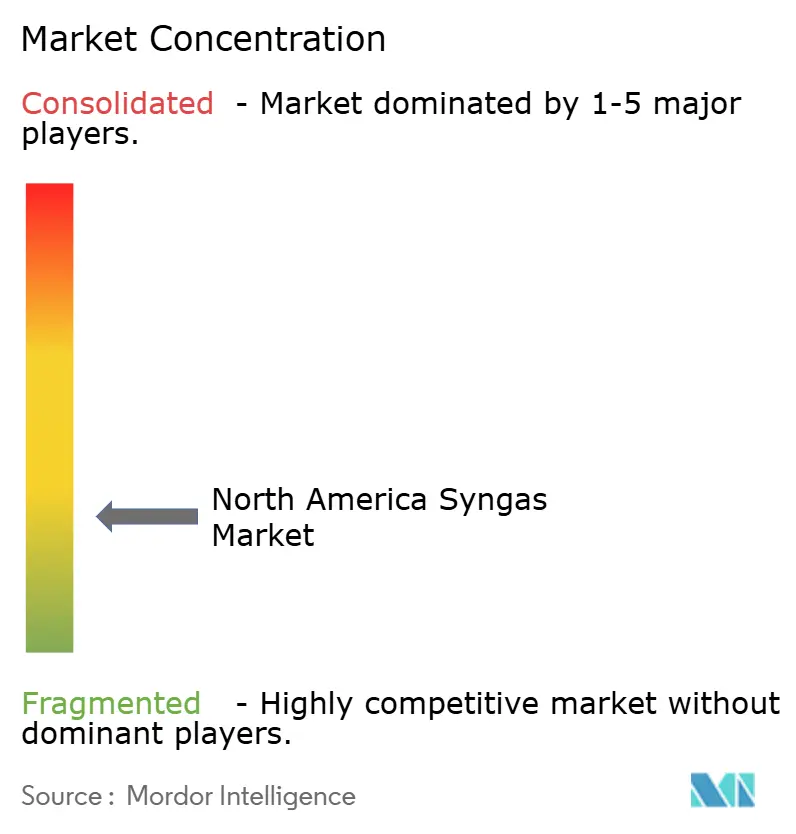
| Market Concentration | Low |
Major Players *Disclaimer: Major Players sorted in no particular order Image ? 黑料不打烊. Reuse requires attribution under CC BY 4.0. | |
North America Syngas Market Analysis by 黑料不打烊
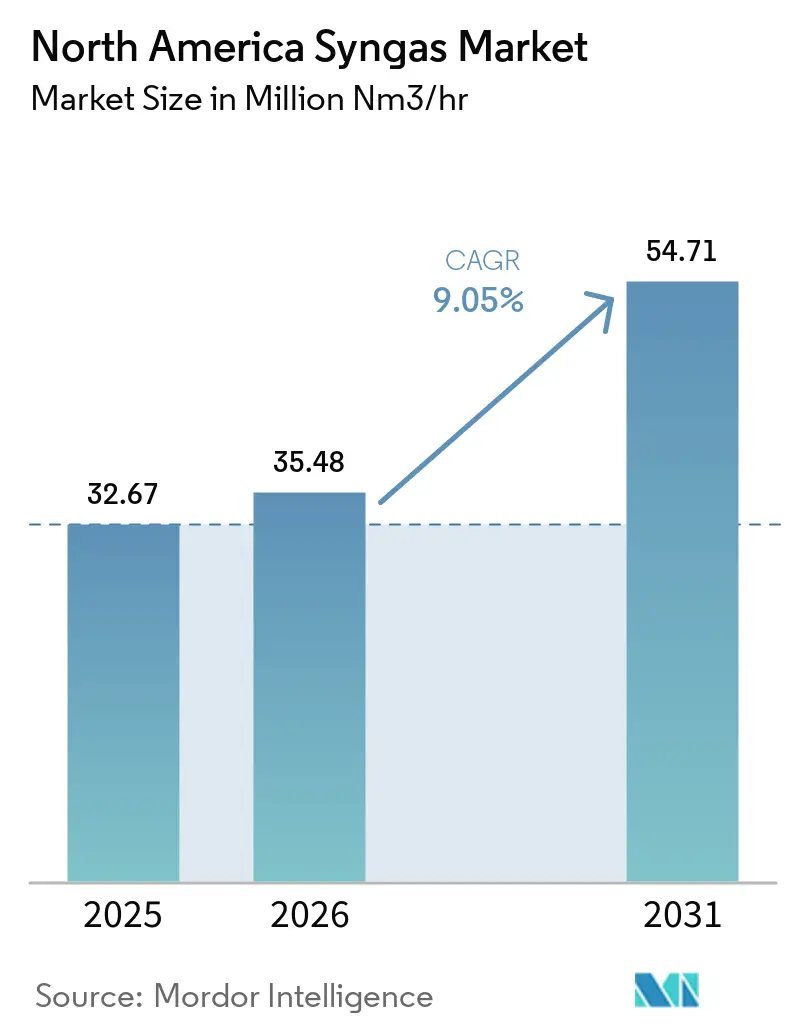
The North America Syngas Market size is expected to grow from 32.67 million metric normal cubic meters per hour (mm nm?/h) in 2025 to 35.48 million metric normal cubic meters per hour (mm nm?/h) in 2026 and is forecast to reach 54.71 million metric normal cubic meters per hour (mm nm?/h) by 2031 at 9.05% CAGR over 2026-2031. The North America syngas market has steam methane reforming and gasification capacity concentrated along the U.S. Gulf Coast. Low-cost shale gas, established industrial gas pipelines, and large petrochemical sites support producer operations. The U.S. Department of Energy’s USD 7 billion Regional Clean Hydrogen Hubs program allocates capital to hydrogen infrastructure, supporting demand for syngas-derived hydrogen. Project economics depend on securing offtake agreements, implementing carbon management solutions, and accessing existing industrial infrastructure. These conditions support developments that use proven technologies and connect with established customers.
Key Report Takeaways
- By feedstock, natural gas accounted for 58.23% of the North America syngas market share in 2025 and is forecast to grow at a CAGR of 10.12% through 2031.
- By technology, gasification accounted for 38.17% of the North America syngas market size in 2025 and is forecast to expand at a CAGR of 9.83% through 2031.
- By gasifier type, fluidized bed gasifiers led with 41.54% market share in 2025, while entrained flow gasifiers are forecast to record the highest CAGR of 10.47% through 2031.
- By application, methanol captured 34.26% market share in 2025, while hydrogen is forecast to advance at a CAGR of 11.21% through 2031.
- By geography, the United States held 72.69% of regional demand in 2025 and is forecast to register the highest CAGR of 10.43% through 2031.
Note: Market size and forecast figures in this report are generated using 黑料不打烊’s proprietary estimation framework, updated with the latest available data and insights as of January 2026.
Market Trends and Insights
Drivers Impact Analysis of North America Syngas Market*
| Drivers | (~) % Impact on CAGR Forecast | Geographic Relevance | Impact Timeline |
|---|---|---|---|
| Expanding Clean-Hydrogen Hub Investment | +2.6% | U.S. Gulf Coast, Appalachian Basin, Pacific Northwest | Medium term (2-4 years) |
| Rising Methanol and Ammonia Demand | +2.1% | U.S. Gulf Coast, Canadian Prairies | Medium term (2-4 years) |
| Feedstock Flexibility and Natural-Gas Availability | +1.8% | U.S. Permian, Marcellus, Haynesville, Western Canada Sedimentary Basin | Short term (≤ 2 years) |
| Carbon-Capture-Ready Reforming and Gasification Projects | +1.5% | U.S. Gulf Coast, Alberta | Long term (≥ 4 years) |
| Existing Gulf Coast Syngas Infrastructure Reuse | +0.9% | Texas and Louisiana industrial corridor | Medium term (2-4 years) |
| Source: 黑料不打烊 | |||
Expanding Clean-Hydrogen Hub Investment
The U.S. Department of Energy's USD 7 billion H2Hubs program supports the North American syngas market by connecting producers, buyers, and infrastructure providers through regional networks. Shared infrastructure and coordinated offtake agreements can improve financing conditions for adjacent steam methane reforming and gasification assets. The Gulf Coast and Mid-Atlantic corridors are linked to hydrogen, methanol, and ammonia value chains that use synthesis gas. The Appalachian hub retains federal support in 2026, although individual projects have faced schedule changes. Hub participation can attract private capital by providing access to customers, transportation infrastructure, and project partners. The opportunity is most relevant where developers can combine hub-related demand with existing natural gas and carbon dioxide infrastructure.
Rising Methanol and Ammonia Demand
Methanol and ammonia are major end-use applications of syngas in the North American syngas market, and both products are linked to maritime fuel and export demand. Johnson Matthey reported that global methanol demand was expected to grow by nearly 3.5% annually, supported in part by orders for dual-fuel vessels and by shipping decarbonization requirements[1]. Methanex completed its USD 2.05 billion acquisition of OCI Global's methanol business in June 2025, adding facilities in Beaumont, Texas, with a combined capacity of nearly 3.7 million tons per year. Linde committed more than USD 400 million to air separation infrastructure for the Blue Point low-carbon ammonia project in Louisiana in 2025. These investments support Texas and Louisiana as locations where natural gas supply, industrial customers, and export facilities converge. They also increase demand for syngas supply and low-carbon product credentials.
Feedstock Flexibility and Natural-Gas Availability
Natural gas remains the leading feedstock in the North American syngas market, supported by supply basins and processing networks across the United States and Canada. U.S. Department of Energy-funded research on gas-switching reforming estimated hydrogen production costs of USD 1.61-1.64 per kilogram while enabling higher carbon dioxide capture rates than reference steam methane reforming cases. This pathway enables natural gas-based production while plants pursue lower-carbon output. Gulf Coast operators can also combine natural gas with petroleum coke in certain gasification applications, reducing dependence on a single commodity input. Multi-feedstock systems can process natural gas, petroleum coke, coal, biomass, or waste streams when the required equipment and cleanup systems are available. This flexibility applies in refinery regions, where locally available petroleum coke can support the economics of integrated sites.
Carbon-Capture-Ready Reforming and Gasification Projects
Autothermal reforming with carbon capture is influencing the design of large-scale projects in the North American syngas market. The 45Q tax credit can provide up to USD 85 per ton of carbon dioxide captured and permanently stored by industrial facilities, supporting carbon-managed production. The National Energy Technology Laboratory identified autothermal reforming with up to 95% carbon dioxide capture as a pathway considered during its 2024 gasification workshop. Topsoe was selected in May 2026 to supply its SynCOR technology for the Sandpiper Chemicals blue methanol project in Texas City, Texas, which targets production of 3,000 tons per day beginning in 2030. Integrating reforming, carbon capture, and downstream synthesis into a single licensed package can reduce interface risks for developers. Storage permitting remains a factor, as delays in access to carbon dioxide sequestration capacity can postpone technically mature projects.
Restraints Impact Analysis of North America Syngas Market*
| Restraints | (~) % Impact on CAGR Forecast | Geographic Relevance | Impact Timeline |
|---|---|---|---|
| High Capital Intensity and Project-Finance Complexity | -1.8% | U.S. Gulf Coast, Canada | Medium term (2-4 years) |
| Permitting and Interconnection Delays | -1.2% | U.S. state-level markets, Texas, Louisiana, and the Appalachian region | Medium term (2-4 years) |
| Carbon-Management and Hydrogen-Policy Uncertainty | -1.0% | United States, with spillover to Canada | Short term (≤ 2 years) |
| Source: 黑料不打烊 | |||
High Capital Intensity and Project-Finance Complexity
Large syngas facilities require significant capital investment, secured offtake agreements, technology performance guarantees, and, for low-carbon configurations, access to carbon dioxide storage. Methanol and hydrogen projects based on steam methane reforming or autothermal reforming can require USD 2 billion to USD 9 billion in committed capital. In June 2026, Air Products discontinued its Louisiana Clean Energy Complex and recorded a USD 2.9 billion pre-tax charge. The decision reflects the impact of project returns and execution risks on large-scale developments, despite scale and policy support. Procuring large autothermal reformers and acid-gas removal units can require two to three years, limiting developers’ ability to recover from missed financing windows. Projects with committed customers and integrated assets have a clearer path to final investment decisions than developments that rely on multiple uncommitted counterparties.
Permitting and Interconnection Delays
Permitting and interconnection timelines can delay the addition of new syngas capacity, even when feedstock availability and customer demand are sufficient. Developers must coordinate air permits, site approvals, pipeline connections, power access, and, where applicable, permits for carbon dioxide transport and storage. The North America syngas market faces these constraints in industrial corridors with significant planned low-carbon development. The National Academies noted that carbon dioxide utilization and management infrastructure requires coordinated planning across capture sites, transport systems, and end uses[2]. Permit delays can increase costs by extending engineering and equipment commitments before projects generate revenue. Brownfield sites and established industrial parks can support shorter development cycles for applicable projects.
*Our forecasts treat driver/restraint impacts as directional, not additive. The impact forecasts reflect baseline growth, mix effects, and variable interactions.
North America Syngas Market Segment Analysis
By Feedstock:
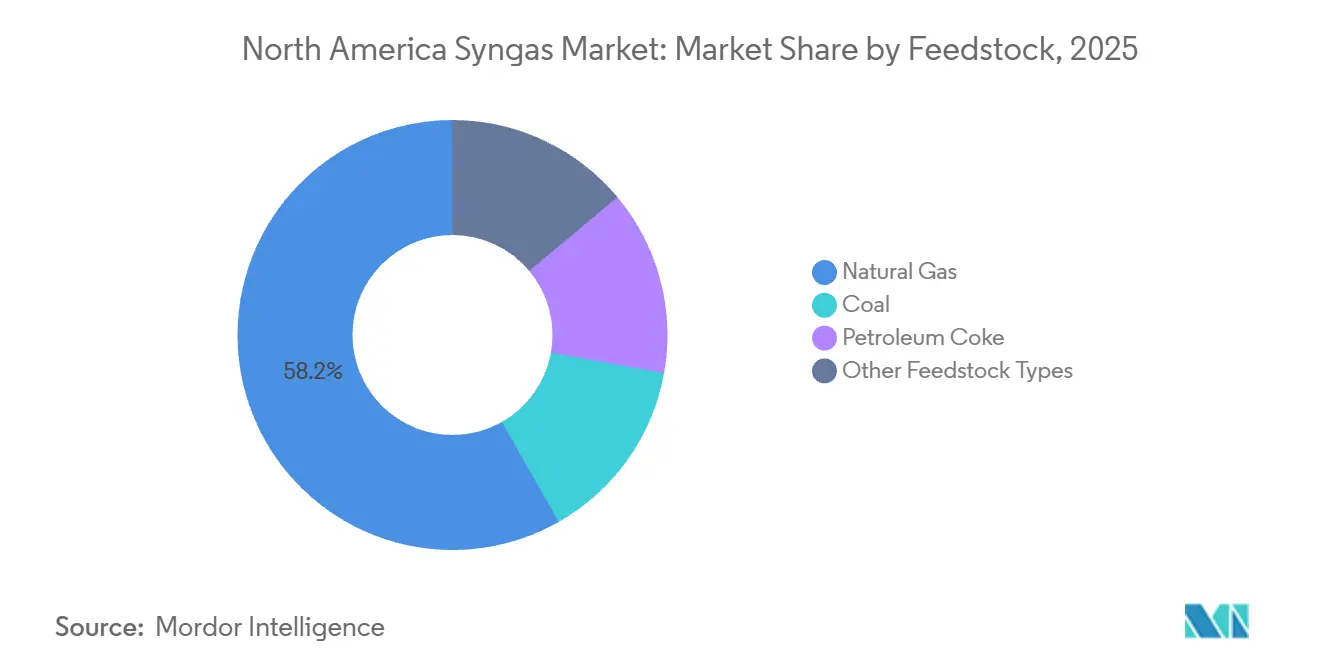
Natural Gas Supports Existing Capacity and Circular Inputs Gain AttentionNatural gas accounted for 58.23% of the North America syngas market in 2025 and is projected to expand at a CAGR of 10.12% through 2031. Supply from the Permian, Haynesville, and Marcellus basins supports the economics of steam methane reforming for methanol and hydrogen producers. The North America syngas industry also uses established gas processing and distribution infrastructure. Natural gas provides a flexible feedstock option, enabling operators to adjust blends with petroleum coke to manage operating costs and syngas composition. Petroleum coke remains suitable for entrained-flow systems because Gulf Coast refineries provide a local supply. Coal holds a smaller share, including at the Great Plains Synfuels Plant in North Dakota, which the National Energy Technology Laboratory identifies as the country’s only coal-to-synthetic-natural-gas facility.
Other feedstocks are gaining relevance as companies explore the circular use of chemical byproduct streams. In 2024, BASF was selected to negotiate USD 75 million in U.S. Department of Energy funding for a project in Freeport, Texas, to convert recycled liquid chemical byproducts into lower-carbon syngas using plasma gasification and renewable power. BASF stated that the project targets up to a 90% reduction in carbon dioxide emissions compared with existing natural gas incineration. Such projects can convert residual streams into usable feedstocks at large chemical sites. Lifecycle assessment standards, including ISO 14040, are becoming relevant as buyers assess the carbon intensity of methanol and ammonia. These criteria may increase the appeal of feedstocks that reduce waste and support lower-emissions product claims.

By Technology:
Gasification Leads While Autothermal Reforming ExpandsGasification accounted for 38.17% of the North America syngas market in 2025 and is projected to grow at a CAGR of 9.83% through 2031. The technology can process a wide range of feedstocks, including petroleum coke, coal, biomass, and waste streams. This flexibility supports producers seeking to adjust feedstock selection based on local availability and cost conditions. Gasification can also integrate with carbon capture systems for projects targeting lower carbon emissions. The North America syngas industry continues to use steam reforming in large methanol and hydrogen complexes, where operating experience and installed equipment remain important. Gasification maintains an advantage in projects requiring broader feedstock flexibility or high-purity synthesis gas.
Autothermal reforming is used in world-scale facilities that combine hydrogen or methanol production with carbon capture. The National Energy Technology Laboratory’s 2024 workshop identified autothermal reforming with up to 95% carbon dioxide capture as a priority pathway. Topsoe’s SynCOR platform was selected for the Sandpiper Chemicals Texas City project, which is in the front-end engineering and design stage and targets startup in 2030. Steam reforming remains relevant in Canada, where blue hydrogen projects can use natural gas from the Western Canada Sedimentary Basin and access available clean hydrogen incentives. Other production technologies include partial oxidation, biomass reforming, and plasma-assisted gasification. Although these technologies currently have a limited combined role, demonstration projects may expand their commercial application.
By Gasifier Type:
Fluidized Bed Capacity Leads and Entrained Flow Grows FasterFluidized-bed gasifiers accounted for 41.54% of regional capacity in 2025, reflecting their established use with coal, petroleum coke, biomass, and mixed-waste feedstocks. Their modular configuration can support incremental capacity additions at industrial sites. Entrained-flow gasifiers are projected to grow at a CAGR of 10.47% through 2031. These units operate at high temperatures and pressures, producing synthesis gas for methanol and hydrogen applications. They also provide a hydrogen-to-carbon monoxide ratio suited to these applications and lower methane slip. Fixed-bed systems remain operational but are projected to experience more limited growth, as new projects prioritize designs with integrated carbon capture.
Research published in Fuel in 2026 found that swirl optimization in pressurized entrained-flow gasifiers can increase char conversion to 99.9% under modeled conditions. Higher conversion can improve syngas yield per unit of feedstock and support the economics of large-scale units. Cerilon GTL ND signed a technology licensing agreement with Topsoe and Sasol in June 2026 for its planned gas-to-liquids facility in Williams County, North Dakota. The project combines Topsoe’s synthesis gas technology with Sasol’s low-temperature Fischer-Tropsch technology. Digital performance tools can improve control over complex gasifier operations, supporting the use of process data to improve conversion, reliability, and output quality.
By Application:
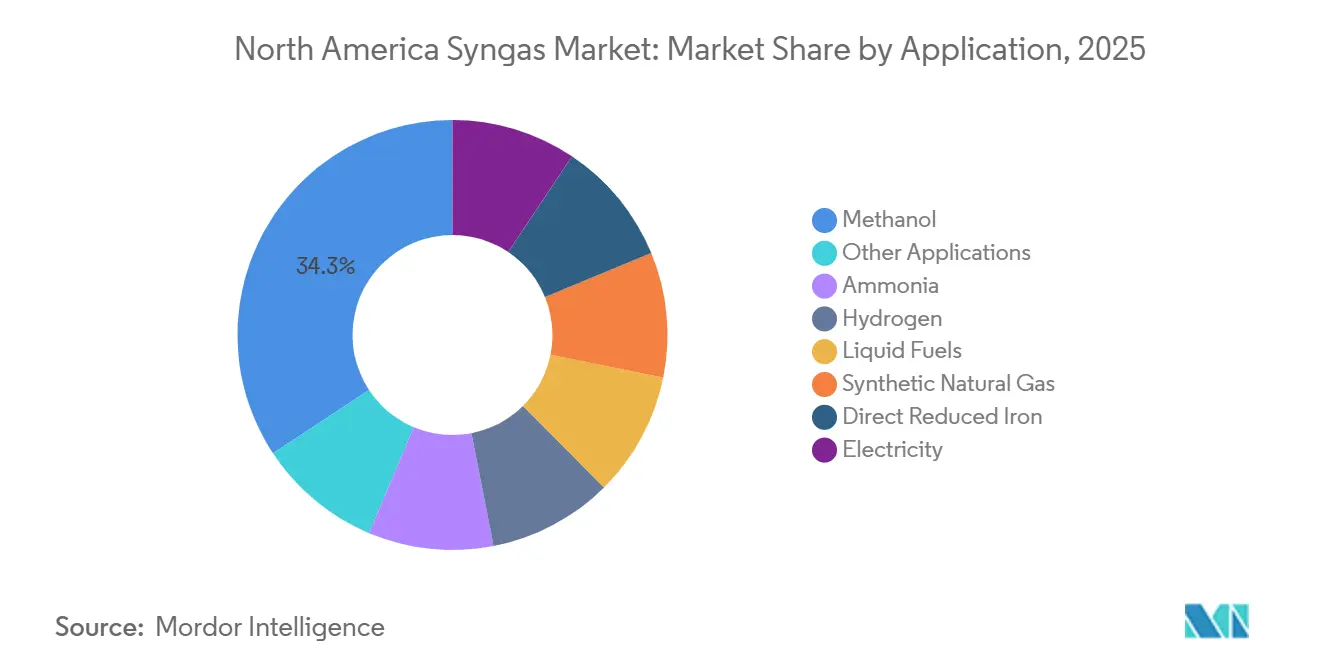
Methanol Is the Largest Outlet, and Hydrogen Has the Fastest GrowthMethanol accounted for 34.26% of syngas consumption in 2025, making it the largest application in the North America syngas market. The region’s methanol facilities benefit from shale gas availability and access to Gulf Coast export infrastructure. Shipping demand may supplement chemical-sector consumption as operators order vessels capable of using methanol fuel. INEOS Acetyls and Sandpiper Chemicals announced their USD 1.7 billion low-carbon methanol project in Texas City in April 2026. The project entered the front-end engineering and design stage in the second quarter of 2026, with a final investment decision targeted for 2027 and initial production anticipated in 2030. These developments indicate that export-oriented producers increasingly consider low-carbon product certification.
Hydrogen is projected to grow at a CAGR of 11.21% through 2031, representing the fastest growth rate among applications. U.S. refinery hydrotreating provides an established demand base, while low-carbon projects can add new volumes. Ammonia also benefits from fertilizer demand and planned exports to Asian and European buyers. Linde’s Blue Point commitment illustrates the relationship between large air separation systems, ammonia production, and syngas-derived hydrogen. Liquid fuels, synthetic natural gas, direct reduced iron, power generation, and specialty chemicals represent additional application areas. Their growth potential will depend on project economics, policy support, and the availability of low-carbon inputs.
Geography Analysis
Gulf Coast and North Dakota Syngas Market
The United States held a 72.69% share of the North American syngas market in 2025 and is projected to record the highest CAGR of 10.43% through 2031. Texas and Louisiana offer access to natural gas, large chemical sites, deep-water terminals, and industrial gas networks. These factors position the Gulf Coast as a key investment location for methanol, hydrogen, and ammonia production. Air Liquide's 2026 Bay City decision indicates how existing industrial parks can support additional syngas capacity. The Cerilon project in North Dakota also indicates that natural gas resources can support projects outside the Gulf Coast. The United States combines operating assets with locations for carbon-managed production.
Canada Syngas Market
Canada is the region's second-largest country, with a market profile shaped by its clean hydrogen strategy and resource base. The federal Clean Hydrogen Investment Tax Credit provides refundable support ranging from 15% to 40%, based on the lifecycle carbon intensity of eligible projects. Natural gas from the Western Canada Sedimentary Basin supports blue hydrogen pathways, while hydropower supports renewable hydrogen production. Hubs in Edmonton, Vancouver, and Southern Ontario serve different industrial and energy applications. Linde's long-term supply agreement for Dow's Path2Zero project in Fort Saskatchewan includes an autothermal reforming complex and cracker off-gas recovery. Fiscal support and diversified resources may support geographically distributed development compared with the United States.
Mexico Syngas Market
Mexico holds the smallest share of the North American syngas market and faces feedstock constraints. The country relies heavily on imported natural gas, limiting domestic projects' ability to secure stable feedstock supplies. The proposed 2026-2030 Petrochemical and Fertilizer Reactivation Plan targets the rehabilitation of PEMEX facilities, including assets in the ammonia-urea value chain. If rehabilitation and supply arrangements proceed, the initiative could generate additional demand for synthesis gas. Trade discussions under the United States-Mexico-Canada Agreement may also affect the flow of chemicals and feedstocks across the region. Mexico's role will depend on whether infrastructure improvements and domestic natural gas availability keep pace with planned petrochemical investments.
Competitive Landscape
The North America syngas market is fragmented. Topsoe, KBR, Johnson Matthey, Technip Energies, and MAIRE compete in technology licensing. Producers compete through long-term supply agreements, while licensors differentiate through process design, catalysts, engineering packages, and performance guarantees. Carbon capture integration and autothermal reforming capabilities are key differentiators. Companies that combine these elements into an integrated project package can reduce execution risk for developers.
Air Liquide's final investment decision for a new syngas unit at OQ Chemicals' Bay City site indicates how producers use established industrial locations to expand supply. Topsoe's selection for the Sandpiper Texas City blue methanol project reflects the role of technology suppliers in large-scale carbon-managed developments. Linde's agreement to supply industrial gases for the Blue Point low-carbon ammonia facility indicates the role of air separation capacity in the project value chain. These initiatives combine asset ownership, access to technology, and downstream exposure. Their commercial viability depends on competitive feedstock costs and reliable customer demand.
Smaller and newer participants pursue modular systems, circular feedstocks, and specialized equipment. The partnership among Topsoe, Synergen Green Energy, and Shaw Group to develop modular green ammonia facilities in Texas offers an alternative to large, single-train plants. BASF's Freeport plasma gasification project assesses whether chemical byproduct streams can serve as an in-house, lower-carbon source of syngas. Regulatory compliance and access to established industrial sites also affect project timelines.
North America Syngas Industry Leaders
-
Air Products and Chemicals, Inc.
-
Linde PLC
-
Air Liquide
-
Methanex Corporation
-
Shell plc
- *Disclaimer: Major Players sorted in no particular order
North America Syngas Market Companies Covered in this Report
- Air Liquide
- Air Products and Chemicals, Inc.
- BASF
- Honeywell International Inc.
- Johnson Matthey
- KBR, Inc.
- Linde PLC
- MAIRE S.p.A.
- Methanex Corporation
- Sasol
- Shell plc
- Siemens Energy
- Technip Energies N.V.
- thyssenkrupp AG
- Topsoe
Recent Industry Developments in North America Syngas Market
- July 2026: Air Liquide and OQ Chemicals confirmed a final investment decision for a purpose-built syngas unit in Bay City, Texas. Site preparation began in Q3 2026, with project completion expected by the end of 2028. The unit will use CO? recirculation to reduce net site emissions and expand capacity for the production of propionaldehyde, propanol, and butanol.
- June 2026: Cerilon GTL ND Inc. signed a definitive technology licensing agreement with Topsoe and Sasol for hydrogen production, gas reforming, and Fischer-Tropsch conversion at its planned gas-to-liquids facility in Williams County, North Dakota. The facility will combine Topsoe’s SynCOR syngas technology with Sasol’s low-temperature Fischer-Tropsch process.
North America Syngas Market Report Scope
Syngas is a fuel gas mixture primarily composed of hydrogen and carbon monoxide, with smaller quantities of carbon dioxide and methane. It serves as an intermediate feedstock for producing chemicals, fuels, and power.
The North America syngas market is segmented by feedstock, technology, gasifier type, application, and geography. By feedstock, the market is segmented into coal, natural gas, petroleum coke, and other feedstock types. By technology, the market is segmented into steam reforming, gasification, and other production technologies. By gasifier type, the market is segmented into fixed bed, fluidized bed, and entrained flow. By application, the market is segmented into methanol, ammonia, hydrogen, liquid fuels, synthetic natural gas, direct reduced iron, electricity, and other applications. The report also covers the market size and forecasts for syngas in 3 countries across the region. The market sizes and forecasts are provided in terms of Volume (MM Nm?/H).
Segmentation Overview
By Feedstock
| Coal |
| Natural Gas |
| Petroleum Coke |
| Other Feedstock Types |
By Technology
| Steam Reforming |
| Gasification |
| Other Production Technologies |
By Gasifier Type
| Fixed Bed |
| Fluidized Bed |
| Entrained Flow |
By Application
| Methanol |
| Ammonia |
| Hydrogen |
| Liquid Fuels |
| Synthetic Natural Gas |
| Direct Reduced Iron |
| Electricity |
| Other Applications |
By Geography
| United States |
| Canada |
| Mexico |
| By Feedstock | Coal |
| Natural Gas | |
| Petroleum Coke | |
| Other Feedstock Types | |
| By Technology | Steam Reforming |
| Gasification | |
| Other Production Technologies | |
| By Gasifier Type | Fixed Bed |
| Fluidized Bed | |
| Entrained Flow | |
| By Application | Methanol |
| Ammonia | |
| Hydrogen | |
| Liquid Fuels | |
| Synthetic Natural Gas | |
| Direct Reduced Iron | |
| Electricity | |
| Other Applications | |
| By Geography | United States |
| Canada | |
| Mexico |
Key Questions Answered in the Report
What is current market size of North America Syngas Market?
The North America Syngas Market size is expected to grow from 32.67 million metric normal cubic meters per hour (mm nm?/h) in 2025 to 35.48 million metric normal cubic meters per hour (mm nm?/h) in 2026 and is forecast to reach 54.71 million metric normal cubic meters per hour (mm nm?/h) by 2031 at 9.05% CAGR over 2026-2031.
Which feedstock leads syngas production in North America?
Natural gas led with a 58.23% share in 2025 and is projected to grow at a 10.12% CAGR through 2031.
Which application uses the most syngas in North America?
Methanol was the largest application, accounting for 34.26% of consumption in 2025.
Which type of gasifier is expected to grow the fastest?
Entrained-flow gasifiers are expected to grow at a CAGR of 10.47% through 2031 because they can provide high-purity syngas for downstream synthesis.