
Liquid Egg Market Size and Share
Market Overview
| Study Period | 2021 - 2031 |
|---|---|
| Market Size (2026) | USD 3.22 Billion |
| Market Size (2031) | USD 4.16 Billion |
| Growth Rate (2026 - 2031) | 5.26 % |
| Fastest Growing Market | Asia Pacific |
| Largest Market | North America |
| Market Concentration | Medium |
Major Players *Disclaimer: Major Players sorted in no particular order Image ? 黑料不打烊. Reuse requires attribution under CC BY 4.0. | |
Liquid Egg Market Analysis by 黑料不打烊
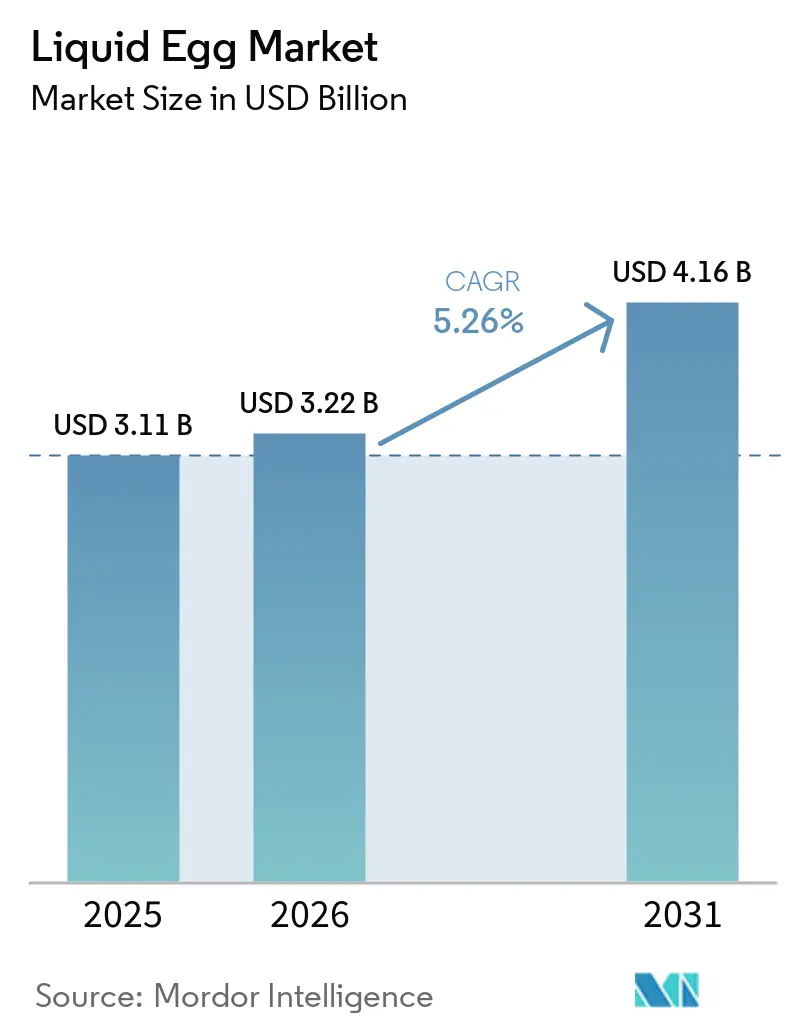
The liquid egg market size was valued at USD 3.11 billion in 2025 and is estimated to grow from USD 3.22 billion in 2026 to reach USD 4.16 billion by 2031, at a CAGR of 5.26% during the forecast period (2026-2031). Demand is shifting toward pre-cracked and pasteurized formats because commercial kitchens and food processors need faster, more consistent preparation. These formats reduce shell handling, support standardized recipes, and fit automated dosing systems used by larger buyers. Food safety rules also support pasteurized egg products in regulated foodservice and industrial settings, particularly where traceability and validated processes are required. Expansion in cold-chain networks and central kitchens is widening the addressable customer base in developing economies. The liquid egg market also faces input-cost exposure when avian influenza disrupts laying flocks, although contracted supply arrangements can give large buyers more predictable access to product. Buyers increasingly evaluate liquid egg suppliers on their capacity to maintain quality and delivery during periods of raw material disruption. This places greater value on integrated sourcing, processing flexibility, and carefully managed customer contracts. In the liquid egg market, these capabilities can be as important as the stated product price because they shape the buyer's exposure to disruption.
Key Report Takeaways
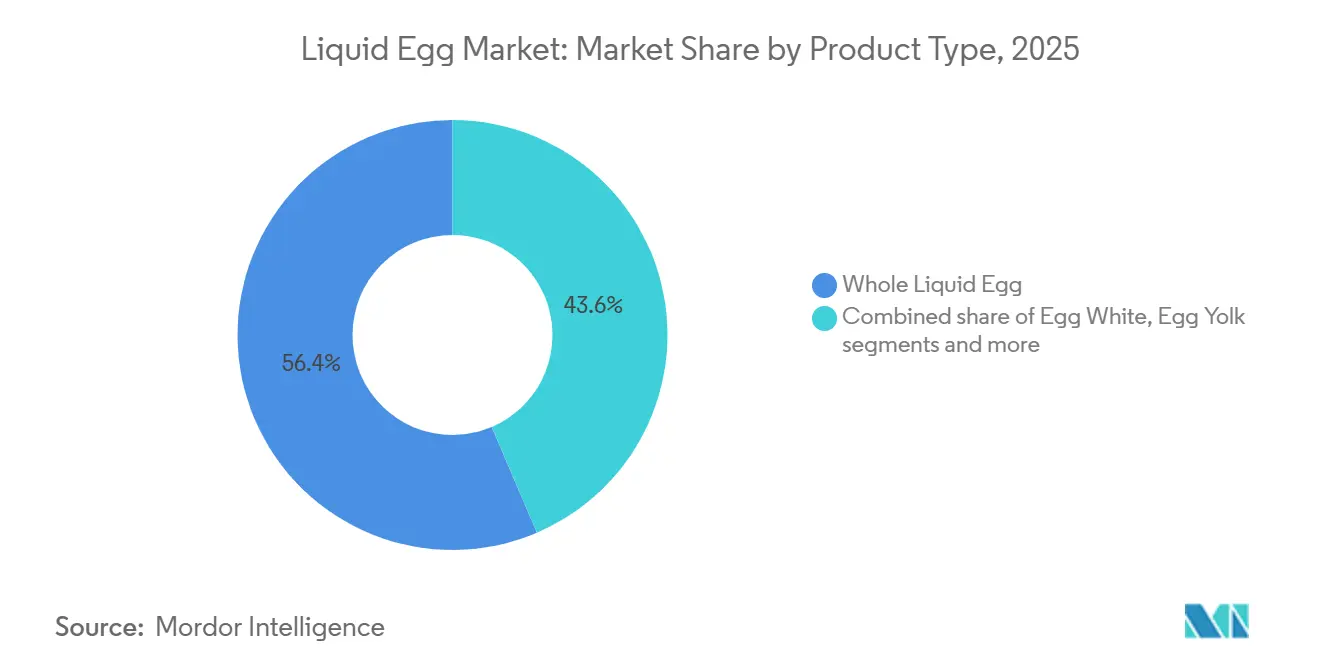
- By product type, whole liquid eggs held 56.42% of the liquid egg market share in 2025, while egg whites are forecast to grow at a 6.32% CAGR through 2031.
- By form, refrigerated liquid eggs held a 47.66% share in 2025, while ambient and shelf-stable formats are forecast to grow at a 7.05% CAGR through 2031.
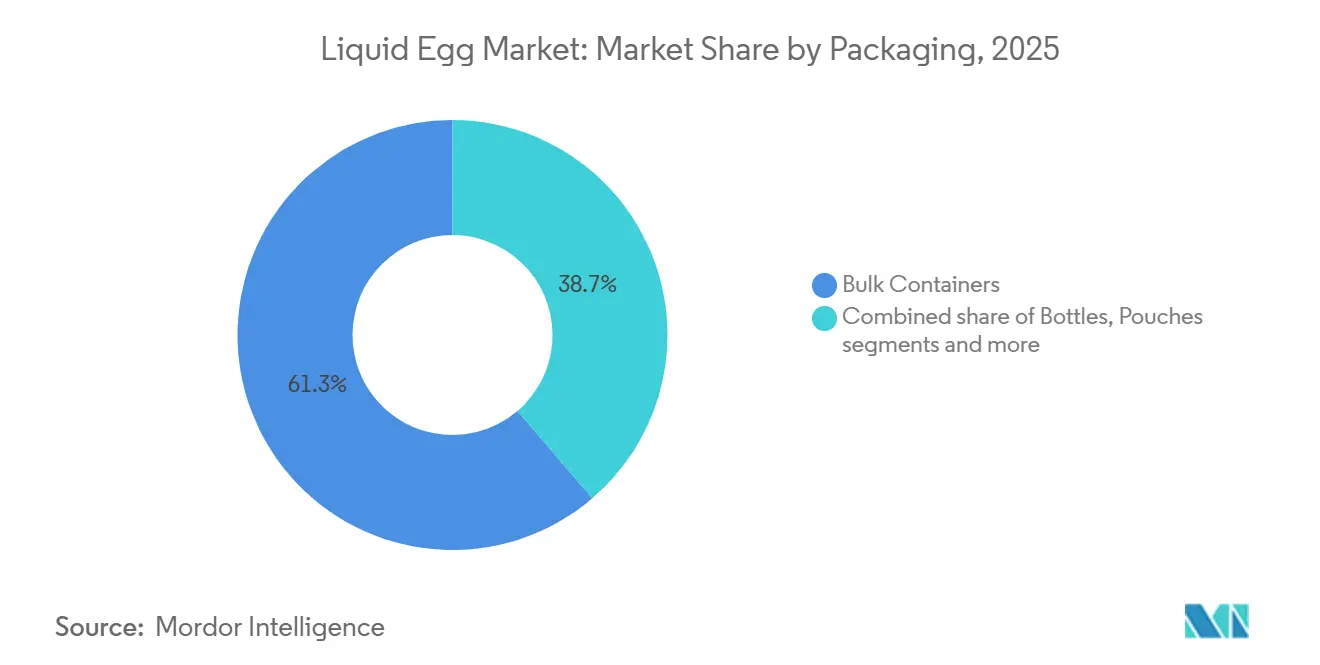
- By packaging, bulk containers accounted for a 61.27% share in 2025, while pouches are forecast to grow at a 7.11% CAGR through 2031.
- By distribution channel, industrial sales held a 51.27% share in 2025, while retail is forecast to grow at a 6.78% CAGR through 2031.
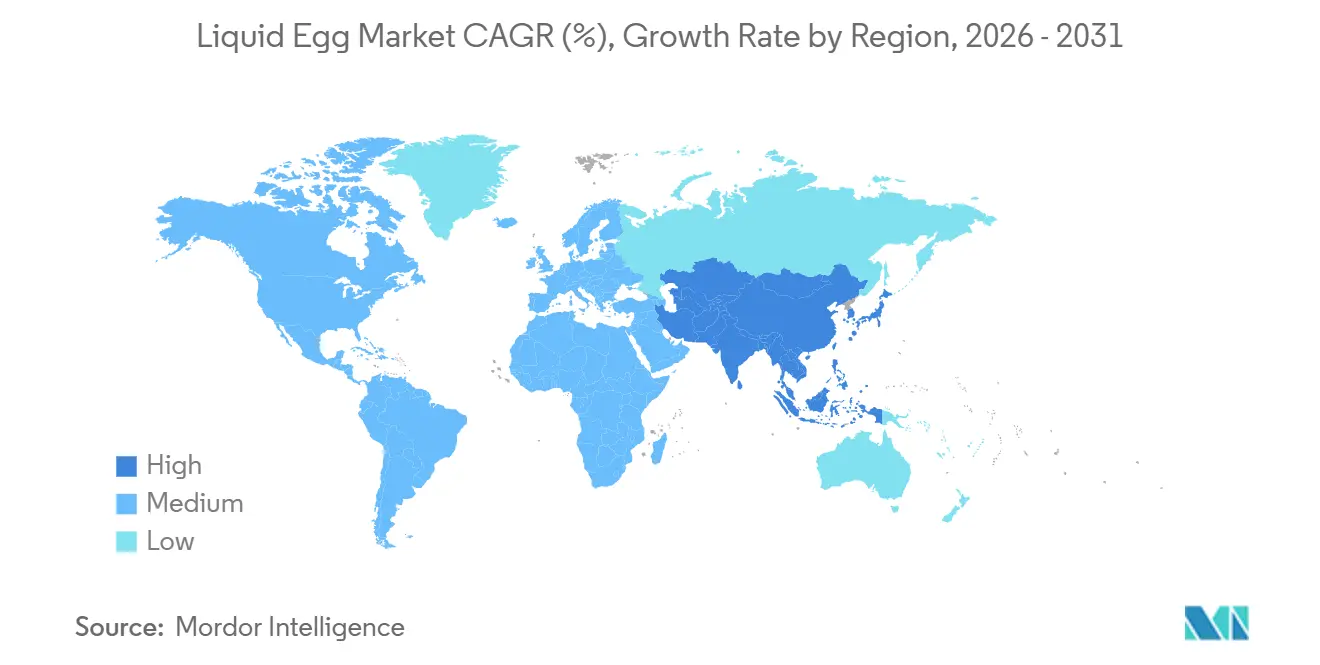
- By geography, North America held a 35.46% share in 2025, while Asia-Pacific is forecast to grow at a 7.23% CAGR through 2031.
Note: Market size and forecast figures in this report are generated using 黑料不打烊’s proprietary estimation framework, updated with the latest available data and insights as of January 2026.
Market Trends and Insights
Drivers Impact Analysis of Liquid Egg Market*
| Driver | (~) % Impact on CAGR Forecast | Geographic Relevance | Impact Timeline |
|---|---|---|---|
| Rising Convenience Demand from Foodservice and Industrial Baking | +1.5% | Global, led by North America and Europe, with rising adoption in Asia-Pacific | Medium term (2-4 years) |
| Food Safety Regulations Supporting Pasteurized Liquid Eggs | +0.9% | North America, Europe, China, and India | Short term (≤ 2 years) |
| High-Protein Diet Adoption | +0.8% | Global, concentrated in North America and urban Asia-Pacific | Medium term (2-4 years) |
| Ready-to-Cook and Processed Food Applications | +0.6% | Global, strongest in South and Southeast Asia | Medium term (2-4 years) |
| Demand for Ethically Sourced and Cage-Free Eggs | +0.4% | North America, Europe, and early-stage Asia-Pacific | Long term (≥ 4 years) |
| Product Formulation and Packaging Innovation | +0.6% | Global, particularly retail and foodservice markets | Medium term (2-4 years) |
| Source: 黑料不打烊 | |||
Rising Convenience-Driven Demand from Foodservice and Industrial Baking
Commercial kitchens are increasingly using liquid eggs because they remove routine shell-cracking work from food preparation. The format also lowers the handling steps that can introduce cross-contamination in high-volume operations. Industrial bakers use liquid eggs to manage ingredient dosing and maintain stable recipe performance across large production runs. The supplied research noted that liquid egg solids generally range from 24% to 26%, which supports accurate formulation. U.S. industrial baking operations used the equivalent of 2.185 billion dozen shell eggs during the first 11 months of 2025 for ingredient demand. As kitchen labor costs rise, labor savings and lower breakage can narrow the cost difference between liquid and shell eggs. Liquid ingredients can also make staff training easier because employees do not need to handle shell separation at the point of preparation. The operational case is strongest in settings that prepare the same products repeatedly across many locations.
Increasing Food-Safety Regulations Supporting the Adoption of Pasteurized Liquid Eggs
Food safety requirements create a clear basis for pasteurized egg product demand in the liquid egg market. The Egg Products Inspection Act requires continuous U.S. Department of Agriculture inspection of egg-product processing and requires distributed egg products to be pasteurized[1]. The U.S. Food Safety and Inspection Service issued a new HACCP model for pasteurized liquid egg products in June 2025. This guidance gives establishments a more defined framework for meeting federal process-control expectations. It can support entry by processors that have the equipment and documentation needed to validate their systems. Export-oriented processors in India and Southeast Asia are also aligning operations with ISO 22000 requirements as they pursue institutional customers in Europe and the Gulf. Producers that meet these requirements can use documented controls as part of their customer qualification process. The compliance burden is therefore a constraint for less prepared facilities but a differentiator for validated processors. In the liquid egg market, documented controls can also make customer audits and ongoing supplier approval more manageable.
Growing Adoption of High-Protein Diets Among Fitness-Conscious Consumers
Egg whites are positioned for demand from shoppers and food manufacturers that prioritize protein content. Liquid formats offer foodservice operators and meal-preparation businesses a convenient way to add egg white to recipes. The supplied research identified egg whites as the fastest-growing product type through 2031. Their low-fat profile can suit meals designed around protein-focused eating patterns. This demand is relevant to retail cartons as well as foodservice packs used by meal-preparation companies. It also increases the importance of supply reliability and clear product specifications for buyers of liquid egg whites.
Product Formulation and Packaging Innovations
Packaging innovation is helping liquid egg suppliers reach customers beyond bulk industrial use. Resealable side-spout pouches developed for Sunny Queen used ultrasonic cold-sealing technology to provide a sealed retail format. Sealed Air states that its flexible packaging for liquid food can extend refrigerated shelf life by 1 to 20 weeks compared with rigid containers, depending on the application. Galdi offers gable-top packaging equipment for liquid egg products at speeds of up to 14,000 cartons per hour. These formats can improve portion control and retail presentation while giving processors more options for foodservice sizes. Product development therefore supports a wider mix of refrigerated, ambient, and flexible-pack formats in the liquid egg market. It allows manufacturers in the liquid egg market to match pack design to the way customers store, dose, and use the ingredient. Suppliers can also use packaging choice to serve both professional kitchens and household buyers without changing the basic product proposition.
Restraints Impact Analysis of Liquid Egg Market*
| Restraint | (~) % Impact on CAGR Forecast | Geographic Relevance | Impact Timeline |
|---|---|---|---|
| Volatility in Raw Egg and Poultry Prices | -0.7% | Global, most acute in North America and Europe | Medium term (2-4 years) |
| Competition from Plant-Based Egg Alternatives | -0.4% | North America, Western Europe, and premium Asia-Pacific urban markets | Medium term (2-4 years) |
| Inadequate Cold-Chain Infrastructure | -0.3% | Asia-Pacific, Middle East and Africa, and parts of South America | Medium term (2-4 years) |
| Consumer Concerns About Processed Food Products | -0.2% | North America, Western Europe, and premium Asia-Pacific urban markets | Long term (≥ 4 years) |
| Source: 黑料不打烊 | |||
Volatility in Raw Egg and Poultry Prices
Raw egg availability remains the most direct operating risk for liquid egg processors. U.S. retail egg prices reached USD 6.23 per dozen in March 2025 and fell to USD 2.50 per dozen in February 2026[2]. This movement shows how quickly input costs can change when avian influenza affects laying flocks. The Congressional Research Service found that outbreaks were associated with higher egg prices and that egg-type laying hens made up a large share of affected birds[3]. Processors with fixed-price supply agreements can face pressure when their raw egg costs rise faster than contract prices. Cage-free conversion requirements may also raise the baseline cost of supply for buyers that need certified inputs. These cost movements are hard to manage when customers operate with fixed menu prices or annual procurement budgets. They make active price-management provisions more important in liquid egg market commercial supply arrangements.
Increasing Competition from Plant-Based Egg Alternatives
Plant-based and fermentation-derived ingredients compete most directly in reformulation-led applications. The pressure is greater in premium products where buyers value functional claims, protein content, or animal-free positioning. Conventional liquid egg suppliers still retain established demand in applications where egg functionality is difficult to replace. Alternative products can nevertheless compete for innovation budgets in egg white applications and retail convenience categories. This requires established processors to protect customer relationships through product quality, traceability, and dependable supply. It also limits the benefit of focusing only on commodity bulk formats as the liquid egg market develops. Value-added formats can help conventional processors retain relevance in applications that are open to reformulation. The competitive response depends on a clear understanding of which uses require traditional egg functionality and which can accept alternatives.
*Our forecasts treat driver/restraint impacts as directional, not additive. The impact forecasts reflect baseline growth, mix effects, and variable interactions.
Liquid Egg Market Segment Analysis
By Product Type:
Whole Liquid Eggs Hold the Broadest Application BaseWhole liquid eggs held 56.42% of liquid egg markett share in 2025. Their role in bakery, confectionery, pasta, and large foodservice operations supports this leading position. The product provides emulsifying, binding, and texturizing functions that are difficult to replace in many established recipes. This makes whole egg a practical choice for users who require a single ingredient with several processing roles. Food manufacturers also value its suitability for standardized, high-volume production. The product type has broad use across both industrial and foodservice demand. Its use across multiple recipe categories helps spread demand across different customer groups. It also gives processors a high-volume base from which to offer related white, yolk, and blended products.
Egg whites are forecast to expand at a 6.32% CAGR through 2031, making them the fastest-growing product type. The liquid egg market size for egg whites benefits from protein-focused food and beverage formulations. Egg yolk keeps a more specialized role in mayonnaise, hollandaise, and premium confectionery. Its fat-rich functional properties remain important in applications that need flavor and texture. Blends and scrambled mixes are gaining use in hospitals, schools, hotels, and other institutional kitchens. These ready-to-cook products can simplify preparation where staffing and kitchen consistency matter. They are particularly useful where a central buyer serves multiple sites with similar menus. The category provides processors with a route to move beyond basic ingredient supply into preparation-oriented solutions. This gives the liquid egg market a stronger connection to the needs of institutional kitchens that value simple preparation steps.

By Form:
Refrigerated Products Lead While Ambient Formats ExpandRefrigerated liquid eggs accounted for 47.66% of the liquid egg category in 2025. This form benefits from established refrigerated distribution networks in North America and Europe. It is familiar to food manufacturers and foodservice customers that already manage chilled ingredients. Refrigerated products also fit frequent delivery schedules for commercial kitchens and bakery plants. Their position reflects the operational maturity of cold-chain handling in these regions. The format remains central to industrial buyers that require dependable short-cycle supply. Producers serving this segment must manage temperature controls through processing, storage, and delivery. Reliable refrigerated distribution is therefore as important as the product specification for retaining these accounts.
Ambient and shelf-stable liquid eggs are forecast to grow at a 7.05% CAGR through 2031. These products can help suppliers reach retail and export markets where refrigerated transport is less consistent. Frozen liquid egg maintains a role in long-storage applications, seasonal demand planning, and export shipments. It can support industrial buyers that hold larger inventories and have access to freezing and tempering equipment. Ambient formats can reduce the need for refrigeration during storage and distribution. The form mix is therefore widening as suppliers serve markets with different logistics conditions. Suppliers can select a format based on the customer's storage capacity, delivery frequency, and expected rate of use. This flexibility is particularly relevant as the liquid egg market reaches new retail and export destinations. The liquid egg market can therefore grow through better fit with local storage and delivery conditions, rather than through a single format alone.
By Packaging:
Bulk Containers Retain Scale AdvantagesBulk containers captured 61.27% of packaging revenue in 2025. The format serves industrial and foodservice buyers that purchase liquid eggs in volumes ranging from 3 to 1,000 liters. Large bakeries use integrated filling and dosing systems designed for high-volume ingredient handling. These systems can create switching costs because packaging changes may require new handling procedures. Bulk packs also support lower unit packaging costs for customers with steady demand. This keeps bulk containers important to the core liquid egg market customer base. High-throughput users usually value handling efficiency over the convenience features found in consumer-sized packs. The segment remains closely tied to the scale of industrial baking and food manufacturing activity.
Pouches are projected to grow at a 7.11% CAGR through 2031. Resealable pouches can support smaller foodservice users and retail buyers that need manageable pack sizes. Flexible packaging can lower material use relative to some rigid formats. Cartons remain important in retail-facing chilled products because they offer a recognizable format and portion flexibility. Bottles serve mid-volume foodservice customers and markets where PET packaging is common. Aran Group offers bag-in-box systems for liquid eggs in 3 to 25 liter sizes, illustrating the range of flexible formats available to commercial users. These pack sizes can bridge the gap between small retail units and large industrial containers. They give commercial kitchens a practical option when demand is too variable for high-volume bulk purchasing.
By Distribution Channel:
Industrial Buyers Remain the Largest Customer GroupIndustrial distribution accounted for 51.27% of revenue in 2025. Food manufacturers buy liquid egg as a standardized input for bakery, confectionery, pasta, and other prepared food lines. Long-term supply agreements and established ingredient specifications reinforce this channel's position. Large processors value consistent solids content, traceability, and supply planning. The channel also relies on high-volume packs that fit automated production systems. These factors give industrial users a strong role in the liquid egg market. The channel's purchasing scale can support long production runs and predictable utilization for processors. It also makes the industrial buyer relationship central to capacity planning and raw material procurement.
Retail is forecast to grow at a 6.78% CAGR through 2031. Packaging improvements are helping suppliers offer formats that are more practical for household use. Foodservice and institutional demand remains significant across quick-service restaurants, healthcare catering, and hotels. These users often move from shell eggs to liquid formats to reduce preparation time and handling risks. The 2024 and 2025 avian influenza cycle showed the need for processors to manage price exposure in supply contracts. Retail growth can provide producers with another outlet, although it requires suitable branding, smaller packs, and effective distribution. This channel may carry different service expectations from industrial accounts, including shelf presentation and more frequent replenishment. Producers need to balance these requirements against the scale efficiencies of their core commercial business.
Geography Analysis
North America held 35.46% of the liquid egg category in 2025. The region has mature processing infrastructure and extensive integration between egg suppliers, food manufacturers, and foodservice businesses. Avian influenza disruptions also encourage institutional buyers to use contracted sourcing arrangements. South America offers further demand potential through bakery production and institutional catering, although uneven cold-chain coverage and economic conditions can slow adoption. Suppliers that can maintain product quality through varied distribution conditions may have a clearer path to serving these customers. The region's opportunity is therefore linked to both food demand and logistics investment. Suppliers in the liquid egg market must assess whether distribution conditions match the storage needs of the formats they intend to sell.
Europe is the second-largest regional cluster for liquid egg processing and consumption. Processing capacity is well developed in the Netherlands, France, Germany, and Belgium. Traceability and cage-free requirements make compliance capability an important part of supplier selection. Import demand can favor suppliers with reliable cross-border logistics and well-documented traceability. European buyers also place weight on sourcing credentials when selecting products for retail and foodservice channels.
Asia-Pacific is projected to grow at a 7.23% CAGR through 2031. The liquid egg market size in the region is supported by the expansion of central kitchens and quick-service restaurant chains. China's central kitchen model is increasing use of standardized pasteurized egg ingredients. India is also developing demand through urbanization, changing diets, and export-oriented food processing. Refrigeration gaps make shelf-stable formats especially relevant in parts of the region. Middle East and Africa demand remains largely import-led, while hospitality and institutional catering create opportunities for dependable suppliers. Regional customers may benefit from products with suitable shelf-life characteristics and stable delivery schedules. These needs make logistics capability a key consideration for companies seeking to build a position in the area.
Competitive Landscape
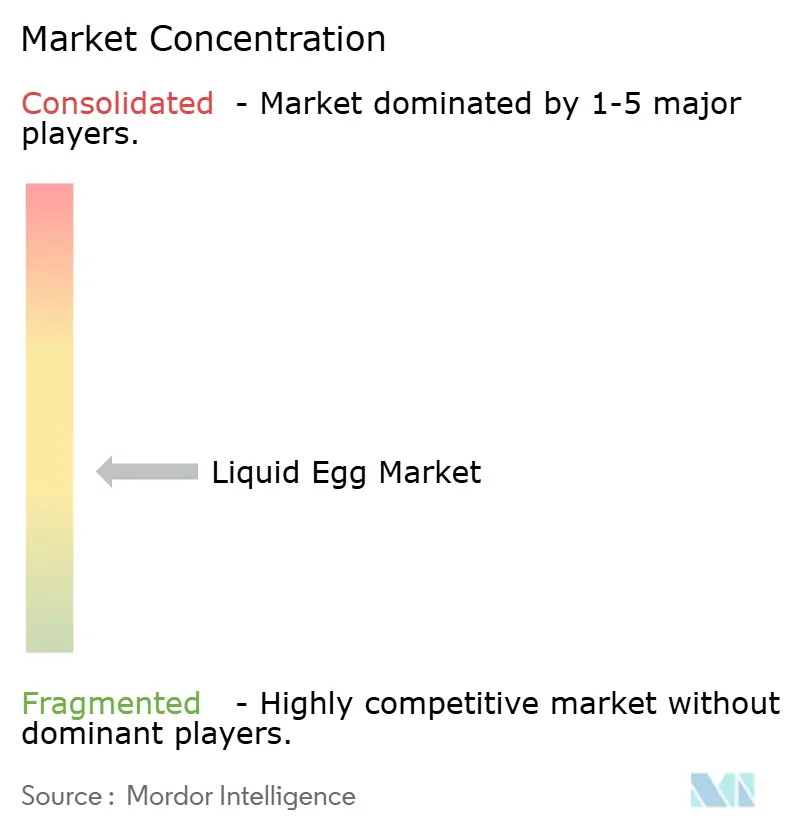
The liquid egg market is moderately fragmented, creating consolidation opportunities for regional and specialty players. Major processors pursue vertical integration to manage supply chains from production to distribution, while smaller companies target niche segments or regional markets where specialized products can command premium prices.
Companies use advanced pasteurization methods, including high-temperature, short-time processing and ultra-high-temperature treatment, as well as innovative packaging technologies such as aseptic and modified-atmosphere packaging, to gain market share by offering products with enhanced quality and extended shelf life. Companies are also expanding their geographic presence and product portfolios through strategic acquisitions and consolidation, targeting complementary businesses, distribution networks, and manufacturing capabilities to strengthen their market positions.
The market offers significant growth opportunities in emerging regions, where limited cold-chain infrastructure drives demand for shelf-stable products. In the premium segment, organic, cage-free, and specialty nutritional products offer manufacturers opportunities to achieve higher profit margins. These premium categories appeal to health-conscious consumers willing to pay more for products that align with their dietary preferences and values. Manufacturers that invest in differentiated product lines within these segments can capitalize on growing consumer demand for high-quality, specialized products.
Liquid Egg Industry Leaders
-
Igreca S.A.
-
Ovobest Eiprodukte GmbH & Co. KG
-
Cal-Maine Foods Inc.
-
Cargill Incorporated
-
Michael Foods Inc.
- *Disclaimer: Major Players sorted in no particular order
Liquid Egg Market Companies Covered in this Report
- Michael Foods Inc. (Post Holdings)
- Cargill Incorporated
- Cal-Maine Foods Inc.
- Rose Acre Farms Inc.
- Ovobest Eiprodukte GmbH & Co. KG
- Igreca S.A.
- Rembrandt Foods
- EggSolutions (Global Egg Corp)
- Noble Foods Ltd.
- Eurovo Srl
- DAVA Foods A/S
- Deb-El Food Products LLC
- Global Food Group BV
- MPS Egg Farms
- Eggway International Asia Pvt Ltd.
- Ready Egg Products Ltd.
- Newburg Egg Inc.
- Vital Farms Inc.
- The EVERY Company
- Fremont Farms of Iowa
Recent Industry Developments in Liquid Egg Market
- June 2026: St Ewe Free Range Eggs entered the liquid egg market with a new range developed specifically for professional kitchens and foodservice operators. The range comprises liquid whole egg, liquid egg white, and liquid egg yolk, all made from British free-range eggs and supplied in 1 kg ready-to-pour cartons.
- May 2026: Gruppo Eurovo launched Le Naturelle Albume d’Uovo, its first ambient liquid egg white, across Italy in 500 g Pure-Pak? Classic cartons supplied by Elopak. The product uses carton packaging as an alternative to conventional PET bottles and can be stored at room temperature for up to six months, providing greater convenience and shelf-life flexibility for consumers.
- May 2025: Sa-Nguan Farm introduced pasteurized cage-free liquid whole eggs in January 2025 and plans to release pasteurized cage-free liquid egg white and yolk products in mid-2025.
Global Liquid Egg Market Report Scope
Liquid egg refers to processed egg products in fluid form, produced from whole eggs, egg whites, egg yolks, or formulated egg blends and supplied in refrigerated, frozen, or shelf-stable formats. The Liquid Egg Market is segmented by product type, form, packaging, distribution channel, and geography. By product type, the market includes Whole Liquid Egg, Egg White, Egg Yolk, and Blends/Scrambled Mixes (with Milk, Salt, etc.). By form, the market is segmented into Refrigerated Liquid, Frozen Liquid, and Ambient/Shelf-stable. By packaging, the market is categorized into Cartons, Bottles, Pouches, and Bulk Containers. By distribution channel, the market is divided into Industrial, Foodservice, Institutional, and Retail. By geography, the report covers North America, South America, Europe, Asia-Pacific, and the Middle East and Africa, with market size and forecasts provided for each region. The market sizing has been done in value terms in USD for all the abovementioned segments.
Segmentation Overview
| Whole Liquid Egg |
| Egg White |
| Egg Yolk |
| Blends/Scrambled Mixes (with Milk, Salt, etc.) |
| Refrigerated Liquid |
| Frozen Liquid |
| Ambient/Shelf-stable |
| Cartons |
| Bottles |
| Pouches |
| Bulk Containers |
| Industrial |
| Foodservice and Institutional |
| Retail |
| North America | United States |
| Canada | |
| Mexico | |
| Rest of North America | |
| South America | Brazil |
| Argentina | |
| Rest of South America | |
| Europe | Germany |
| France | |
| United Kingdom | |
| Spain | |
| Italy | |
| Russia | |
| Rest of Europe | |
| Asia-Pacific | China |
| India | |
| Japan | |
| South Korea | |
| Australia | |
| New Zealand | |
| Rest of Asia-Pacific | |
| Middle East and Africa | Saudi Arabia |
| United Arab Emirates | |
| South Africa | |
| Rest of Middle East and Africa |
| By Product Type | Whole Liquid Egg | |
| Egg White | ||
| Egg Yolk | ||
| Blends/Scrambled Mixes (with Milk, Salt, etc.) | ||
| By Form | Refrigerated Liquid | |
| Frozen Liquid | ||
| Ambient/Shelf-stable | ||
| By Packaging | Cartons | |
| Bottles | ||
| Pouches | ||
| Bulk Containers | ||
| By Distribution Channel | Industrial | |
| Foodservice and Institutional | ||
| Retail | ||
| By Geography | North America | United States |
| Canada | ||
| Mexico | ||
| Rest of North America | ||
| South America | Brazil | |
| Argentina | ||
| Rest of South America | ||
| Europe | Germany | |
| France | ||
| United Kingdom | ||
| Spain | ||
| Italy | ||
| Russia | ||
| Rest of Europe | ||
| Asia-Pacific | China | |
| India | ||
| Japan | ||
| South Korea | ||
| Australia | ||
| New Zealand | ||
| Rest of Asia-Pacific | ||
| Middle East and Africa | Saudi Arabia | |
| United Arab Emirates | ||
| South Africa | ||
| Rest of Middle East and Africa | ||
Key Questions Answered in the Report
What is the projected value of the liquid egg market by 2031?
The liquid egg market is projected to reach USD 4.16 billion by 2031, rising from USD 3.22 billion in 2026 at a 5.26% CAGR.
Which liquid egg product is growing fastest?
Egg whites are forecast to grow at a 6.32% CAGR through 2031, supported by demand for protein-focused products.
Why do food manufacturers use liquid eggs?
Liquid eggs support standardized dosing, lower shell-handling work, and fit high-volume bakery and prepared-food production. They can also reduce the preparation steps required in commercial kitchens.
Which form is expected to grow fastest through 2031?
Ambient and shelf-stable liquid eggs are forecast to grow at a 7.05% CAGR, aided by their relevance in markets with uneven refrigeration.