
India Private Equity Market Size and Share
Market Overview
| Study Period | 2021 - 2032 |
|---|---|
| Forecast Data Period | 2027 - 2032 |
| Base Year Market Size (2026) | USD 33.30 Billion |
| Market Size (2027) | USD 36 Billion |
| Market Size (2032) | USD 54.20 Billion |
| Growth Rate (2027 - 2032) | 8.50 % |
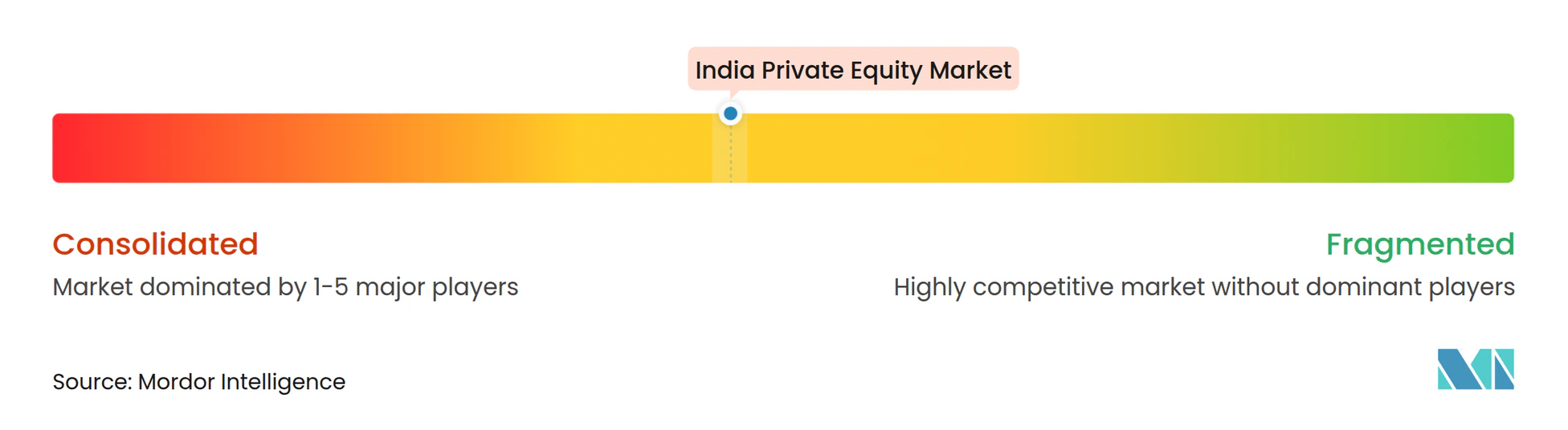
| Market Concentration | Medium |
Major Players *Disclaimer: Major Players sorted in no particular order Image ? 黑料不打烊. Reuse requires attribution under CC BY 4.0. | |
India Private Equity Market Analysis by 黑料不打烊
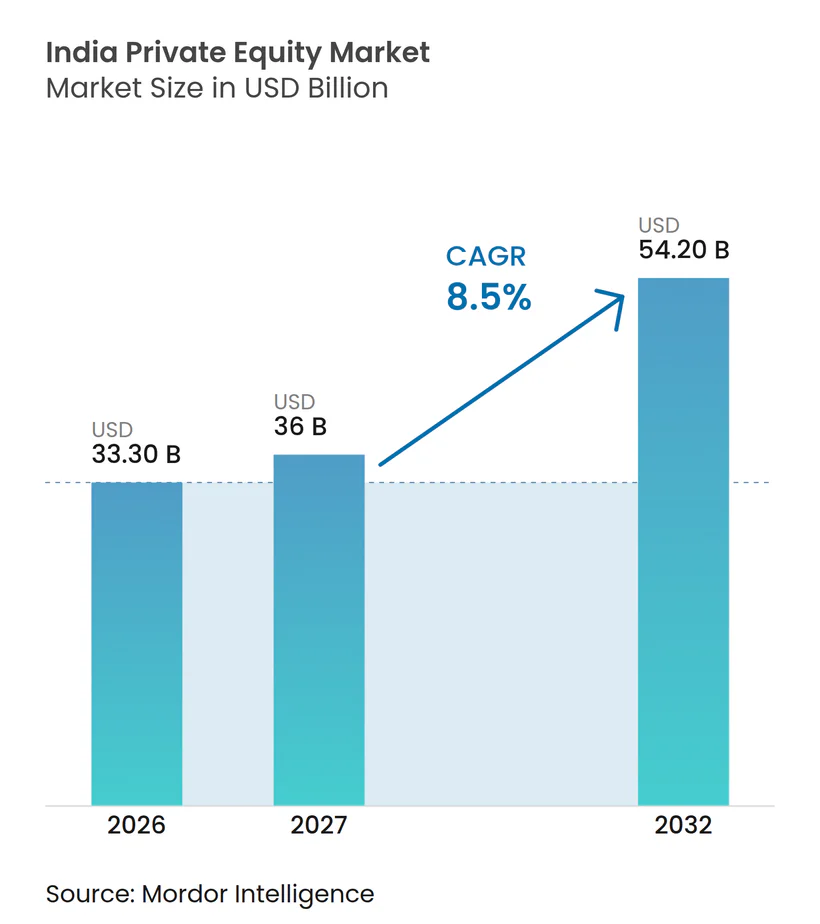
The India Private Equity Market size is expected to grow from USD 33.30 billion in 2026 to USD 36 billion in 2027 and is forecast to reach USD 54.20 billion by 2032 at 8.5% CAGR over 2027-2032.
The India private equity market is supported by a larger domestic capital base, broader acceptance of institutional ownership, and investable businesses created by industrial and digital expansion. Growth equity remains important because many founder-led companies still prefer minority capital with governance support over an immediate sale of control. At the same time, buyouts are becoming more common as founders consider succession plans and as earlier private equity investors seek exits. India private equity market activity also depends on whether funds can improve operations and sell assets at suitable valuations, rather than relying on higher valuation multiples. The opportunity is strongest where managers can combine disciplined pricing, sector expertise, and operational support with access to domestic and offshore capital.
Key Report Takeaways
- By strategy, growth equity held 43.6% of the India private equity market share in 2026, while buyout is forecast to grow at a 10.5% CAGR through 2032.
- By investee sector, IT, ITeS & Software held 28.8% of the India private equity market share in 2026, while healthcare & life sciences is forecast to grow at an 11.3% CAGR through 2032.
- By equity cheque, the USD 25-100 million bracket held 35.4% of the India private equity market share in 2026, while the USD 100-250 million bracket is forecast to grow at a 12.2% CAGR through 2032.
- By sponsor domicile, offshore sponsors held 65.3% of the India private equity market share in 2026, while domestic sponsors are forecast to grow at an 11.8% CAGR through 2032.
- By investee zone, West India held 38.1% of the India private equity market share in 2026, while South India is forecast to grow at a 10.5% CAGR through 2032.
Note: Market numbers in this report are based on 黑料不打烊's proprietary estimation framework, which combines nine months of actuals with Q4 projections for base year 2026.
India Private Equity Market Trends and Insights
Drivers Impact Analysis*
| Driver | (~) % Impact on CAGR Forecast | Geographic Relevance | Impact Timeline |
|---|---|---|---|
| Strong Domestic Consumption and Economic Growth | +2.0% | National | Short term (≤ 2 years) |
| Digitalization and Technology-Led Business Transformation | +1.8% | National, with early gains in Bengaluru, Hyderabad, and Pune | Medium term (2-4 years) |
| Manufacturing, Infrastructure, and Industrial Expansion | +1.5% | National, concentrated in Tamil Nadu, Gujarat, and Maharashtra | Medium term (2-4 years) |
| Deepening Domestic Institutional and AIF Capital | +1.3% | National, with early gains in Mumbai and Delhi | Long term (≥ 4 years) |
| Expansion of Data Centers, AI, and Digital Infrastructure | +1.4% | National, concentrated in Chennai, Mumbai, Hyderabad, and Noida | Medium term (2-4 years) |
| Improving Strategic M&A and Public-Market Exit Opportunities | +0.9% | National | Short term (≤ 2 years) |
| Source: 黑料不打烊 | |||
Strong Domestic Consumption and Economic Growth
Domestic consumption and economic growth give private equity investors a wider pool of businesses with recurring demand. The Union Budget allocated USD 134.44 billion (INR 12.2 lakh crore) to public capital expenditure for FY2027, supporting transport, logistics, power, and industrial projects that can create investable operating assets. India private equity market participants can use this investment cycle to identify companies that benefit from stronger connectivity and formal supply chains. Consumer-facing, financial services, and food-processing businesses can also benefit when organized operators gain scale in place of smaller, unorganized firms. The Indian private equity market, therefore, has a stronger basis for underwriting revenue resilience in businesses tied to domestic demand. This can support investment decisions where earnings visibility matters more than short-term expansion in sales.
Digitalization and Technology-Led Business Transformation
Digital tools are expanding the set of companies that can meet private equity underwriting requirements. IT, ITeS & Software accounts for 28.8% of investment value in 2026, but the effect of technology extends well beyond software businesses. Digital distribution, API-led financial services, and data-based logistics can make revenue patterns and operating performance easier to assess. The India private equity market can therefore reach companies in established sectors that previously lacked reliable information or scalable processes. Multiples Private Equity acquired a controlling stake in QBurst for USD 200 million in February 2025, illustrating the use of control capital in digital product engineering[1]. Better reporting, clearer customer data, and stronger management capacity can improve the suitability of mid-market businesses for institutional ownership.
Manufacturing, Infrastructure, and Industrial Expansion
Manufacturing and infrastructure development create opportunities across industrial services, logistics, utilities, and supporting businesses. Public investment can improve the commercial case for companies located outside the largest financial centers by strengthening roads, power networks, and freight routes. India private equity market investors can support regional businesses once these firms have sufficient scale and stable cash generation. Tamil Nadu, Gujarat, and Maharashtra remain relevant because they combine industrial capacity with established supplier and service networks. The India private equity market also has opportunities in companies that provide specialized inputs, warehousing, engineering services, and distribution for expanding industrial activity. Investment selection remains important because many such businesses require operational improvement before they can attract high exit valuations.
Deepening Domestic Institutional and AIF Capital
A larger domestic investor base can reduce dependence on offshore fundraising cycles. Domestic capital can provide longer holding periods for private equity funds and can help fund managers close vehicles when international investors are cautious. The India private equity market benefits when pensions, insurers, family offices, and other long-term investors participate in alternative investment funds. This can allow managers to pursue buyouts, growth investments, and follow-on funding without relying solely on global liquidity conditions. A broader local limited partner base may also support capital recycling as domestic fund managers realize investments and raise new funds. This creates a more durable funding structure for India's private equity market participants across different market conditions.
Restraints Impact Analysis*
| Restraint | (~) % Impact on CAGR Forecast | Geographic Relevance | Impact Timeline |
|---|---|---|---|
| High Entry Valuations and Buyer-Seller Valuation Gaps | -1.5% | National, most acute in Mumbai and Bengaluru large-cap markets | Short term (≤ 2 years) |
| Global Geopolitical and Currency Volatility | -1.0% | Global, with spillover to India’s offshore GP and LP base | Short term (≤ 2 years) |
| AIF Tax, FEMA, and Regulatory Complexity | -0.6% | National, with early friction in GIFT City fund structures | Medium term (2-4 years) |
| Longer Holding Periods and Uneven Exit Timing | -0.7% | National | Medium term (2-4 years) |
| Source: 黑料不打烊 | |||
High Entry Valuations and Buyer-Seller Valuation Gaps
Valuation gaps can slow transactions when sellers expect prices based on earlier market conditions and buyers apply more cautious assumptions. This can extend negotiations and increase the use of staged payments or other transaction structures. For the India private equity market, the concern is not only the entry price but also the ability to exit at a price that delivers acceptable returns. Managers holding assets for longer may need to improve operations more substantially before a sale or listing becomes practical. India private equity market activity can remain healthy, but fund performance may weaken if portfolio exits are postponed or sold at lower multiples. Investors are likely to focus more closely on cash flow, governance, and operational plans before committing capital.
Global Geopolitical and Currency Volatility
Currency movement and geopolitical uncertainty can reduce USD-denominated returns for offshore investors. The effect is material for funds whose portfolio companies earn in Indian rupees while their limited partners assess performance in USD. India private equity market managers can face higher hedging costs and slower investment decisions during periods of currency pressure or volatile energy prices. These conditions can also limit public-market exits and reduce the willingness of global investors to allocate capital to emerging markets. The India private equity market remains attractive because of local growth prospects, but foreign capital may become more selective when global risks increase. Fund managers with domestic capital access and flexible holding periods can be better placed to manage this constraint.
*Our forecasts treat driver/restraint impacts as directional, not additive. The impact forecasts reflect baseline growth, mix effects, and variable interactions.
Segment Analysis
By Strategy: Growth Equity Leads While Buyouts Gain Ground
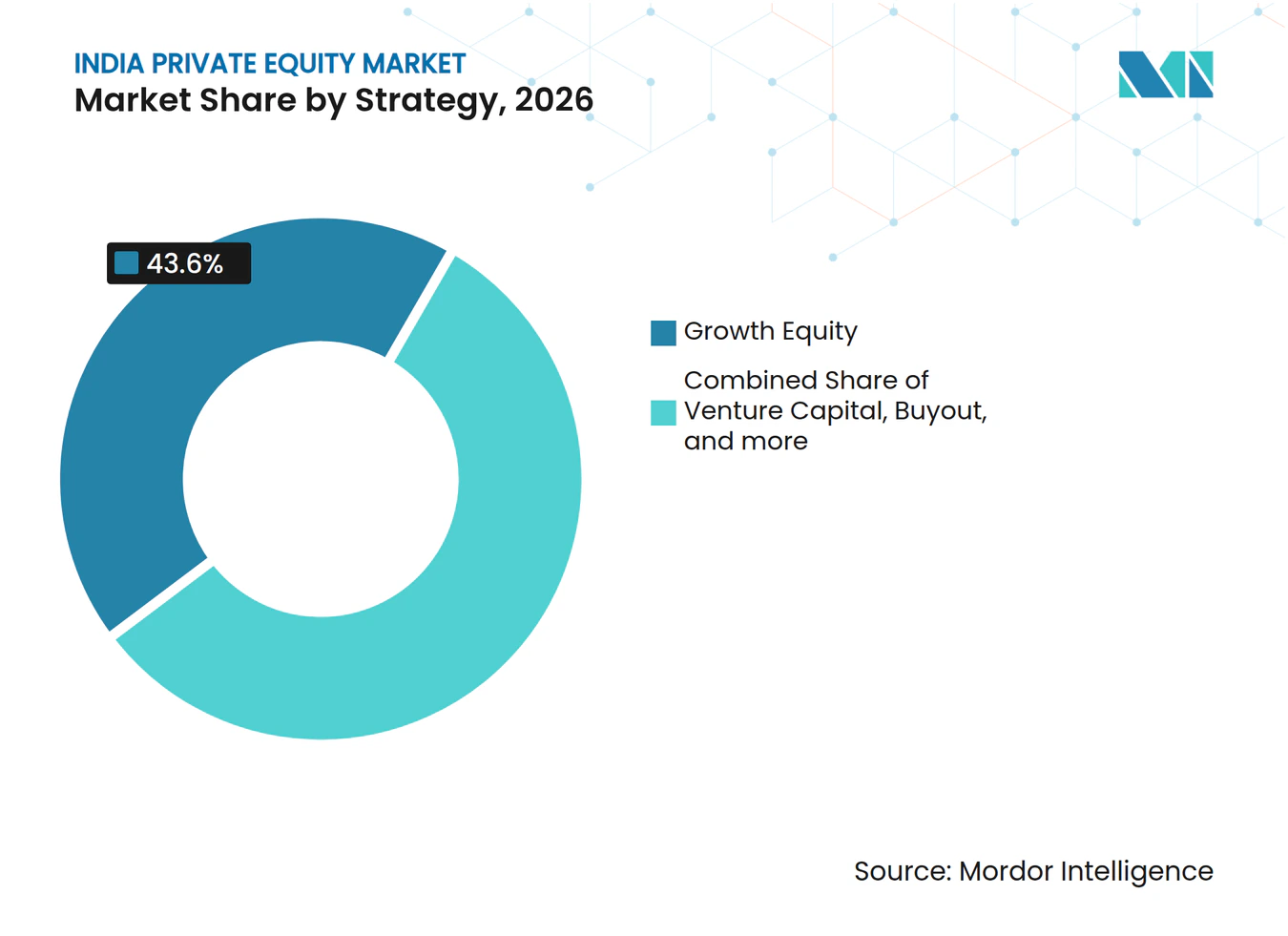
Growth equity held 43.6% of the India private equity market share in 2026, making it the leading investment strategy. Minority investment continues to fit many founder-owned companies that want capital, governance support, and operating guidance without an immediate transfer of control. The India private equity market size for growth equity is supported by expansion-stage companies in technology, consumer services, and financial services. Venture capital remains relevant as a pipeline for later-stage private equity investments in software, fintech, and consumer technology. Special-situations equity is also emerging through distressed assets and resolution processes. These strategies allow investors to match capital structures with different stages of business maturity.
Buyout is the fastest-growing strategy, with the India private equity market size for buyouts projected to increase at a 10.5% CAGR through 2032. Control transactions are becoming more viable as founder succession needs increase and prior financial sponsors look for liquidity. Buy-and-build plans can be effective where a platform company can acquire complementary businesses and create a broader operating group. This approach is particularly relevant for mid-sized assets that can improve margins or expand through carefully selected acquisitions. Larger hospital, infrastructure, and business-services transactions have increased the visibility of buyouts. The shift does not remove the role of growth equity, but it broadens the set of ownership structures available to sponsors.
By Investee Sector: Technology Holds the Largest Share, and Healthcare Grows Fastest
IT, ITeS & software held 28.8% of the India private equity market share in 2026. The sector benefits from India’s large base of engineering and software services companies, along with demand for digital products and enterprise technology. Technology can also support value creation in nontechnology businesses by improving customer reach, data quality, and operating processes. The India private equity market continues to attract capital to companies that can show recurring revenue, skilled workforces, and potential for overseas expansion. Digital infrastructure and product engineering remain relevant parts of this investment case. Managers will still need to distinguish between durable businesses and companies that depend on short-lived growth assumptions.
Healthcare & life sciences is the fastest-growing sector, with a projected CAGR of 11.3% through 2032. Hospital chains, diagnostics networks, pharmaceutical services, and specialized care providers offer scope for consolidation and operating improvement. Advent International agreed to invest ~USD 330 million (INR 3,150 crore) for a 24.9% stake in Yatharth Hospitals in September 2026[2]. Research published in BMC Health Services Research identified 70 private-equity-backed healthcare acquisitions in India through May 2025, with hospitals and multispecialty chains accounting for two-thirds of the total[3]. The India private equity market has a clear role in financing regional hospital clusters, integrated diagnostics, and broader care networks. Healthcare investments must still balance growth objectives with clinical governance and long-term service quality.
By Equity Cheque: Mid-Market Transactions Form the Largest Band
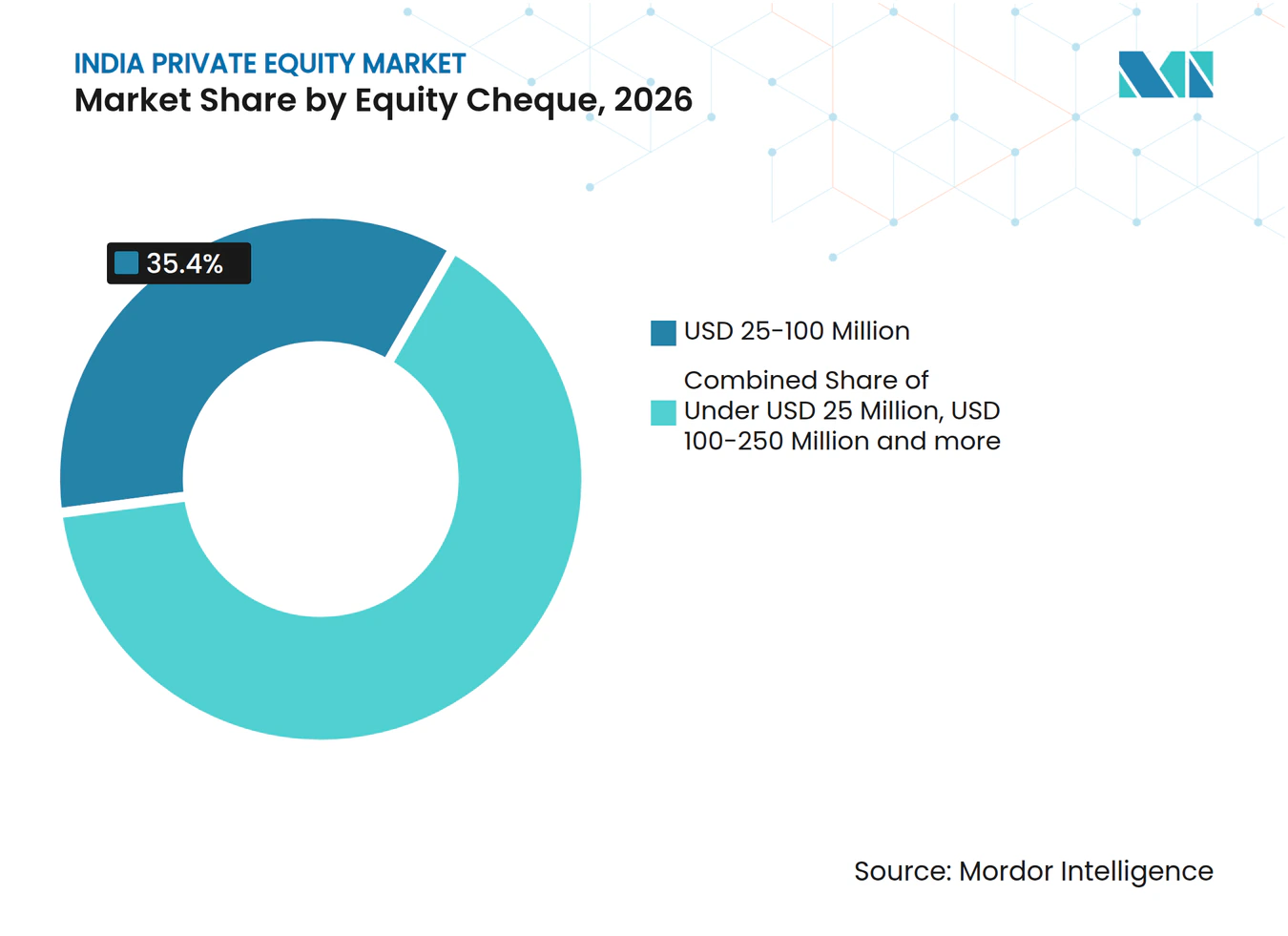
The USD 25-100 million equity cheque band held 35.4% of the India private equity market share in 2026. This range fits minority growth investments, partial founder exits, and initial institutional investment in regional companies. Mid-market transactions can offer more room for valuation discipline than highly contested large-cap assets. The India private equity market has a broad set of businesses in this range across technology, consumer, healthcare, logistics, and industrial services. These companies often need capital and management support to formalize operations or expand beyond their original region. The size band, therefore, remains important for both domestic and offshore sponsors.
The USD 100-250 million bracket is projected to grow at a 12.2% CAGR through 2032. Companies in this range may have completed an earlier funding cycle and may now need capital for acquisitions, geographic expansion, or a larger ownership transition. This can create opportunities for platform investments where the sponsor can support a more complex operating plan. The India private equity market can also see greater competition in this band as domestic managers develop the capacity to lead larger control transactions. The USD 250 million and above category remains more selective because it often requires very large funds, financing relationships, and complex transaction execution. Cheque sizes below USD 25 million continue to support smaller businesses and venture-to-private-equity transitions, including companies outside major metropolitan areas.
By Sponsor Domicile: Offshore Sponsors Lead and Domestic Managers Expand
Offshore sponsors held 65.3% of the India private equity market share in 2026. Global funds can participate in large control transactions because they have substantial fund commitments, international investor networks, and experience with complex financing structures. KKR, Blackstone, Brookfield, Carlyle, and other global firms are active in large-cap transactions across infrastructure, services, healthcare, and real assets. The Indian private equity market benefits from its ability to bring global operating knowledge and capital to domestic businesses. Offshore funds can also support cross-border expansion by portfolio companies. Their investment pace can, however, be affected by global risk appetite and currency conditions.
Domestic sponsors are forecast to grow at an 11.8% CAGR through 2032. Local managers can use long-standing business relationships and familiarity with regional companies to identify transactions outside formal auction processes. Domestic capital can be particularly valuable for companies that need patient ownership or a staged path to institutional governance. India private equity market participants, such as ChrysCapital and Multiples Private Equity, show that domestic sponsors are moving into larger control transactions. The expansion of domestic managers can also increase competition for quality mid-market assets. A balance between offshore scale and domestic sourcing capability is likely to shape the sponsor landscape during the forecast period.
Geography Analysis
West India held 38.1% of the India private equity market share in 2026. Maharashtra remains central because Mumbai combines financial services, corporate headquarters, professional advisers, and a deep pool of potential buyers and sellers. Pune adds automotive, manufacturing, and technology businesses to the region’s investment base. NITI Aayog reported that Maharashtra attracted 35% of national private equity and venture capital investments[4]. Gujarat also supports the region through GIFT City and its industrial base. The India private equity market size in the West reflects the region’s established corporate networks and its ability to support both investment origination and exits.
South India is forecast to grow at a 10.5% CAGR through 2032. Bengaluru supports technology and enterprise services investment, while Tamil Nadu offers a large manufacturing and electronics base. Hyderabad adds pharmaceutical manufacturing, technology services, and healthcare businesses to the regional opportunity. Evidence from healthcare research shows that private equity activity is concentrated in Karnataka, Maharashtra, and Telangana. The region can support hospital platforms, digital infrastructure, engineering businesses, and export-oriented manufacturing. The India private equity market is likely to benefit where regional companies can combine skilled workforces with export access and strong domestic demand.
North India remains important for technology, consumer businesses, financial services, and listed mid-cap companies in Delhi-NCR. Its listed company base can create public-market exit options for sponsors, although these exits still depend on valuation conditions. East and Northeast India, together with Central India, have smaller private equity allocations but may offer opportunities as infrastructure networks improve. New highways, logistics corridors, and power capacity can make regional businesses more investable over time. The India private equity market can expand geographically when infrastructure improvement is matched by companies with strong governance and scalable operations.
Competitive Landscape
The India private equity market has moderate-to-high concentration in large-cap transactions because a limited number of global sponsors can write very large equity checks. KKR, Blackstone, Brookfield, Carlyle, Warburg Pincus, and other large funds have the capital base and financing relationships required for major buyouts. Competition is most intense for assets with strong cash flow, a clear leadership position, and a credible path to exit. India private equity market managers are responding by developing sector expertise, operating teams, and more detailed portfolio plans. This shifts competition from simple deal sourcing toward the ability to improve business performance after investment. Funds with specialist knowledge in healthcare, infrastructure, digital assets, or financial services may have an advantage in contested processes.
Partners Group announced plans in March 2026 to raise at least USD 1 billion for an India-focused buyout fund. Advent International agreed to invest in Yatharth Hospitals, strengthening its healthcare exposure. The competition in India's private equity market is therefore visible in both traditional control deals and long-term digital infrastructure platforms. Domestic managers remain relevant because relationship-led sourcing can provide access to businesses that do not enter large competitive auctions.
Exit execution is becoming a major point of differentiation. Continuation vehicles, secondary transactions, and longer ownership periods can provide alternatives when an initial public offering or strategic sale does not offer an acceptable price. The India private equity market has substantial available capital, but managers still need to identify assets that can justify entry prices and support operational improvement. Buy-and-build programs can be useful where a sponsor can create a stronger platform through acquisitions and integration. Funds also need to show founder-sellers that they can provide management support, governance, and commercial expertise after signing a transaction.
India Private Equity Industry Leaders
-
Chrys Capital
-
Blackstone Group
-
Advent International
-
KKR
-
Bain Capital
- *Disclaimer: Major Players sorted in no particular order
Recent Industry Developments
- September 2026: Advent International agreed to invest ~USD 350.6 million (INR 3,150 crore) for a 24.9% stake in Yatharth Hospital and Trauma Care Services, described as the largest primary PE infusion in an Indian listed hospital. The investment deepens Advent's India healthcare platform, which already includes Apollo 24/7, Cohance, Felix Pharma, Bharat Serums and Vaccines, and Care Hospitals.
- June 2026: CPP Investments committed up to USD 737.4 million (INR 7,000 crore) to CtrlS Datacenters, including a direct equity stake and a joint venture to develop hyperscale datacenter campuses across India for cloud, AI, and hyperscaler demand.
- March 2026: Partners Group announced plans to raise at least USD 1 billion for its inaugural India-focused buyout fund, its first vehicle exclusively outside Europe, signaling India's arrival as a standalone buyout market for top-tier global PE managers.
- February 2025: Multiples Private Equity acquired a controlling stake in QBurst, a high-growth digital product engineering platform, for approximately USD 200 million. This was Multiples' largest control investment and signaled domestic GP capability to lead enterprise technology buyouts at scale.
India Private Equity Market Report Scope
| Buyout |
| Growth Equity |
| Venture Capital |
| Special-situations Equity |
| IT, ITeS and Software |
| Healthcare and Life Sciences |
| Financial Services |
| Consumer and Retail |
| Industrials and Business Services |
| Energy and Utilities |
| Telecom, Media, and Entertainment |
| Logistics and Transportation |
| Other (Education, Agriculture, and Food Processing, etc.) |
| Under USD 25 Million |
| USD 25-100 Million |
| USD 100-250 Million |
| USD 250 Million and Above |
| North |
| West |
| South |
| East and Northeast |
| Central |
| Domestic |
| Offshore |
| By Strategy | Buyout |
| Growth Equity | |
| Venture Capital | |
| Special-situations Equity | |
| By Investee Sector | IT, ITeS and Software |
| Healthcare and Life Sciences | |
| Financial Services | |
| Consumer and Retail | |
| Industrials and Business Services | |
| Energy and Utilities | |
| Telecom, Media, and Entertainment | |
| Logistics and Transportation | |
| Other (Education, Agriculture, and Food Processing, etc.) | |
| By Equity cheque | Under USD 25 Million |
| USD 25-100 Million | |
| USD 100-250 Million | |
| USD 250 Million and Above | |
| By Investee zone | North |
| West | |
| South | |
| East and Northeast | |
| Central | |
| By Sponsor domicile | Domestic |
| Offshore |
Key Questions Answered in the Report
What is the projected size of the India private equity market by 2032?
The India private equity market is projected to reach USD 54.2 billion by 2032, from USD 36 billion in 2027, at an 8.5% CAGR. This forecast reflects expanding deal activity across several investment approaches.
Which investment strategy has the largest share in India?
Growth equity holds the largest share at 43.6% in 2026, while buyouts are the fastest-growing strategy at a 10.5% CAGR through 2032. Founder succession and secondary exits support the rising use of control transactions.
Which sectors are attracting private equity investment in India?
IT, ITeS & software holds the largest sector share at 28.8% in 2026, while healthcare & life sciences is forecast to grow fastest at an 11.3% CAGR. Healthcare growth is supported by hospital, diagnostic, and pharmaceutical services transactions.
Why are domestic private equity firms becoming more important?
Domestic sponsors are projected to grow at an 11.8% CAGR through 2032 as local capital and relationship-led deal sourcing gain importance. They can also support patient ownership of mid-market businesses.
Which regions are most important for private equity activity in India?
West India holds the largest share at 38.1% in 2026, while South India is expected to grow fastest at a 10.5% CAGR through 2032. Maharashtra, Karnataka, Tamil Nadu, and Telangana remain key investment locations.
What are the main risks for private equity investors in India?
High entry valuations, currency volatility, regulatory complexity, and longer holding periods can reduce returns or delay exits. Strong operating plans and disciplined pricing remain important responses.