
Market Overview
| Study Period | 2021 - 2031 |
|---|---|
| Forecast Data Period | 2026 - 2031 |
| Base Year Market Size (2025) | USD 0.75 Billion |
| Market Size (2026) | USD 0.83 Billion |
| Market Size (2031) | USD 1.33 Billion |
| Growth Rate (2026 - 2031) | 9.89 % |
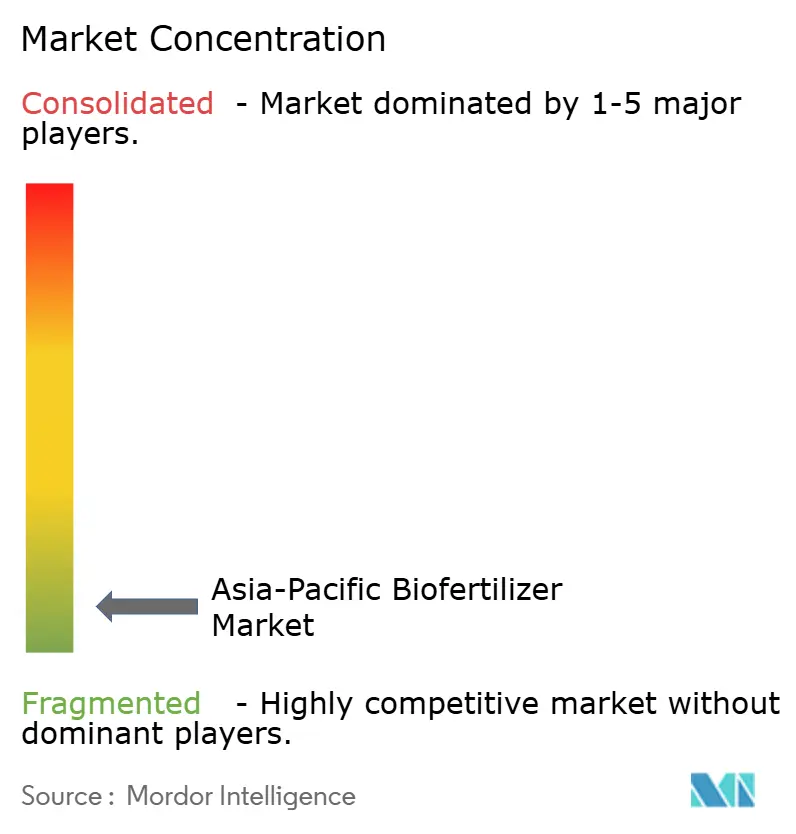
| Market Concentration | Low |
Major Players *Disclaimer: Major Players sorted in no particular order Image ? 黑料不打烊. Reuse requires attribution under CC BY 4.0. | |
Asia-Pacific Biofertilizer Market Analysis by 黑料不打烊
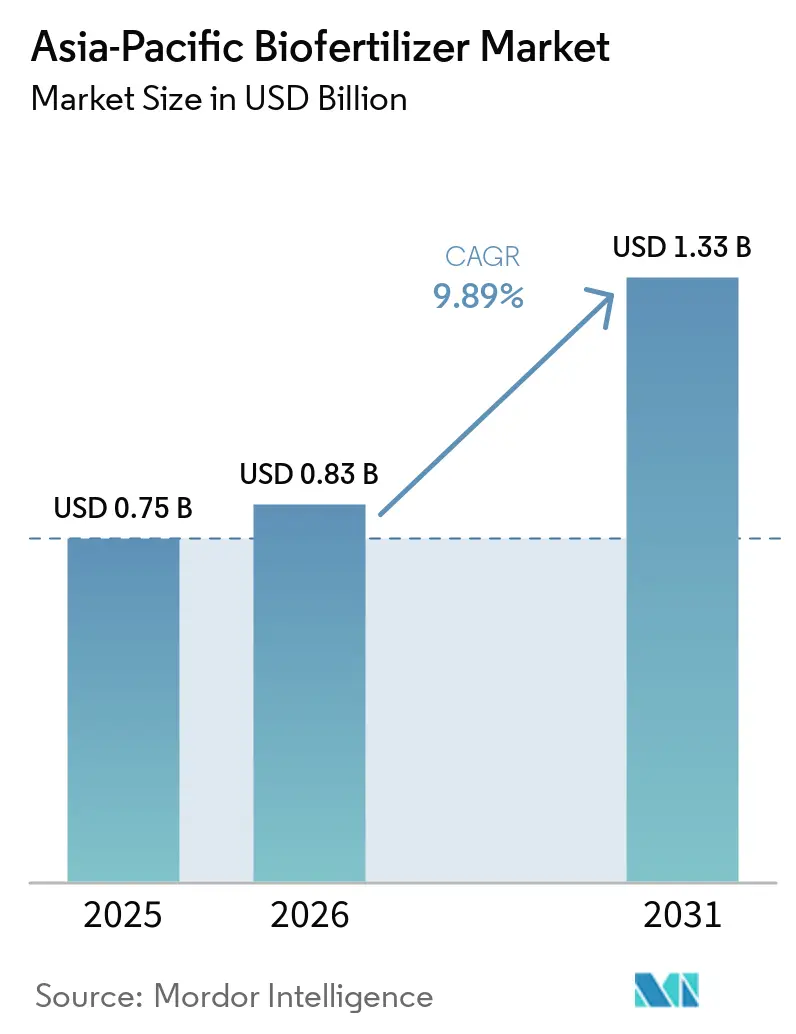
The Asia-Pacific biofertilizer market size was valued at USD 0.75 billion in 2025 and is forecast to grow from USD 0.83 billion in 2026 to USD 1.33 billion by 2031, at a CAGR of 9.89% from 2026 to 2031. Government subsidy programs, chemical fertilizer controls, and certified organic production are shaping demand across the region. Export supply chains are increasing the importance of residue compliance for growers of premium crops. Cooperative federations, procurement agencies, and agribusiness platforms are emerging as important distribution channels. The Asia-Pacific biofertilizer market is moving beyond its earlier role as a lower-cost input for smallholders, with products that perform consistently in specific soils and climates having a stronger basis for adoption.
Key Report Takeaways
- By form, Azotobacter accounted for 29.5% of the Asia-Pacific biofertilizer market share in 2025, while Rhizobium is forecast to grow at a CAGR of 11.2% from 2026 to 2031.
- By crop type, row crops accounted for 82% of the Asia-Pacific biofertilizer market size in 2025, while horticultural crops are forecast to grow at a CAGR of 11.4% from 2026 to 2031.
- By geography, China accounted for 67.1% of the market share in 2025, while Vietnam is forecast to grow at a CAGR of 9.0% from 2026 to 2031.
Note: Market size and forecast figures in this report are generated using 黑料不打烊’s proprietary estimation framework, updated with the latest available data and insights as of January 2026.
Market Trends and Insights
Drivers Impact Analysis of Asia-Pacific Biofertilizer Market*
| Driver | (~) % Impact on CAGR Forecast | Geographic Relevance | Impact Timeline |
|---|---|---|---|
| Government Subsidies and Demonstration Programs Improve Adoption Economics | +2.2% | Asia-Pacific core, primarily China and India, with spillover to Indonesia, Thailand, and Vietnam | Short term (≤ 2 years) |
| Expansion of Organic and Export-Oriented Cultivation | +1.8% | India, Vietnam, Thailand, the Philippines, and Australia | Medium term (2-4 years) |
| Restrictions on Chemical Fertilizer Use and Stricter Residue Compliance | +1.5% | China and India, with a secondary effect in Japan and Southeast Asia | Medium term (2-4 years) |
| Development of Microbial Consortia for Drought, Salinity, and Heat Stress | +1.2% | Highest intensity in coastal and irrigated areas of India, Indonesia, Thailand, and Vietnam | Long term (≥ 4 years) |
| Humid-Climate Shelf-Stable Formulations Reduce Viability Losses | +0.9% | Indonesia, Vietnam, Thailand, and the Philippines | Medium term (2-4 years) |
| Soil Health Programs Linked to Carbon and Regenerative Agriculture | +0.6% | Australia, Japan, and India, with early adoption in China | Long term (≥ 4 years) |
| Source: 黑料不打烊 | |||
Government Subsidies and Demonstration Programs Improve Adoption Economics
State support remains a major factor in biofertilizer adoption across smallholder farming systems. China introduced biotechnology and digital agricultural tools in its 2025 No. 1 Central Document, thereby strengthening the policy framework for biological inputs. India continued to support natural farming through its 2025 budget and cooperative procurement channels serving more than 35,600 member societies[1]. Demonstration plots reduce the risk of first-time purchases by allowing growers to observe crop results under local conditions. Provincial programs in Fujian and Zhejiang provided support of up to CNY 100 (USD 14) for commercial organic and biofertilizer applications during 2025[2]. Together, financial incentives and field demonstrations lower the cost and perceived risk of adoption, supporting wider uptake of biofertilizers among farmers across the region.
Expansion of Organic and Export-Oriented Cultivation
Expanding organic acreage and residue-sensitive export supply chains are increasing demand for biological inputs. India's organic product exports reached USD 665.96 million in 2024-2025, reflecting 34.6% growth, while export volume rose by 4% to 368,155 metric tons [3]. India's revised organic production standards align with the European Commission and Swiss equivalency requirements. Such standards can support demand for inputs that meet organic production requirements. Southeast Asian suppliers of coffee, palm products, tea, and tropical fruit face residue checks from buyers in Japan and the European Union. Vietnam aims for organic farmland to account for 2.5% to 3% of agricultural land by 2030. The expansion of organic production and residue-sensitive export agriculture is increasing the need for inputs that meet organic and market-specific compliance requirements, creating additional demand for biofertilizers across the Asia-Pacific.
Restrictions on Chemical Fertilizer Use and Stricter Residue Compliance
Restrictions on chemical fertilizer use are creating additional opportunities for biological inputs in selected farming systems. India’s 2025 amendment to the Fertilizer Control Order governs biofertilizer quality standards under Schedule III and introduces new biological categories, including organic carbon enhancers. China’s fertilizer-reduction policy is supported by provincial implementation programs in major grain-producing areas, giving agricultural extension workers a role in selecting and promoting biological alternatives. This institutional role can reduce the cost of reaching growers for companies supplying government contracts. Stricter quality requirements also improve market confidence in compliant biofertilizer products, while restrictions on conventional fertilizer use create additional opportunities for biological alternatives across the region.
Development of Microbial Consortia for Drought, Salinity, and Heat Stress
Advances in microbial consortia are expanding biofertilizer applications beyond nutrient management to include crop resilience under drought and salinity stress. In 2025, studies published in Plants and the International Journal of Molecular Sciences reported improvements in seedling performance under drought and saline conditions using synthetic microbial communities. These developments support the potential for specialized biofertilizers in stress-prone agricultural regions across Asia-Pacific, including India, Indonesia, Vietnam, and the Philippines. The commercialization and local validation of stress-tolerant microbial formulations could broaden biofertilizer applications and support market growth.
Restraints Impact Analysis of Asia-Pacific Biofertilizer Market*
| Restraint | (~) % Impact on CAGR Forecast | Geographic Relevance | Impact Timeline |
|---|---|---|---|
| Rural Storage and Last-Mile Distribution Gaps | -1.5% | India, Vietnam, Indonesia, the Philippines, and Thailand | Short term (≤ 2 years) |
| Performance Variability Across Soils, Crops, and Seasons | -1.2% | South Asia and Southeast Asia | Medium term (2-4 years) |
| Short Product Shelf Life and Viable-Cell Count Decay | -0.9% | Indonesia, Vietnam, and the Philippines | Short term (≤ 2 years) |
| Fragmented Registration and Quality-Control Requirements | -0.8% | Japan, China, and Australia | Medium term (2-4 years) |
| Source: 黑料不打烊 | |||
Rural Storage and Last-Mile Distribution Gaps
Inadequate storage and last-mile logistics create reliability challenges for biological products in rural distribution. In 2024, more than 90% of India’s cold-chain sector was fragmented and privately owned, with shortages of refrigerated vehicles and inconsistent storage standards. The Asian Development Bank identified last-mile vendors in South and Southeast Asia without cold-storage capability. Sustained temperatures above 35°C can sharply reduce viable cell counts in liquid formulations. A 2024 analysis published by the South Asian Society for Agrochemical and Pest Management identified inadequate storage as the second-highest production-level risk, with a Risk Priority Number of 210. Limited access to suitable rural storage and transport can therefore reduce product viability during distribution, increasing the risk of inconsistent field performance and limiting biofertilizer adoption in remote farming areas.
Performance Variability Across Soils, Crops, and Seasons
Inconsistent field results remain a significant constraint, as they can undermine farmers' confidence and institutional procurement decisions. Product efficacy depends on soil pH, organic carbon, native microbial populations, crop variety, and application timing. A 2025 study published in Plant and Soil found that microbial consortia increased maize shoot growth in loamy soil under well-watered conditions, whereas no significant growth effects were observed in sandy soil due to high variability. Differences in field performance across growing conditions can reduce confidence in the consistency of biofertilizer outcomes and discourage repeat purchases following unsuccessful trials. This variability in efficacy can complicate product positioning, application recommendations, and adoption decisions, particularly across the diverse soil and climatic conditions of the Asia-Pacific region.
*Our forecasts treat driver/restraint impacts as directional, not additive. The impact forecasts reflect baseline growth, mix effects, and variable interactions.
Asia-Pacific Biofertilizer Market Segment Analysis
By Form:
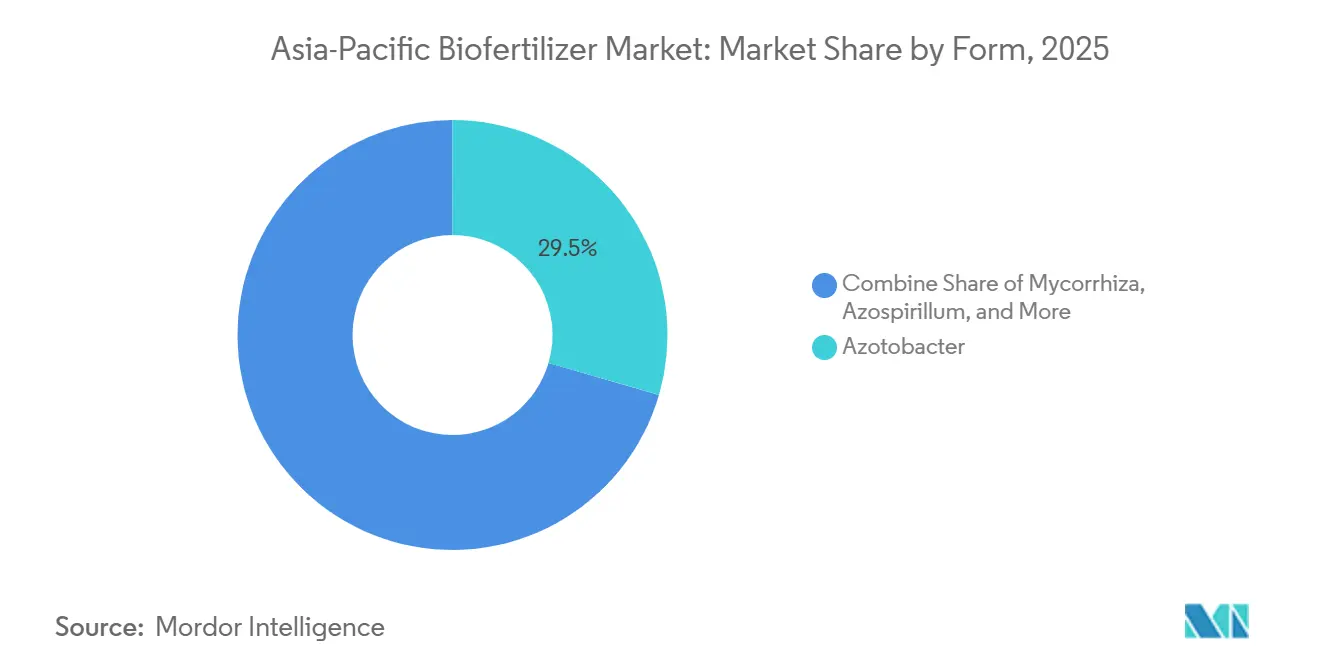
Azotobacter Led While Rhizobium Is Forecast to Record Strong GrowthAzotobacter accounted for 29.5% of the Asia-Pacific biofertilizer market share in 2025, supported by its application across non-leguminous crops, including cereals such as rice and wheat. Azospirillum is attracting interest in nitrogen fixation and phytohormone production properties. Phosphate Solubilizing Bacteria are often used alongside Rhizobium to address nitrogen and phosphorus deficits in degraded tropical soils. Mycorrhizal products are applied to horticultural and plantation crops, where root colonization can enhance crop quality and yield.
Rhizobium is forecast to grow at a CAGR of 11.2% from 2026 to 2031 in the Asia-Pacific biofertilizer market. Its nitrogen-fixing relationship with legumes supports use in soybean, chickpea, lentil, pigeon pea, and groundnut rotations. Multi-strain formulations combining Rhizobium, Azotobacter, and Phosphate Solubilizing Bacteria are gaining attention from agricultural departments seeking simpler application protocols. A 2026 study published in Frontiers in Plant Science reported a 36% increase in grain yield from a microalgae-PGPB consortium, including Azospirillum, under drought conditions in field trials. Japan classifies VA mycorrhiza as an ordinance-designated soil conditioner, providing a defined regulatory pathway for that product type.

By Crop Type:
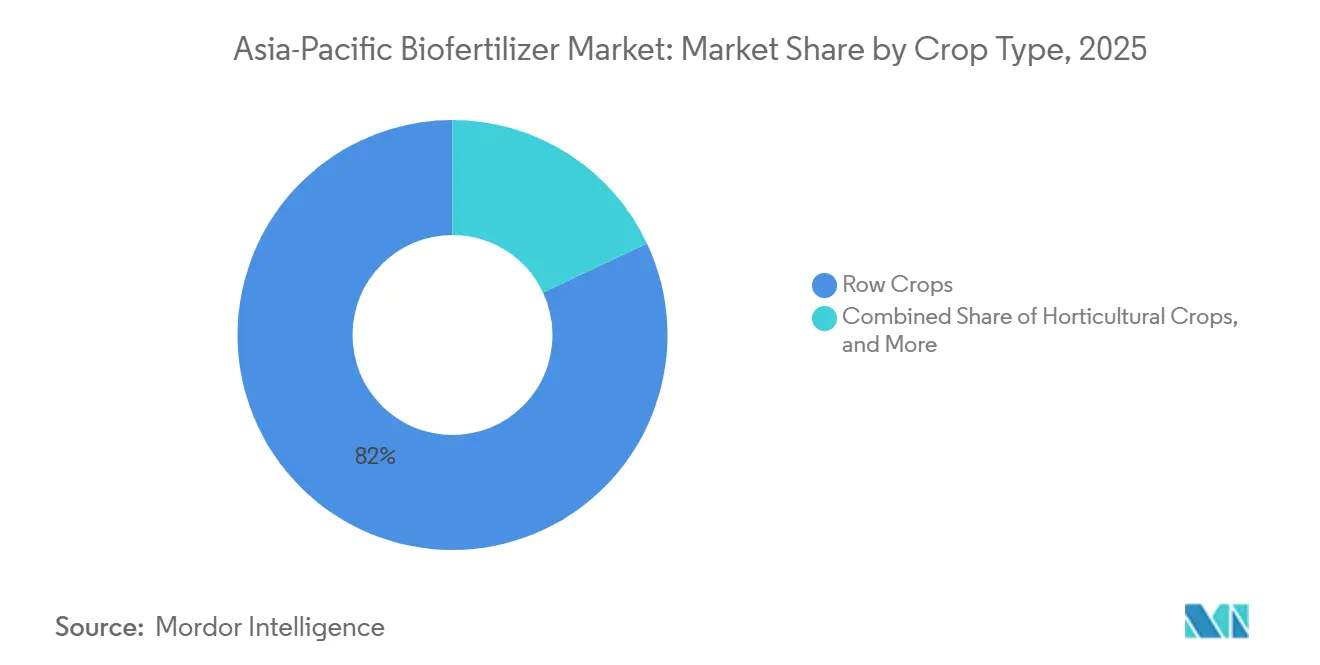
Row Crops Lead While Horticultural Crops ExpandRow crops accounted for 82% of the Asia-Pacific biofertilizer market size in 2025. Rice, wheat, maize, and soybean production across China, India, Vietnam, Indonesia, and Thailand supports this position. State subsidy programs, integrated nutrient management rules, and cooperative channels target row crops more directly than dispersed horticultural operations. This institutional access gives producers a reliable route to a large group of growers. Pulses are important for the distribution of Rhizobium in India as they are classified as row crops and are supported by subsidy programs.
Horticultural crops are forecast to grow at a CAGR of 11.4% from 2026 to 2031, representing a growing opportunity for high-value fruit and vegetable producers that require residue-compliant nutrition. Mycorrhizal inoculants are particularly relevant to roots, tubers, and perennial plantation crops. Cash crops include sugarcane, cotton, oil palm, and rubber, with relevance in Indonesia, Thailand, and Vietnam. Export buyers are increasingly assessing biological inputs as part of agricultural production practices and pesticide residue compliance requirements in these supply chains. Vietnam’s agricultural development initiatives cover multiple crop groups, including rice, coffee, rubber, tea, pepper, and horticultural products. These export links expand opportunities for biofertilizer adoption in Asia-Pacific crop systems that serve regulated buyers.
Geography Analysis
China and India Biofertilizer Market
China accounted for 67.1% of the market share in 2025. Its position is supported by agricultural modernization programs, established fermentation capacity, and provincial subsidies for the use of organic and biological fertilizers. The Ministry of Agriculture and Rural Affairs has linked biological inputs to fertilizer reduction and green agriculture certification. India has a well-established distribution model. Cooperative networks, procurement agencies, and the National Biofertilizer Development Centre production units support the use of Rhizobium, Azotobacter, and Phosphate Solubilizing Bacteria. India’s quality standards under Schedule III set minimum viable cell counts for biofertilizers.
Vietnam Biofertilizer Market
Vietnam is forecast to grow at a CAGR of 9.0% from 2026 to 2031. Vietnam’s June 2024 circular-economy initiative and the National Action Plan for Circular Economy, adopted in January 2025, promote resource efficiency and sustainable agricultural practices. These initiatives could support the adoption of biofertilizers as part of broader efforts to improve nutrient management and reduce reliance on conventional chemical fertilizers.
APAC Biofertilizer Market
Indonesia, Thailand, the Philippines, and the Rest of Asia-Pacific represent high-growth but logistically demanding markets. Indonesia’s palm oil and rice farms offer demand for mycorrhizal and nitrogen-fixing inoculants, but dealer fragmentation and weak cold chains remain obstacles. Thailand’s tropical fruit and sugarcane exporters face residue certification requirements from European buyers. The Philippines is seeing interest in partnerships for biological product registration and distribution. These varied country conditions mean the Asia-Pacific biofertilizer market requires country-specific products, routes to market, and regulatory plans.
Competitive Landscape
The Asia-Pacific biofertilizer market was fragmented in 2025, with competition spanning cooperative-based suppliers, domestic manufacturers, and international biological input companies. Indian Farmers Fertiliser Cooperative Limited and Gujarat State Fertilizers and Chemicals Limited compete through cooperative distribution and government contract access, giving both companies access to established domestic distribution networks and institutional channels. Novonesis A/S and Corteva Agriscience, Inc. compete through proprietary microbial strains, encapsulation technology, and agronomic data. Novonesis A/S worked with KRIBHCO to introduce Rhizosuper, a mycorrhizal biofertilizer using LCO Promoter Technology for paddy, wheat, and pulse growers. The collaboration combines Novonesis' microbial technology with KRIBHCO's cooperative distribution network in India.
Coromandel International Limited holds a gene bank of 450 cultures, 17 of which are deposited with the National Bureau of Agriculturally Important Microorganisms. This research base supports product differentiation where buyers seek evidence of local strain performance. Japan’s Organic JAS standards and India’s Fertilizer Control Order also raise the compliance threshold for lower-quality entrants. Smaller suppliers such as T. Stanes and Company Limited, Kan Biosys Private Limited, IPL Biologicals Limited, and Agri Life compete by adapting to local strains and distributing domestically. Rallis India Limited supports its Geogreen brand through Tata’s rural retail network. The Asia-Pacific biofertilizer industry continues to reward local performance evidence, proximity to distribution, and public-sector access.
Shelf-stable formulations for tropical distribution represent a significant opportunity. Salt-tolerant strains can also be used in coastal and irrigated soils in Southeast Asia. Digital advisory systems could provide distributors with soil-specific performance data and reduce uncertainty at the farm level. Coromandel International Limited expanded its biological product portfolio through the 2024 launch of Cortus, Grovibe, and Grovibe Paddy Pro. Novonesis A/S, IPL Biologicals Limited, and Coromandel International Limited are each pursuing geographic expansion as well as product development.
Asia-Pacific Biofertilizer Industry Leaders
-
Indian Farmers Fertiliser Cooperative Limited
-
Gujarat State Fertilizers and Chemicals Limited
-
Novonesis A/S
-
Corteva Agriscience, Inc.
-
Coromandel International Limited
- *Disclaimer: Major Players sorted in no particular order
Asia-Pacific Biofertilizer Market Companies Covered in this Report
- Indian Farmers Fertiliser Cooperative Limited
- Gujarat State Fertilizers and Chemicals Limited
- Novonesis A/S
- REKA Group B.V.
- Biostadt India Limited
- Lallemand Inc.
- Corteva Agriscience, Inc.
- T. Stanes and Company Limited
- Rizobacter Argentina S.A. (Bioceres Crop Solutions Corp.)
- Coromandel International Limited
- Rallis India Limited (Tata Group)
- Agri Life
- National Fertilizers Limited
- Kan Biosys Private Limited
- IPL Biologicals Limited
Recent Industry Developments in Asia-Pacific Biofertilizer Market
- May 2026: IPL Biologicals Limited inaugurated a cGMP-compliant biological manufacturing facility in Vadodara, Gujarat, India, as part of its planned INR 400 crore expansion. The first phase involved an investment of INR 200 crore, increasing the company’s total annual production capacity to 7,000 KL for manufacturing biofertilizers, biopesticides, and other crop health products.
- September 2024: Novonesis A/S and KRIBHCO signed a long-term memorandum of understanding to collaborate on agri-biosolutions. As part of the initial collaboration, KRIBHCO introduced Rhizosuper, a mycorrhizal biofertilizer using Novonesis A/S proprietary LCO (Lipo-chitooligosaccharides) Promoter Technology.
- May 2024: Coromandel International Limited introduced 10 new agricultural products, including Cortus, a neem-based formulation containing VAM and proprietary NPK consortia, and Grovibe and Grovibe Paddy Pro, mycorrhizal biofertilizer products. The company also reported an in-house microbial gene bank of 450 cultures, with 17 cultures deposited at the National Bureau of Agriculturally Important Microorganisms.
Asia-Pacific Biofertilizer Market Report Scope
Biofertilizers are microbial-based agricultural inputs containing living microorganisms that enhance nutrient availability, nutrient uptake, or soil fertility when applied to soil or crops. The scope excludes chemical fertilizers, biostimulants that do not primarily function as biofertilizers, and synthetic soil amendments.
The Asia-Pacific biofertilizer market report is segmented by form (Azospirillum, Azotobacter, Mycorrhiza, phosphate-solubilizing bacteria, Rhizobium, and other biofertilizers), by crop type (cash crops, horticultural crops, and row crops), and by geography (Australia, China, India, Indonesia, Japan, the Philippines, Thailand, Vietnam, and the rest of Asia-Pacific). The market size and forecasts are provided in terms of value (USD) and volume (metric tons).
Segmentation Overview
By Form
| Azospirillum |
| Azotobacter |
| Mycorrhiza |
| Phosphate Solubilizing Bacteria |
| Rhizobium |
| Other Biofertilizers |
By Crop Type
| Cash Crops |
| Horticultural Crops |
| Row Crops |
By Geography
| Australia |
| China |
| India |
| Indonesia |
| Japan |
| Philippines |
| Thailand |
| Vietnam |
| Rest of Asia-Pacific |
| By Form | Azospirillum |
| Azotobacter | |
| Mycorrhiza | |
| Phosphate Solubilizing Bacteria | |
| Rhizobium | |
| Other Biofertilizers | |
| By Crop Type | Cash Crops |
| Horticultural Crops | |
| Row Crops | |
| By Geography | Australia |
| China | |
| India | |
| Indonesia | |
| Japan | |
| Philippines | |
| Thailand | |
| Vietnam | |
| Rest of Asia-Pacific |
Market Definition
- AVERAGE DOSAGE RATE - The average application rate is the average volume of biofertilizers applied per hectare of farmland in the respective region/country.
- CROP TYPE - Crop type includes Row crops (Cereals, Pulses, Oilseeds), Horticultural Crops (Fruits and vegetables) and Cash Crops (Plantation Crops, Fibre Crops and Other Industrial Crops)
- FUNCTION - The crop nutrition function of agricultural biological consists of various products that provide essential plant nutrients and enhance soil quality.
- TYPE - Biofertilizers enhance soil quality by increasing the population of beneficial microorganisms. They help crops absorb nutrients from the environment.
| Keyword | Definition |
|---|---|
| Cash Crops? | Cash crops are non-consumable crops sold as a whole or part of the crop to manufacture end-products to make a profit. |
| Integrated Pest Management (IPM)? | IPM is an environment-friendly and sustainable approach to control pests in various crops. It involves a combination of methods, including biological controls, cultural practices, and selective use of pesticides. |
| Bacterial biocontrol agents? | Bacteria used to control pests and diseases in crops. They work by producing toxins harmful to the target pests or competing with them for nutrients and space in the growing environment. Some examples of commonly used bacterial biocontrol agents include Bacillus thuringiensis (Bt), Pseudomonas fluorescens, and Streptomyces spp.? |
| Plant Protection Product (PPP)? | A plant protection product is a formulation applied to crops to protect from pests, such as weeds, diseases, or insects. They contain one or more active substances with other co-formulants such as solvents, carriers, inert material, wetting agents or adjuvants formulated to give optimum product efficacy.? |
| Pathogen? | A pathogen is an organism causing disease to its host, with the severity of the disease symptoms.? |
| Parasitoids? | Parasitoids are insects that lay their eggs on or within the host insect, with their larvae feeding on the host insect. In?agriculture, parasitoids can be used as a form of biological pest control, as they help to control pest damage to crops and?decrease the need for chemical pesticides.? |
| Entomopathogenic Nematodes (EPN)? | Entomopathogenic nematodes are parasitic roundworms that infect and kill pests by releasing bacteria from their gut. Entomopathogenic nematodes are a form of biocontrol agents used in agriculture.? |
| Vesicular-arbuscular mycorrhiza (VAM)? | VAM fungi are mycorrhizal species of fungus. They live in the roots of different higher-order plants. They develop a symbiotic relationship with the plants in the roots of these plants.? |
| Fungal biocontrol agents? | Fungal biocontrol agents are the beneficial fungi that control plant pests and diseases. They are an alternative to chemical pesticides. They infect and kill the pests or compete with pathogenic fungi for nutrients and space.? |
| Biofertilizers? | Biofertilizers contain beneficial microorganisms that enhance soil fertility and promote plant growth.? |
| Biopesticides? | Biopesticides are natural/bio-based compounds used to manage agricultural pests using specific biological effects.? |
| Predators? | Predators?in?agriculture?are?the organisms?that?feed?on?pests?and?help?control?pest damage to the?crops.?Some?common?predator?species?used?in?agriculture?include?ladybugs,?lacewings,?and?predatory?mites.? |
| Biocontrol agents? | Biocontrol agents are living organisms used to control pests and diseases in agriculture. They are alternatives to chemical pesticides and are known for their lesser impact on the environment and human health.? |
| Organic Fertilizers? | Organic fertilizer is composed of animal or vegetable matter used alone or in combination with one or more non-synthetically derived elements or compounds used for soil fertility and plant growth.? |
| Protein hydrolysates (PHs)? | Protein hydrolysate-based biostimulants contain free amino acids, oligopeptides, and polypeptides produced by enzymatic or chemical hydrolysis of proteins, primarily from vegetal or animal sources.? |
| Biostimulants/Plant Growth Regulators?(PGR)? | Biostimulants/Plant Growth Regulators (PGR) are substances derived from natural resources to enhance plant growth and health by stimulating plant processes (metabolism).? |
| Soil Amendments? | Soil Amendments are substances applied to soil that improve soil health, such as soil fertility and soil structure.? |
| Seaweed Extract? | Seaweed extracts are rich in micro and macronutrients, proteins, polysaccharides, polyphenols, phytohormones, and osmolytes. These substances boost seed germination and crop establishment, total plant growth and productivity.? |
| Compounds related to biocontrol and/or?promoting growth (CRBPG)? | Compounds related to biocontrol or promoting growth (CRBPG)? are the ability of a bacteria to produce compounds for phytopathogen biocontrol and plant growth promotion.? |
| Symbiotic Nitrogen-Fixing Bacteria? | Symbiotic nitrogen-fixing bacteria such as Rhizobium obtain food and shelter from the host, and in return, they help by providing fixed nitrogen to the plants.? |
| Nitrogen Fixation? | Nitrogen fixation is a chemical process in soil which converts molecular nitrogen into ammonia or related nitrogenous compounds.? |
| ARS (Agricultural Research Service)? | ARS is the U.S. Department of Agriculture's chief scientific in-house research agency. It aims to find solutions to agricultural problems faced by the farmers in the country.? |
| Phytosanitary Regulations? | Phytosanitary regulations imposed by the respective government bodies check or prohibit the importation and marketing of certain insects, plant species, or products of these plants to prevent the introduction or spread of new plant pests or pathogens.? |
| Ectomycorrhizae?(ECM)? | Ectomycorrhiza (ECM) is a symbiotic interaction of fungi with the feeder roots of higher plants in which both the plant and the fungi benefit through the association for survival.? |
Research Methodology
黑料不打烊 follows a four-step methodology in all our reports.
- Step-1: Identify Key Variables: In order to build a robust forecasting methodology, the variables and factors identified in Step-1 are tested against available historical market numbers. Through an iterative process, the variables required for market forecast are set and the model is built on the basis of these variables.
- Step-2: Build a Market Model: Market-size estimations for the forecast years are in nominal?terms. Inflation is not a part of the pricing, and the average selling price (ASP) is kept constant throughout the forecast period.
- Step-3: Validate and Finalize: In this important step, all market numbers, variables and analyst calls are validated through an extensive network of primary research experts from the market studied. The respondents are selected across levels and functions to generate a holistic picture of the market studied.
- Step-4: Research Outputs: Syndicated Reports, Custom Consulting Assignments, Databases & Subscription Platforms.


